


2018 School Spending Survey Report

Let's Be Bees
Betsy Bird on Shawn Harris's Let's Be Bees: "You know what’s truly distinguished? Finding a way to convince kids at the earliest of ages that books can be captivating and enthralling."
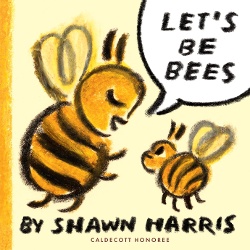 It is a singular rite of passage when a newly minted children’s librarian comes to the sudden (and, in some cases, slightly traumatizing) realization that not all picture books are good read-alouds to groups of small children. I myself recall the dawning horror I felt when I attempted to read Horton Hatches the Egg by Dr. Seuss to a room of small children, their attention spans disintegrating into dust before my very eyes. When a picture book is read to many kids all at once, causing them to shower it with love and praise, that is the moment when you hug that book to your chest and vow never to let it go. And there is surely much similar chest-hugging involved as people encounter this latest picture book from previous Caldecott Honoree Shawn Harris.
Let’s Be Bees is an interactive picture book in the best sense. Drawn entirely in colorful crayons with thick black outlines, the adult in the story prompts and the child (and, by extension, the children listening along) responds. “Let’s be bees. Let’s buzz.” Suddenly the two are depicted as “...fuzzy, buzzy bees.” Together they make buzzing sounds. Then they pretend to be other animals, plants, forces of nature, etc. And that’s it! That’s the gist of it. Even so, it’s a great deal of fun watching Harris shift the action, ramping it up and letting it go. My favorite sequence (and, I suspect, a favorite of storytime readers everywhere) is when the two are snow, “silent. Until...AVALANCHE!” You can practically see the kids imitating the rumbling, tumbling snow as you read this.
Caldecott consideration, of course, doesn’t care boo whether or not you’ve won before, as Harris has. It’s far more interested in which books are the most “distinguished.” Which raises the inevitable question: Are crayons distinguished? Are books for the youngest of readers?
No stranger to changing his artistic techniques from book to book, Harris is on record in a 2021 interview with What To Read To Your Kids as saying that, “Often, I like using art supplies that the kids reading my books might already have access to. It’s fun to do school visits and share my techniques with kids. I probably learn as much from watching them make art as they do from me.” And since this book is ideal for preschoolers, crayons are the perfect medium.
Let’s take it a step further. Over the years, I’ve noticed that when picture book committees give out awards, they’ve a penchant for visual and literary sophistication. We are adults, after all. Visual and literary sophistication is kind of our thing. It would be wrong, though, to forget that there is a great deal of difficulty inherent in creating a truly great book for the very young. Harris’s art is visible across a crowded room, but when inspected up close you notice how Harris uses borders at key moments, then breaks through them. In one sequence he incorporates the gutter into a backing and forthing across one page and another, which, with a turn of a page, suddenly reveals a gigantic moose roaring right into the face of the child listeners. Crayons may be the medium, but this is as distinguished a use of them as you’re likely to find. It’s not everyone who can use paraffin wax to inspire whole rooms of children to cut loose and howl in unison.
And lest we forget, interactive picture books are a twenty-first-century staple of the Caldecott. How else to explain the Caldecott Honor bequeathed to Mo Willems’s Don’t Let the Pigeon Drive the Bus twenty-two years ago? That book set off an explosion of fourth-wall-bursting picture book lookalikes, which never truly ebbed away. Let’s Be Bees is different. Like fellow Caldecott winner Lane Smith and his delightful Recess, these picture books encourage interaction but don’t demand it. The silliness is invited. Never demanded.
If picture books get little respect from the greater literary world, picture books for preschoolers feel like the shunted aside sub-genre. The younger the reader, the less the respect. Technically, the enjoyment of children is not a requirement when establishing who can and cannot win a shiny sticker on its cover. Even so, Let’s Be Bees hits the sweet spot. Its tantalizing use of a material best suited to tiny people with proto-motor control, its incredible knowledge of how to build and build on what, at its heart, is a very simple concept, and its utter respect for making picture books fun AND funny. You know what’s truly distinguished? Finding a way to convince kids at the earliest of ages that books can be captivating and enthralling. Let’s be...happy Shawn Harris knocked this out of the park.
[Read The Horn Book Magazine review of Let's Be Bees]


Added To Cart
RELATED


RECOMMENDED
Please register with us to continue reading.
ALREADY A SUBSCRIBER? LOG IN
We are currently offering this content for free. Sign up now to activate your personal profile, where you can save articles for future viewing.
ALREADY A SUBSCRIBER? LOG IN
Thank you for visiting.
We’ve noticed you are using a private browser. To continue, please log in or create an account.

Add Comment :-
Be the first reader to comment.
Comment Policy:
Comment should not be empty !!!