


2018 School Spending Survey Report
Reviews of the 2026 Sibert Award Winners
Reviews of the 2026 Sibert Award winner and honorees.
Winner
 Alberto Salas Plays Paka Paka con la Papa: Join the Quest with Peru’s Famed Scientist and Potato Expert
by Sara Andrea Fajardo; illus. by Juana Martinez-Neal
Primary Roaring Brook 40 pp.
3/25 9781250838612 $19.99
e-book ed. 9781250422866 $11.99
Spanish ed. 9781250905932 $19.99
In the Andes Mountains of Peru, Alberto Salas (b. 1943) hunts for papas (potatoes), “playing an epic game of paka paka con la papa, potato hide-and-seek.” His mission is to collect wild potato specimens and deliver them to the International Potato Center gene bank—a living library of potatoes, where his finds are used by scientists to grow new varieties that help fight hunger. Fajardo’s playful narrative brings readers along on Salas’s quest, touching lightly but directly on serious issues that affect his work, such as climate change and human encroachment on natural habitats. The text is enriched with Quechua and Spanish words (a “cultural dictionary” is appended). Martinez-Neal’s soft-hued mixed-media illustrations are lively and textured. Salas is depicted wearing bright yellow, drawing attention to him on the pages, while the earth-toned splotchy background is reminiscent of potatoes. Back matter includes additional information about Salas and potatoes along with author and illustrator notes. Concurrently published in Spanish as Alberto Salas juega a la paka paka con la papa. YESICA HURD
From the July/August 2025 issue of The Horn Book Magazine.
Honors
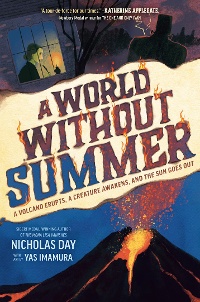
 A World Without Summer: A Volcano Erupts, a Creature Awakens, and the Sun Goes Out
by Nicholas Day; illus. by Yas Imamura
Intermediate, Middle School Random House Studio/Random 304 pp.
9/25 9780593643877 $19.99
On April 10, 1815, on the small Indonesian island of Sumbawa, the volcano Tambora erupted with such explosive force that it changed Earth’s climate and thus the course of human history. The island was devastated by lava, rock, and ash, but the event—far more explosive than the eruptions of Vesuvius or Krakatoa—was little more than a footnote in many newspapers on the other side of the globe. In fact, the ash from this eruption rose high into the stratosphere and wreaked havoc around the world: torrential rain leading to unprecedented flooding; rapid changes in temperature that either caused or resulted from mysterious sunspots; dramatically shortened growing seasons without enough sun and rain; famine, disease, and rebellion among the people; and, years later, a global cholera pandemic. Day (Sibert and Boston Globe–Horn Book Award winner for The Mona Lisa Vanishes, rev. 9/23) crafts a remarkable nonfiction narrative that jumps forward and backward through time and across the globe, pulling seemingly disparate threads together and frequently breaking the fourth wall to ask readers to consider historical methodology, storytelling tropes, literary themes, and lessons learned. The subplot about Mary Shelley and the birth of Frankenstein initially seems forced—until it does not: Day reveals the book and its themes to be a product of this time, this “world without summer.” Black-and-white illustrations by Imamura, ranging from lively vignettes to dramatic full-page images, are interspersed (some final art not seen). An extensive bibliography, thorough source notes, and an index are appended. JONATHAN HUNT
From the November/December 2025 issue of The Horn Book Magazine.
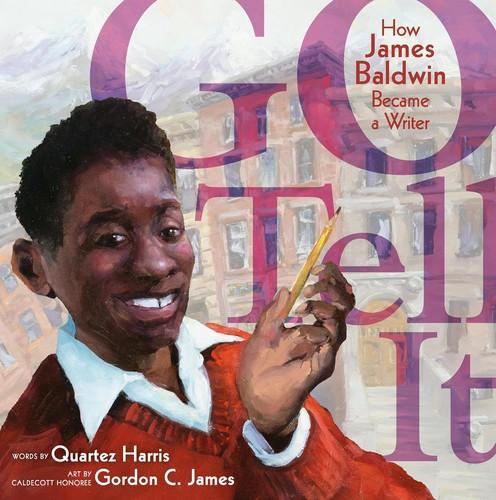 Go Tell It: How James Baldwin Became a Writer
by Quartez Harris; illus. by Gordon C. James
Primary, Intermediate Little, Brown 40 pp.
1/25 9780316483933 $18.99
Few writers have commanded the English language like James Baldwin (1924–1987). As a child in Harlem, Jimmy was expected to care for his eight siblings while his mother did domestic work. He endured a domineering stepfather, bullying, racism, and police violence. All the while, he escaped through the world of words and books. He eventually moved to France, where he used his pen to reconcile his experiences as a Black man in the United States. The result was his first novel, Go Tell It on the Mountain, which sparked a successful literary career. Harris lyrically narrates Baldwin’s childhood and his pathway to becoming a published author, highlighting how reading captivated him at a young age (“in the library, Jimmy could hear the books singing to him”) and capturing the essence of a man whose literature still resonates today. James’s oil on board illustrations are resplendent in rich jewel tones, with double-page spreads that are at times reminiscent of impressionist paintings. The delight of the library stacks, the fervor of Sunday service, the solitude on a hill in Central Park are all lavishly rendered. This is a beautiful tribute to Baldwin and the book that ignited his career. Back matter includes more information about Baldwin and a list of select sources, along with author and illustrator notes. Pair with Meadows and Law's Jimmy's Rhythm and Blues: The Extraordinary Life of James Baldwin (rev. 3/24). MONIQUE HARRIS
From the March/April 2025 issue of The Horn Book Magazine.
 At Last She Stood: How Joey Guerrero Spied, Survived, and Fought for Freedom
by Erin Entrada Kelly
Intermediate, Middle School Greenwillow 208 pp.
5/25 9780063218901 $19.99
e-book ed. 9780063218925 $9.99
When Josefina Veluya Guerrero (1917–1996), known as Joey, was a little girl in the town of Lucban in the Philippine Islands, Joan of Arc was her hero. A devoted Catholic, she “wanted to serve her faith and walk through battlefields” like Joan. And, as Kelly’s excellent nonfiction debut delineates, she did just that. As WWII begins, Guerrero is a young mother suffering from leprosy, but she joins the resistance movement and spies on the actions of Japanese soldiers, writes reports, delivers messages, and attends to injured fighters. When it is rumored that the Japanese military intends to slaughter prisoners in the Santo Tomas internment camp, she undertakes a tortuous forty-mile journey on foot to deliver an essential map to the U.S. Army’s Thirty-Seventh Division headquarters. After the war, Guerrero’s story continues at Carville, a leprosarium in Louisiana where she spends nine years. It’s a large stage to set, and Kelly provides thorough historical context for it all—many sidebars for information about the war and leprosy, as well as abundant archival photographs and maps, all while attempting to keep Guerrero’s narrative, related in immediate-sounding present tense, in the foreground. A fitting tribute to a fascinating figure. Back matter includes an author’s note, further resources, source notes, an extensive bibliography, and an index (unseen). DEAN SCHNEIDER
From the July/August 2025 issue of The Horn Book Magazine.
 Silenced Voices: Reclaiming Memories from the Guatemalan Genocide
by Pablo Leon; illus. by the author
High School HarperAlley/HarperCollins 240 pp.
9/25 9780063223561 $26.99
REVIEW TO COME
 The History of We
by Nikkolas Smith; illus. by the author
Primary, Intermediate Kokila/Penguin 40 pp.
5/25 9780593619681 $18.99
e-book ed. 9780593619698 $11.99
About a quarter of a million years ago, “we”—modern humans—first appeared in Africa. Combining vibrant, painterly illustrations and short, lyrical, explanatory paragraphs, Smith outlines major contributions of these various groups from prehistoric Africa, including acquiring language, making music and art, creating tools, growing crops, and developing and using medicines. Back matter includes an illustrated chart that corresponds to each contribution, arranged in the same chronological order as the text, and shares brief historical information about each milestone. For example, readers glimpse two early humans in a cave with the accompanying text: “We questioned, ‘What could this blank canvas possibly become?’” The chart in the back matter supplies more details: the earliest human drawings date back seventy-three thousand years and were found in the Blombos Cave in South Africa. In addition, these early Africans explored, pondering, “Perhaps these Nile perch are not the only ones who can river-fly. Can we not try?” An impressionistic migration map suggests the paths Africans took to populate the rest of the globe. An author’s note and a timeline complete the book. BETTY CARTER
From the July/August 2025 issue of The Horn Book Magazine.
For more, click on the tag ALA 2026.


Added To Cart
RELATED


RECOMMENDED

Please register with us to continue reading.
ALREADY A SUBSCRIBER? LOG IN
We are currently offering this content for free. Sign up now to activate your personal profile, where you can save articles for future viewing.
ALREADY A SUBSCRIBER? LOG IN
Thank you for visiting.
We’ve noticed you are using a private browser. To continue, please log in or create an account.

Add Comment :-
Be the first reader to comment.
Comment Policy:
Comment should not be empty !!!