



2018 School Spending Survey Report
An Important Job: National Ambassador for Young People's Literature
I started writing books for children because I love reading picture books out loud to kids. But I started loving reading because my mom read picture books out loud to me. My mom and dad divorced when I was one, and she took being a single mom very seriously. She did a lot of research and bought a lot of books, including one that recommended picture books to read aloud to your kid and how to do it. Some of my most vivid memories of childhood are sitting on our couch, morning, afternoon, and evening, reading picture books, and then again at bedtime too.
 |
I started writing books for children because I love reading picture books out loud to kids. But I started loving reading because my mom read picture books out loud to me. My mom and dad divorced when I was one, and she took being a single mom very seriously. She did a lot of research and bought a lot of books, including one that recommended picture books to read aloud to your kid and how to do it. Some of my most vivid memories of childhood are sitting on our couch, morning, afternoon, and evening, reading picture books, and then again at bedtime too.
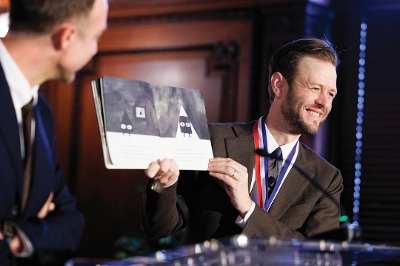 |
| Mac Barnett reads from Triangle, illustrated by Jon Klassen (left), at the inauguration ceremony. Photo: Shawn Miller/Library of Congress. |
My mom is one of the funniest people I know, and she has kind of a wicked sense of humor. I remember very vividly her reading me picture books by James Marshall, who’s one of the funniest picture-book writers to ever do it, and laughing so hard that tears were coming out of her eyes. I think James Marshall’s books are so funny, too, and that was validating to share. Picture books were a huge part of our life together. It’s how we made sense of the world, through inside jokes and references. These books bound us together as a family.
 I knew I wanted to be a writer pretty early on, but I didn’t figure out what kind until I was in college and worked at a summer camp for four- to six-year-olds. It was a sports-themed summer camp, and I was in charge of the four-year-olds because I don’t really play sports and neither do many four-year-olds. The soccer coach would say, “All right, kids, dribble the ball around these cones.” The first kid would knock over the cone and start crying, and the rest of the kids would start crying, and then the coach would blow the whistle again and be like, “Okay, that’s the end of soccer. Just go under that shady tree where Mac is, and he’s going to tell you a story.” That was my first audience: overheated four-year-olds whose dreams of being professional soccer players had just been dashed. I had to find stories that met their needs, and I made them up. Most of the books on the little shelf of books at this summer camp weren’t very good, and I was not going to read them out loud.
There was one picture book, though, that was sitting there at the end of the shelf, and I picked it up because I thought it had a cool cover: The Stinky Cheese Man and Other Fairly Stupid Tales by Jon Scieszka and Lane Smith. When I read this book, it blew my mind. It was so funny, so strange, so smart. This book was teaching you to understand the jokes as it was telling them. And it was a very sophisticated set of jokes! But it knew that its audience, even my four-year-olds, could understand them. They might be missing some of the references, but sophistication, complexity — here was a book that respected kids and was fresh and experimental.
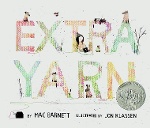
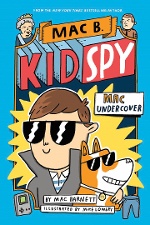
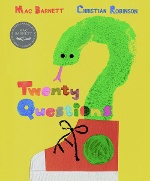
And it’s only right that children’s literature be experimental because childhood is experimental. You’re trying to figure things out. I find that kids are better than adults at reading books like this: books that aren’t just meant to be passively read but that ask the reader to do some work too. Adults, when we come in contact with something we don’t immediately understand, often push it aside. But kids do what they always do: they bravely figure out how it works, or at least what it means to them. When you’re a kid, you’re always having to do that kind of stuff. Every situation has a different set of rules.
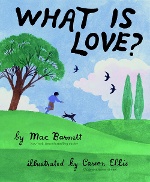
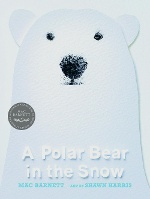
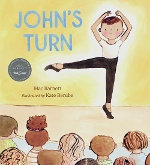
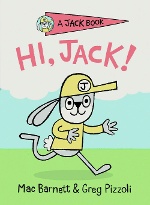
Here, then, is a challenging age to write for. A lot of people think writing kids’ books is easy or cute or simple, but it’s hard work because they deserve great art that reflects their complex lives. My dad was a pediatrician, his dad was a pediatrician — I broke the family line — but we don’t think about pediatricians like, “Oh, that’s cute medicine.” We know it’s hard work, and actually, we want the best doctors to do those jobs. People who know medicine generally, but also who understand specifically how to apply it to heal children. Well, just as pediatricians take care of our children’s bodies, children’s book writers take care of their souls. This is an important job. And this medal right here that I get to wear, this title that I get to hold for two years — National Ambassador for Young People’s Literature — is a sign that there are people in this nation who believe children’s books are important. And that means they believe that children are important. So I just want to thank Dr. Carla Hayden, the Library of Congress, Every Child a Reader, and the selection committee for appointing me to this position.
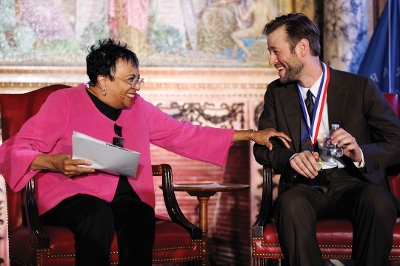 |
| Photo: Shawn Miller/Library of Congress. |
Q&A with Dr. Carla Hayden and Mac Barnett
Then–Librarian of Congress (and forever Friend of the Horn Book!) Dr. Carla Hayden, above, kicked off a question-and-answer session with Mac Barnett.
CH: I get the honor of being the first one to ask you some questions before we open it up. Because you are a fun-loving author —
MB: I am a fun-loving author. You’re a fun-loving librarian.
CH: How will your identity as a picture-book writer help your work as an ambassador? What will be special about it?
MB: I really wanted to focus on picture books for this term, and I think it’s going to be special because the picture book is such a special art form. There’s no other way that we tell a story that works quite like this. We know there are words and pictures together telling the story, and that’s very powerful. You see all kinds of images of the world around you, or imagined worlds, but also you need well-crafted prose or sometimes poetry to make these work.
The kid who we write these books for is synthesizing words, language, and pictures to create the story. But usually a picture book is read out loud to a kid by an adult. So it’s tied to the oral tradition. It’s a lot like a performance. The adult reading has to both be a reader and sort of an actor and play many parts, maybe do voices. There are aspects of dance — the body is so important, the angle between the book and your face and your arm, the way you turn the pages.
A picture book is usually sixteen page-turns, and each one of those page-turns is so exciting. It’s this ephemeral thing where the story is the work that some grownups do in reading to children, but it’s also this tangible thing that they can hold and touch. We spend a lot of time trying to make them beautiful and make the paper feel nice, and kids interact with these things like objects that they own, and that’s really special too. I just don’t think that there’s any art form like it, and I think picture books deserve a place alongside the novel, the short story, poetry, plays, as one of the great literary forms.
Find the complete ceremony at youtube.com/@loc. Mac Barnett’s upcoming tour visits are: Sept. 22–23: Hanover, PA; Oct. 13–14: Elkhart, IN; Oct. 23: Manvel, TX; Oct. 25–28: Greensboro, NC. This article is adapted from his inauguration speech delivered on February 6, 2025, at the Library of Congress in Washington, DC. From the September/October 2025 issue of The Horn Book Magazine.
Single copies of this issue are available for $15.00 including postage and may be ordered from:
Horn Book Magazine Customer Service
magazinesupport@mediasourceinc.com
Full subscription information is here.


RECOMMENDED
Please register with us to continue reading.
ALREADY A SUBSCRIBER? LOG IN
We are currently offering this content for free. Sign up now to activate your personal profile, where you can save articles for future viewing.
ALREADY A SUBSCRIBER? LOG IN
Thank you for visiting.
We’ve noticed you are using a private browser. To continue, please log in or create an account.

Add Comment :-
Be the first reader to comment.
Comment Policy:
Comment should not be empty !!!