



2018 School Spending Survey Report
Curating The Art of Grace Lin
In the pages of Grace Lin’s books, young protagonists might spend the day with their families building kites to fly. Or, they might journey through a mythical world where dragons talk. When I was tapped to curate a retrospective exhibit of Lin’s artwork at The Eric Carle Museum of Picture Book Art, at the top of my mind was this question: How could I bring the charm of Lin’s worlds — whether realistic or magical — off the page and into 3D? In June 2025, after a ten-month process, The Art of Grace Lin: Meeting a Friend in an Unexpected Place opened at The Carle.
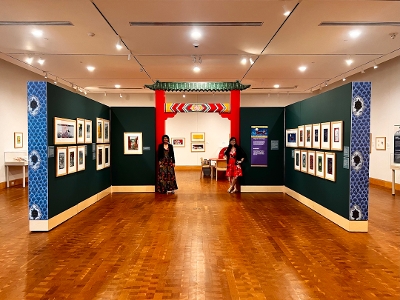 |
| Hung, left, and Lin stand in front of a gate that mimics Chinatown entryways. Photo courtesy of Melissa Hung. |
In the pages of Grace Lin’s books, young protagonists might spend the day with their families building kites to fly. Or, they might journey through a mythical world where dragons talk. When I was tapped to curate a retrospective exhibit of Lin’s artwork at The Eric Carle Museum of Picture Book Art, at the top of my mind was this question: How could I bring the charm of Lin’s worlds — whether realistic or magical — off the page and into 3D? In June 2025, after a ten-month process, The Art of Grace Lin: Meeting a Friend in an Unexpected Place opened at The Carle. Featuring more than 130 items, the exhibit showcases original paintings, sketches, and objects spanning Lin’s prolific career, which has produced board books, picture books, early readers, and middle-grade novels. Today, I’m sharing a behind-the-scenes look at designing the show.
My first step was to dive into everything Grace Lin, which included perusing her books, reading interviews and reviews, poring over her social media and her old blog, and visiting Lin at her studio in Northampton, Massachusetts. Based on this research, themes emerged that guided me in organizing the show into seven sections: Celebrating Culture & Traditions; Ling & Ting; The Stories of Food; Myths & Journeys; Modern Mom Myths; Grace Lin’s Studio; and Adventures Through Imagination. I thought it would be more engaging to tell the narrative of Lin’s career through the themes in her work, rather than in a purely chronological order.
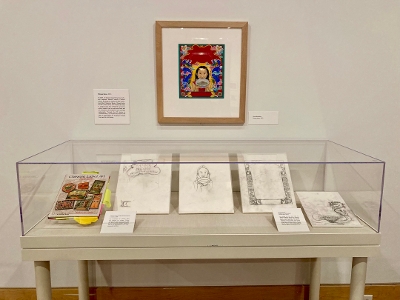 |
| This case celebrates LIn's book Chinese Menu. Photo courtesy of Melissa Hung. |
In imagining the exhibit, I wanted to bring immersive elements into the space so that walking through the gallery would feel a bit like being in Lin’s worlds. The third section of the show, The Stories of Food, features illustrations from The Ugly Vegetables, Dim Sum for Everyone!, and Chinese Menu, among other titles. What if we could have a round table, as in a Chinese restaurant, and a dim sum cart in this section, I wondered — an idea that the staff at The Carle brought to life. Visitors can sit at the table and select a book from the child-sized dim sum cart to read or create drawings inspired by fortune cookie prompts, an exercise that Lin herself partakes in.
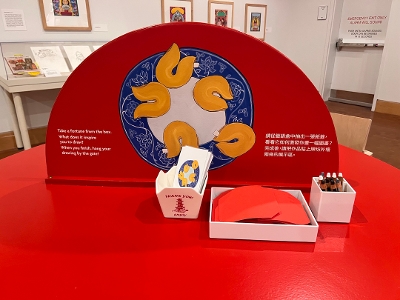 |
| Fortune cookie prompts are one of the exhibit's interactive elements. Photo courtesy of Melissa Hung. |
Visitors can then hang their drawings on a wall and pass through a gate inspired by Lin’s latest novel, The Gate, The Girl, and the Dragon, which in turn is inspired by the ornate gates of Chinatowns. The history of Chinatown gates speaks to immigrant resilience. After the 1906 earthquake and fire, the community in San Francisco Chinatown, the oldest Chinatown in North America, purposely rebuilt their buildings with pagodas, eaves, and dragon motifs in order to attract tourists, for economic survival and to protect the neighborhood against city leaders who had planned to seize the land. In 1969, they added a gate to welcome visitors to Chinatown. The gate in Lin’s novel is an homage to this history. In her story, the gate serves as a portal to a spirit world. In the exhibit it’s a portal to the artwork of her four middle-grade fantasy novels.
Another idea that I added after an initial draft of the layout was replicating the look of Lin’s art studio for the section that explores her artistic process and inspirations. Lin’s studio is located in the attic of her house, under a gabled roof, and includes a window seat between built-in bookshelves. Instead of exhibiting the objects from her studio in a standard case, we displayed them on shelves flanking a reading nook, custom built by Mark Bodah, preparator at The Carle. Isabel Ruiz Cano, associate curator, even sourced a floral rug that’s similar to the one in Lin’s studio.
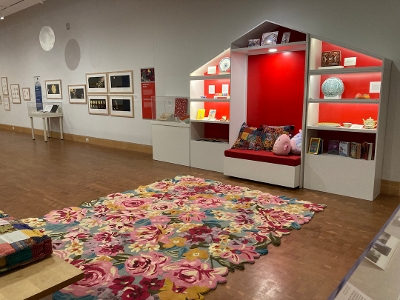 |
| This part of the exhibit is based on Lin's studio. Photo courtesy of Melissa Hung. |
Curators think a lot about labels: how much information they should contain, what they should say. With guidance from Rebecca Klassen, curatorial advisor on the exhibit, the labels convey context about culture, history, and Lin’s career and influences. And though labels may seem boring, there’s room to be creative in this aspect of an exhibit too. The Carle includes family labels in their galleries, which are placed lower on the wall and meant to spark conversation with young children. For the family labels in Lin’s exhibit, we used drawings of rabbits from several of her books. Rabbits are a recurring motif in her stories, often showing characters the way. They play a similar role in the exhibit, guiding visitors along. The family labels and section texts are also bilingual — in English and Traditional Chinese. Though Simplified Chinese is more widely read globally, Traditional Chinese is more appropriate in this case because it is used among Taiwanese communities, which is Lin’s heritage.
Color in the exhibit also tells a story. For example, the walls in the Myths & Journeys section featuring artwork from Lin’s fantasy novels are a jewel-tone blue, reflecting her influences for Where the Mountain Meets the Moon. For her illustrations, Lin looked to traditional Chinese paintings, antique ceramics, and cloisonné for inspiration to evoke the novel’s magical atmosphere.
When I first met with Lin at the start of the curating process, she told me that she didn’t want her artwork hung on standard white gallery walls. I thought the same. Her illustrations incorporate bright colors and playful patterns, and we both imagined a space exuberant with color. Though we were not allowed to paint the actual walls of the gallery, saturating the movable walls with color was key to making the space feel lively. The design studio that works with the museum, Theory One Design, also decorated the edges of the movable walls with patterns from Lin’s artwork.
Grace and I share a hope that visitors to the exhibit will experience joy — in the artwork and in the color and built spaces of the gallery — but that they will also feel the humanity behind her work, work that she began making featuring Asian characters because she never saw any depictions of people who looked like her in the literature that she read as a child. She only saw racist caricatures. As she shared on her podcast with Alvina Ling, Book Friends Forever, “My hope is that when they go through this exhibit, they see the joy, they see it’s bright, they see it’s light — but it’s not shallow. There’s a depth to it even though it’s bright.”
The Art of Grace Lin: Meeting a Friend in an Unexpected Place is on view at The Eric Carle Museum of Picture Book Art in Amherst, Massachusetts, through December 31, 2025. From the November/December 2025 issue of The Horn Book Magazine.
 Single copies of this issue are available for $15.00 including postage and may be ordered from:
Horn Book Magazine Customer Service
magazinesupport@mediasourceinc.com
Full subscription information is here.



RECOMMENDED

Please register with us to continue reading.
ALREADY A SUBSCRIBER? LOG IN
We are currently offering this content for free. Sign up now to activate your personal profile, where you can save articles for future viewing.
ALREADY A SUBSCRIBER? LOG IN
Thank you for visiting.
We’ve noticed you are using a private browser. To continue, please log in or create an account.

Add Comment :-
Be the first reader to comment.
Comment Policy:
Comment should not be empty !!!