


2018 School Spending Survey Report
Families affected by history
In these six works of historical fiction recommended for middle- and/or high-school readers (including prose novels, a graphic novel, and a verse novel), historical events have profound effects on families’ lives.
In these six works of historical fiction recommended for middle- and/or high-school readers (including prose novels, a graphic novel, and a verse novel), historical events have profound effects on families’ lives.
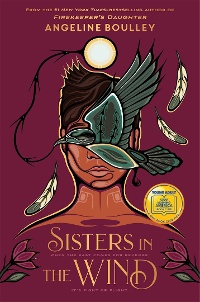
 Sisters in the Wind
by Angeline Boulley
High School Holt 384 pp.
9/25 9781250328533 $19.99
e-book ed. 9781250328540 $11.99
Lucy Smith knows that someone is following her, and she decides it’s time to leave town. At first she suspects the handsome Potawatomi man who insists on talking to her at the Michigan diner where she works, but it turns out the man — who introduces himself as John Jameson, a lawyer who helps Native children who were in foster care find their communities — has only been in town for two days, and can’t be the culprit. Then someone bombs the diner, and Lucy’s resulting broken leg needs to heal before she can leave. While in the hospital, she is introduced to Mr. Jameson’s friend Daunis Fontaine (the protagonist of Firekeeper’s Daughter, rev. 5/21), who claims to know Lucy’s biological mother and her late sister, both Ojibwe. Lucy is forced to think about why her father wouldn’t talk about her mother when he was alive and what it means to be Native when she grew up being told she was white. Boulley (Sault Ste. Marie Tribe of Chippewa Indians) tells a powerful story about the importance of the Indian Child Welfare Act, which aims to ensure that Native children in foster care are placed with Native families. Lucy’s story is related in chapters that alternate between her present (in 2009, between the events of Firekeeper’s Daughter and Warrior Girl Unearthed, rev. 5/23) and her past. Slowly unfolding, sometimes shocking revelations keep pages turning. Boulley’s latest gripping thriller poignantly expands familiar characters’ stories and introduces a compelling new heroine. NICHOLL DENICE MONTGOMERY
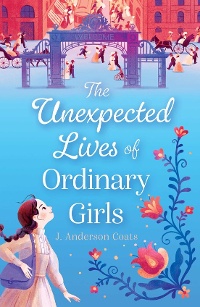 The Unexpected Lives of Ordinary Girls
by J. Anderson Coats
Middle School Atheneum 272 pp.
9/25 9781665968614 $17.99
In 1910 small-town Colorado, Stanislava’s plan for getting out of her Slovene immigrant community — going by the “American name” of Sylvia, concealing her heritage to avoid discrimination, and one day going to college — comes to an abrupt halt when her older sister, Stina, runs away to get married. When their mother demands she stay home to do the never-ending housework in Stina’s stead, Stanislava/Sylvia runs away, too, ending up at the public library in Denver. One of the librarians recruits her to serve as translator for the library’s outreach to Denver’s Slovene community. As she helps to bridge the cultural gap, she meets women who show her that Slovenians are not all just like the ones she grew up with, allowing her to embrace both her Slovenian and American identities as she charts a course for herself. Anderson brings lots of threads together with skill, telling a cohesive story that has as much to say about the present — in terms of gender, ethnicity, race, religion, heritage, assimilation, classism, self-determination — as about its historical setting. Sylvia has an effective balance of naiveté and worldliness, making her an easy protagonist to root for, and her quest for independence is resolved in a gratifying but not overly neat way. This is historical fiction at its best, fusing period details with a compelling narrative and challenging assumptions of then and now. SARAH RETTGER
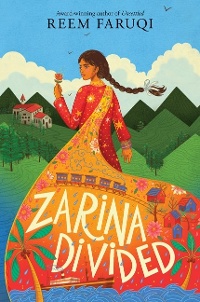 Zarina Divided
by Reem Faruqi
Middle School Harper/HarperCollins 336 pp.
5/25 9780063284999 $19.99
e-book ed. 9780063285064 $9.99
Eleven-year-old Zarina lives a privileged life in Poona, India, until the British withdrawal in 1947, which initiates the partition of India into two separate countries. The family survives the chaos and violence as they flee to what is now Pakistan. When they finally arrive safely in Karachi, the unrest continues around them. Traumatized and unable to concentrate, Zarina struggles in school, while inside their small house her mother, pregnant with her fifth child, is put on bed rest, a need possibly due to Zarina’s accidentally crashing into her while playing in the tight new space. Zarina fights for the chance to go to boarding school like her brothers and starts attending St. Denys’ boarding school without Mummy’s blessing. There she finds a friend, understanding teachers, and the stability she needs to heal. The novel in verse is broken into four segments: Zarina’s life in India and her journey to Pakistan; a new life in Karachi; boarding school; and a return to her now-more-settled family in Karachi over term break to meet her new baby sister and make peace with her mother. Faruqi’s thoughtful use of verse emphasizes the fragmented nature of Zarina’s life — moments of calm are broken by violence, fear, or sadness. Ultimately, Zarina’s is a story of resilience; an author’s note relates that the novel is based loosely on her family history. Back matter also includes a glossary, resources, and photos. MAEVE VISSER KNOTH
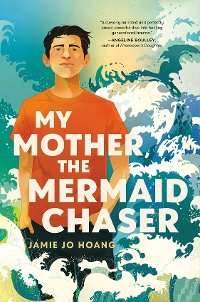 My Mother, the Mermaid Chaser
by Jamie Jo Hoang
High School Crown 384 pp.
9/25 9780593643006 $19.99
In this haunting sequel to My Father, the Panda Killer (rev. 9/23), readers are reacquainted with the complicated Vu family; this time the multilayered story focuses on one San Jose teen’s life-changing Vietnam summer trip while revisiting hardships his estranged refugee mother experienced as a teen during the Vietnam War. Paul, sixteen, travels to Đà Nẵng in 2008 with his abusive father to visit his paternal grandmother. Paul is initially ambivalent about the trip since his older sister, Jane (a protagonist in the first novel), bails, and he feels like an outsider. He eventually bonds with a distant cousin and meets his maternal grandmother. The teen then learns more about his mother, Ngọc Lan, who abandoned the family several years earlier. Alternating chapters from Ngọc Lan’s point of view cover her own parental abandonment and wrenching sea evacuation, her older sister’s drowning (the titular mermaid), and her struggles to establish a new life in California. Hoang’s dramatic coming-of-age novel is an intense exploration of grief, loss, and multigenerational trauma that ultimately leads to understanding, forgiveness, and even love. Back matter includes a list of professional resources for people dealing with abuse and mental health issues. MICHELLE LEE
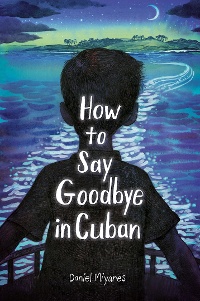 How to Say Goodbye in Cuban
by Daniel Miyares; illus. by the author
Middle School Schwartz/Random 240 pp.
9/25 9780593568293 $21.99
Paper ed. 9780593568309 $13.99
Library ed. 9780593568316 $24.99
In this fictional graphic novel based on Miyares’s father’s childhood, Carlos is growing up in the Cuban countryside in 1956. He loves spending time with his friends and family, especially his abuelo, and searching for shark teeth at the beach. When Carlos’s papi wins the lottery, they all move to a new house in a nearby city. But as Fidel Castro launches his revolution to overthrow then-president Fulgencio Batista, the family’s way of life and personal freedoms are threatened. Papi leaves for over a year to set up life in the United States, eventually returning to help the rest of his family flee. Lush ink and watercolor illustrations bring emotional depth to the story with rich details, frequent shifts in perspective, and a sunset-hued color palette. At the start of each chapter, a line drawing with a straightforward caption depicts a historical moment in the Cuban Revolution timeline. The book’s start in the late 1950s offers a fuller picture of pre-revolution life on the island and an honest look at the complicated relationships within and among Cuban families in this period. Pair with Castellanos’s Isla to Island (rev. 3/22) and Rodriguez’s Worm: A Cuban American Odyssey for graphic-novel and graphic-memoir, respectively, renditions of other Cuban immigration experiences from the mid-to-late twentieth century. MONICA DE LOS REYES
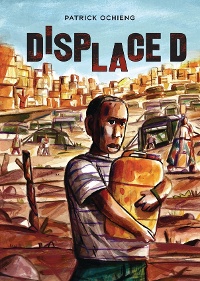 Displaced
by Patrick Ochieng
Middle School, High School Carolrhoda 224 pp.
8/25 9798765648698 $18.99
Fourteen-year-old Kimathi lives in a suburb of the Kenyan city of Eldoret, but when his father is murdered during post-election violence, he flees. Like so many others after the 2007–2008 elections, he ends up in a camp for Internally Displaced Persons with his mother and five-year-old sister, Ngina. Since this is Kim’s first-person present-tense narrative, readers get one boy’s view of camp conditions, but we see enough to know the harsh realities of his new life: nightmares about his father’s death, prejudice at the school he attends, typhoid, fires, and crooked water sellers. Kim is a kind boy able to see the goodness of people trying to make the best of bad situations. He finds a community of friends and even becomes a hero in the camp, for helping both to rescue a woman from a fire and to coordinate the delivery of water tanks that will provide clean water and thus save lives. Through his protagonist’s point of view, Ochieng offers a memorable reminder of how political conflict affects children; as one young person Kim meets in the camp puts it, “We’re just kids! Why can’t we have a normal life like other kids? Is that too much to ask for?” Back matter includes an author’s note and questions for discussion. DEAN SCHNEIDER
From the November 2025 issue of Notes from the Horn Book.


Added To Cart
RELATED


RECOMMENDED

Please register with us to continue reading.
ALREADY A SUBSCRIBER? LOG IN
We are currently offering this content for free. Sign up now to activate your personal profile, where you can save articles for future viewing.
ALREADY A SUBSCRIBER? LOG IN
Thank you for visiting.
We’ve noticed you are using a private browser. To continue, please log in or create an account.

Add Comment :-
Be the first reader to comment.
Comment Policy:
Comment should not be empty !!!