



2018 School Spending Survey Report
Five questions for Laura Amy Schlitz
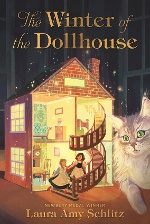
Laura Amy Schlitz’s imagination has created books ranging from the Newbery-winning verse novel Good Masters! Sweet Ladies! to the multi-award-winning historical YA novel The Hired Girl. Her latest, The Winter of the Dollhouse (Candlewick, 9–12 years), is a doll story — with human and doll points of view.
Laura Amy Schlitz’s imagination has created books ranging from the Newbery-winning verse novel Good Masters! Sweet Ladies! to the multi-award-winning historical YA novel The Hired Girl. Her latest, The Winter of the Dollhouse (Candlewick, 9–12 years), is a doll story — with human and doll points of view. Can’t get enough of dolls? See also “Who Was Alice-Heidi?” as well as the Dolls tag in the Guide/Reviews Database. And see also our list Our world meets fantasy in this issue of Notes.
1. How did this book’s unusual approach to point of view come about?
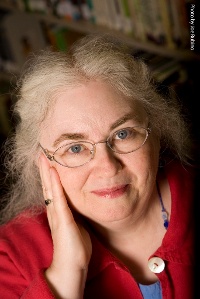 |
| Photo: Joe Rubino. |
Laura Amy Schlitz: When I started The Winter of the Dollhouse, I wanted to write a tête bêche book, like Aliki’s Marianthe’s Story. You’d open the book from the front and read the story of Tiph and Szilvia. Then you’d turn the book upside down, open from the back, and read what happened from the dolls’ point of view. The two books would be bound together, but each would stand on its own. Every chapter in the first book would have a parallel in the second. It would be as elegant as a fugue.
The tête bêche form tickled my vanity, but it didn’t work for me. It was more trouble than it was worth. My reader-friends liked zigzagging from one point of view to another, alternating the chapters. My editor, Liz Bicknell, agreed. She helped me collate the chapters so that I had one book, not two. Farewell, tête bêche!
Beyond my conceit, I think what I was after was the idea of two worlds lying side by side. Tiph and Szilvia are imaginative, but they are rational: they don’t suspect that the dolls are sentient, and they underestimate the cat and the dog. Gretel and Red are creatures of fantasy, but their knowledge is limited to what they can see and overhear. Only the reader knows the whole story.
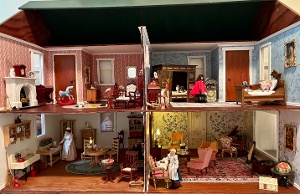 |
| The author's dollhouse. Photo courtesy of Laura Amy Schlitz. |
2. Did you have a dollhouse as a child?
LAS: I did. My uncle and my father were skilled woodworkers, and they made my dollhouse. I played with it throughout my childhood. I renovated my dollhouse this spring, after I finished my book. The restoration was based on the dollhouse in my story, but the story was also rooted in my hopes for the restoration.
3. Tiph’s behavior is realistically complex. Did you guide her actions, or did she guide you?
LAS: (Inhale through teeth.) To tell you the truth, I’m not sure which of us was in charge. For me, a character generally begins with an image. I envisioned Tiph wearing a red buffalo-check jacket. I knew the jacket was a hand-me-down from her father, and that there was a hole in the pocket. I named her — which is a vital step in creation. I’m not synesthetic, but the letters of the alphabet are distinct to me; they have different colors and flavors. Finding the right name is paramount. If you choose the wrong one, the story goes nowhere. I liked the name Tiph, because it’s close to tough; I knew the girl in the red jacket wanted to be tougher than she was.
Tiph’s backstory came to me quickly. I’m trying not to sound woo-woo about this, but creating characters never feels like I’m making things up. It feels like I’m being told a story. It’s thrilling — the vividness, the complexity, the surprises. Sartre be damned — essence precedes existence.
I usually have a good handle on how my characters think and feel, but I can’t always predict what they’re going to do. I try to nudge them to do things that will advance the plot. Mostly, they cooperate. Sometimes they don’t.
 4. Why do you think doll stories continue to capture readers’ imaginations?
LAS: Like puppets, tin soldiers, and action figures, dolls are human-shaped toys. They are engineered for our projections. They invite our fantasies. And we can control them. For a child who is largely under the control of adults, the human-shaped toy is a godsend. Through the toy, the child can be heroic and rebellious, violent and glamorous, scatological and tenderhearted.
I believe the diminutive size of dolls provokes another reaction. Dolls remind us of a time when we were small and vulnerable. Perhaps children feel the urge to alleviate that helplessness. Children are natural animists and are quick to endow their toys with personalities. They talk for them in special voices; they move them in lifelike ways. They speculate about the power of the toy to come to life when no one is there to see.
Stuffed animals also enjoy this hidden life. When their child is asleep or away at school, they can bounce about and enjoy themselves. But stuffed animals are not effigies and are seldom as eerie as dolls. A battered teddy bear is endearing — well-loved. A doll with a missing eye or a broken limb is likely to find herself on the jacket of a horror book. There’s something haunting about an object that wears a human shape and isn’t alive. Most dolls are beautiful, which adds to their fascination.
5. Borrowers, Mennyms, Two Bad Mice, or all of the above?
LAS: Oh, The Borrowers, definitely. When I was a child, someone gave me The Tale of Squirrel Nutkin, and I was appalled. The squirrel was an attention-seeking little thing, just as I was — and his punishment was to be dismembered. He was nearly skinned alive. That did it — no more Beatrix Potter books for me!
By the time the Mennym books came out, I was middle-aged. They couldn’t etch into me as the Borrowers did. But the Borrowers — oh, yes. When I was in fifth grade, my school librarian read aloud the first chapter. After she finished, I bounced against my seat, waving my hand frantically, begging her to let me have it next. One way or another, I got my hands on all the Borrowers books. I also loved Rumer Godden’s doll stories and Miss Hickory, The Return of the Twelves, and The Racketty-Packetty House.
From the November 2025 issue of Notes from the Horn Book.


Added To Cart
RELATED


RECOMMENDED
Please register with us to continue reading.
ALREADY A SUBSCRIBER? LOG IN
We are currently offering this content for free. Sign up now to activate your personal profile, where you can save articles for future viewing.
ALREADY A SUBSCRIBER? LOG IN
Thank you for visiting.
We’ve noticed you are using a private browser. To continue, please log in or create an account.

Add Comment :-
Be the first reader to comment.
Comment Policy:
Comment should not be empty !!!