


2018 School Spending Survey Report

A Gift of Dust
Yesica Hurd considers Juana Martinez-Neal's illustrations for A Gift of Dust: How Saharan Plumes Feed the Planet, written by Martha Brockenbrough.
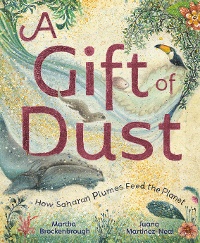 Juana Martinez-Neal's debut picture book, Alma and How She Got Her Name, which she both wrote and illustrated, earned her a 2019 Caldecott Honor. In A Gift of Dust: How Saharan Plumes Feed the Planet, she continues to explore shapes and textures, bringing the Saharan dust plume of Martha Brockenbrough's text to life.
The title page marks the beginning of a journey that reveals the role dust plays in sustaining and feeding our planet. Against a tawny background, dust motes sprinkle onto a blue empty crib. Meanwhile, two stuffed animals with quizzical expressions gaze at the particles raining down from the top left to the bottom right of the spread.
All the illustrations in this nonfiction picture book are double-page spreads. The pictures are rendered in pastels, colored pencils, acrylics, gesso, and fabric on hand-textured paper. Martinez-Neal’s calculated choices enhance the scope and grandeur of the dust by filling each spread to capacity. However, the illustrations never feel crowded; there is ample breathing room in each image, allowing the reader to absorb both the text and pictures together.
Martinez-Neal adroitly uses color in these visually striking spreads. For instance, after the title page, the colors are inverted. The blue of the crib colors the entire spread, while dust is sprinkled onto an expectant mother looking down at the crib. Again, the dust rains down from the upper left corner to the bottom right. The stuffed animals appear bemused and more life-like in their expressions in this scene, while also adding a new friend to make a trio.
The toy animals have inched themselves away from the crib, and two of them have turned as if to walk off the page. The snout of the animal in the orange striped t-shirt is already off the edge, which makes the reader question: Where are these animals going? These whimsical touches bring a bit of humor to Brockenbrough’s words.
The next spread features a single human hand, palm up, holding the original living organisms that composed this life-giving dust. A palimpsest of images crowds the hand as the organisms decompose into the dust. A single beam of light shines across the page, arching in the same direction as the previous dust swirls.
Repetition of color and the theme of the circle of life are found throughout the book.
Martinez-Neal effectively uses color to enhance the initial spreads, showcasing a deliberate and skillful integration that captivates the audience. The overarching tone is warm browns, tans, and beiges. After the first blue spread, various shades of tans and browns, or a hint of yellow dominate the pages until the image of the ocean where a whale looks happy as dust enters the water to help feed plankton, the whale's food source. The connection between water and dust is made apparent in these lushly illustrated scenes.
The illustrations deftly take the viewer from the minutia of the dust to an aerial view of outer space, which reveals the immense plume blowing across the Earth’s landscape. While in space, the Earth is enveloped in a rich, deep brown instead of the usual inky black of space. Meanwhile, the astronaut's breathing tube resembles an umbilical cord, harkening to the first image of the expectant mother.
In the antepenultimate spread, we see the dust whooshing through a window of a straw-covered house, while a red parrot perches on a tree limb. As the blue curtain blows back inside, it ushers in the dust above an empty crib. The trees are swept in movement as they, too, bend toward the dust.
The penultimate page is a compendium of life, depicting two hands: an adult's and a small child's. The adult hand is cast in darker shadows, perhaps symbolizing the life it has lived, while the young child's hand is bathed in glowing light from the dust. There are more items on this spread than in the first one showing the single hand. Moreover, the adult's and child's hands are palm down, and they appear to be reaching towards each other. Dappled in light and dust.
In the final spread, a mother cradles her baby in a loving embrace as dust melds into their warm sepia-colored skin. The mother has voluminous hair and soft facial features, complemented by long lashes. The mother's dress is a collection of textures with a lace fabric overlay. The child's hand reaches to grasp the dust, bringing the moment to a full circle, echoing the words, “This dust...of what lived once sustains what lives today and what will be born...tomorrow.”
In her interpretation of Brockenbrough’s words, Martinez-Neal encapsulates the Caldecott Medal’s spirit by skillfully capturing the book’s theme of dust and the circle of life.
[Read The Horn Book Magazine review of A Gift of Dust]

Added To Cart
RELATED


RECOMMENDED

Please register with us to continue reading.
ALREADY A SUBSCRIBER? LOG IN
We are currently offering this content for free. Sign up now to activate your personal profile, where you can save articles for future viewing.
ALREADY A SUBSCRIBER? LOG IN
Thank you for visiting.
We’ve noticed you are using a private browser. To continue, please log in or create an account.

Add Comment :-
Be the first reader to comment.
Comment Policy:
Comment should not be empty !!!