



2018 School Spending Survey Report
Adib Khorram Talks with Roger
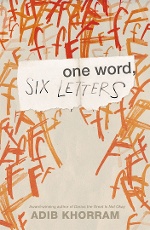
When ninth-grader Dayton, on a dare, shouts out a slur at a visiting poet, another boy, Farshid, wonders what that word — One Word, Six Letters — means for himself. Below, I talk with author Adib Khorram (who received a Boston Globe–Horn Book Honor Award for his first novel, Darius the Great Is Not Okay) about what that word means to him.

Talks with Roger is a sponsored supplement to our free monthly e-newsletter, Notes from the Horn Book. To receive Notes, sign up here.
Sponsored by
When ninth-grader Dayton, on a dare, shouts out a slur at a visiting poet, another boy, Farshid, wonders what that word — One Word, Six Letters — means for himself. Below, I talk with author Adib Khorram (who received a Boston Globe–Horn Book Honor Award for his first novel, Darius the Great Is Not Okay) about what that word means to him.
Roger Sutton: You say this book started with a school visit. Can you tell me about that?
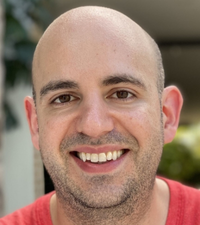 Adib Khorram: Yes. It was in February 2024. I was halfway through my visit talking about my novel Darius the Great Is Not Okay, and this kid just shouted out faggot at me in the middle of the presentation. I was pretty taken aback. It had actually been a while since I had someone shout a slur at me. Thankfully, you can take the kid out of the theater, but you can never take the theater out of the kid. So I pivoted and pretended that I heard the word bacon and waxed eloquently about breakfast while the teachers bodied this fourteen-year-old kid out of the auditorium.
RS: I never would have been that quick.
AK: All those improv classes paid off. The rest of the visit went fine, but afterward a bunch of students, including a bunch of queer students, came up to me to tell me how sorry they were that it happened. The teachers were really apologetic, and I remember thinking, I’m sorry that happened to all of you because you all had to hear that word. I’m an adult; I can deal with it. But you all shouldn’t have to deal with that in your school. And then I went to lunch and the vice principal or maybe the principal came over in his quarter-zip-pullover situation and started walking me through the kid’s punishment plan. I remember thinking, I don't want him to be punished, I want to know why he did what he did, and I want him to be given a chance to meaningfully repair the harm he caused. Because at the end of the day, I get to go home, and these kids are the ones who have to live with the aftermath of what happened. Both the kids who heard the word and the kid who shouted the word. I’m not excusing his behavior in any way, but teenagers are scientifically proven to not have the greatest impulse control or risk assessment. It’s a side effect of your brain braising in a bunch of hormones. So I found myself wondering what would happen to him. Is everyone going to know him as the homophobe? Is he homophobic? Is he parroting what he hears at home? Did he just have low blood sugar? Who knows? I got home and wrote about this experience in my author newsletter because I couldn’t think of anything else to write that month. Then I went on with my life. Then my agent emailed me and said, “You know, there might be a story there.” And when she said that, I thought, Oh crap, there probably is. The book actually very quickly came to me. I take a lot of walks, and I started taking notes on my walks. And then I was fortunate enough to get a MacDowell fellowship a few months after that. So I sat in a cabin in the middle of the woods in New Hampshire and wrote about three-quarters of a first draft in about two weeks, which was really fast for me.
RS: Did you have the alternating second-person narration from the beginning?
AK: I did. The first line is something that came to me very quickly. “You know you’ve messed up when you get marched into the principal’s office.” I knew right away the story had to be in two voices. Before this I never even considered writing anything in second person. I think second person is weird and unnatural. And nonetheless I ended up writing a book in two second-person points of view.
RS: I got a bit scared at the beginning of the second chapter because when I started the book, I thought, Ooh, second-person narration, that’s interesting. I turned the page to the new chapter and, Ooh wait, second person but different character. I hope I can keep up! But it worked really smoothly.
AK: I’m still quite surprised. I really love sitting down and writing without any kind of outline. I like to get to know my characters and explore their choices and the consequences that arise naturally without forcing my idea of a narrative on them. I had no outline. I just sat down and started writing. And to my surprise it came out pretty smoothly as a first draft, and the final book is structurally almost identical to the first draft. Actually it's probably about eight percent the same words. Which is wild to me because usually I do need to do a lot of revising. But it came out sort of intense and visceral, and that really worked for the story.
RS: Did you find yourself taking sides?
AK: I don’t think I did. Because I had to be in those characters’ heads, I had to see the humanity in both of them. And see both of them as kids who are making mistakes and learning and growing, and hopefully they won’t repeat those mistakes. That’s not to say I wasn’t occasionally in Dayton’s head and just thinking, Dayton, you’re being a bonehead. But also you are fourteen and I remember being a bonehead when I was fourteen. So I don’t think I took sides, but I do think I was conscious of where the greatest amount of power lay in the situation, systemic power. It mattered to me that the story starts because a straight white kid shouts a slur. But the story ends with a queer brown kid making a choice of what to do next. It was important to me that Farshid get the last word.
RS: You said that your first draft is essentially the novel — how did your feelings toward those two boys change as you wrote?
AK: I came to understand them over the course of the novel, to empathize with them, and to occasionally get really frustrated with them. As an author, I am in control of the story. But also, if I want it to be a good story, I have to put myself in their situation and ask, “What would this character do?” And if they are making choices I disagree with, that can be very frustrating. Like, “Oh boy I wish you wouldn’t do that, but you are doing it and so I have to follow.” It’s a weird thing as you’re writing that at a certain point the characters stop being characters and start feeling like people. That’s always a beautiful, but unsettling, part of the process. As Dayton and Farshid became people, I found myself remembering other people I had known who were just like them. In a way that made me feel good that I was touching something true, but it was also unnerving.
RS: I thought that you did a great job of not telling us, but also Farshid not really realizing himself, what his position is. Because I remember that. I remember telling myself I wasn’t gay, and it takes a really long time to say it. You’re not just fooling other people; you’re fooling yourself.
AK: We talk a lot about coming out, and in some ways I think the hardest coming out any of us ever have to go through is coming out to ourselves. Because reconciling who we thought we were with who we are or who we are becoming is not comfortable work. And even more so when you’re young and everything about you feels so in flux and suddenly there’s this immutable fact about you staring you in the face — one we, unfortunately, still societally marginalize. That’s terrifying no matter if you have the most loving, supporting family and community. It’s still really scary.
RS: Did Farshid’s journey to self-understanding mirror your own?
AK: There are definitely parts of me in there. I don’t think any writer can create something completely alien from themself. There’s always parts of ourselves in every single character. I do think I put a lot of my teenage anxieties about my queerness in Farshid in a way I don’t think I had with any of my other books. But experience-wise, it was different in a lot of ways. At least the events of my experience were different. But the emotions were very much the same.
RS: Yeah, I felt that. And for me, it was more than fifty years ago that I was going through what Farshid is going through in the 2020s. And when was it for you?
AK: I am forty-one, so I was going through it in the late 1990s and early 2000s, which was a really fun time because everyone was using “that’s so gay” as an insult for everything.
RS: How does a writer for young people bridge the gap between their present self and who they were as a kid? In One Word, Six Letters you have the word faggot shouted out in an assembly, and the kid who wonders about himself, Farshid, takes it very much to heart even though it’s not directed at him. But what about Adib the author, bridging the gap between what he would feel like now if someone yelled that at him, and what he would feel like twenty-five years ago?
AK: In some ways this is where the art or the magic of story comes into play. I think empathy is a crucial skill for authors, especially writing for young people. We have to be able to put ourselves in their shoes and in their heads. And maybe the challenge is not knowing what they feel versus what we feel. Maybe the challenge is figuring out how we can use our adult experience to illuminate what they are feeling and broaden it so that every reader can understand it, if that makes sense.
RS: It does. It’s just that stuff happens when you’re fourteen years old. A little remark can completely destroy a kid. That doesn’t happen to us so much anymore as adults, so how do you get yourself back in that place?
AK: When you are young, everything is a first time, and everything bad that happens to you is the worst thing that has ever happened to you thus far in your life. I think part of it is not letting yourself get numb as an adult. The great thing about getting older is you have more context. But that doesn’t mean you lose sight of what something bad happening feels like. You just have to remind yourself, recalibrate the scale, and say, “Okay, how would this feel if I hadn’t yet felt x, y, and z — if this was the first time this had happened to me?” But also, young people are people, and I think people are all fundamentally the same. I do not find it that hard to connect my humanity to the humanity of a teenager today and try to imagine what it would be like for them.
RS: Do you find that visiting schools helps you with that?
AK: I do. I love talking to teenagers. I think they are endlessly fascinating. One thing I do remember about being a teenager is feeling like I was on top of the world, totally grown up, completely mature. And now I can look back on those years and realize that I was a hot mess.
RS: That’s why I’ve never gotten a tattoo.
AK: I got my first tattoo this year. I thought, This feels like a good mid-life crisis to have. But having that memory of being a mess is I think one of the reasons why spending time with young people who feel that same way fills me with joy. It lets me laugh with them, join in on their jokes, meet them where they are — while, of course, keeping the healthy necessary boundaries I have as an adult. I remember one of the things I most wanted when I was a teenager was to be taken seriously by the adults in my life. And I have found when I take seriously the students I meet at school visits, they respond in kind, and they take me seriously. So I love school visits. I’ve done lots of them. I still don’t understand what 6-7 is, though, and I probably never will, and I think that’s also okay. I don’t want to say the visits keep me young, but they help me remember and recognize what is important in young people’s lives and what ways their lives are different than when I was their age. And the ways it’s the same, which is a lot of ways.
RS: Richard Peck always said that a lot of the experience of being a young person, being fourteen, is the same whether we are talking a hundred years ago, fifty years ago, or today. But that if you don’t get the particulars right, you are going to seem out of touch. And those particulars do change.
AK: They do. I’m really lucky that in addition to school visits I also have several friends and family members with teenagers. Like I had no idea that teenage boys these days are going out and spending hundreds of dollars on cologne.
RS: I know, cologne!
AK: It was an eight-dollar can of AXE body spray when I was in school. One of my friends told me, “Oh my god, I had to take my son to Sephora again and he didn’t even buy anything, he just wanted to sample things and he’s deciding what to ask for for his birthday.” I thought, What a fascinating detail. And I kid you not, about a week after I finished the first draft of this book, the New York Times published an article that was basically, “Why are teenage boys spending hundreds of dollars on cologne?” I thought, I don’t know, but I want to find out. My agent, Molly O’Neill, and I sent the article to my friend and we had a good laugh. She said, “That means you are in touch with your audience,” and I was like, “Yes, exactly.”
 RS: You know, this book is about a word you don’t use until the afterword, but yet you toss the word queer around very easily, just as a descriptor. And for me, both faggot and queer were thrown at me through my adolescence and I think of them as having the same kind of power. I understand the reclamation of the word, and you know we did it in the eighties with Queer Nation and ACT UP and AIDS activism, so it wasn’t new to me. But it’s so interesting to me how that word has become more neutral, whereas faggot still has its power to get somebody.
AK: It really does. I thought long and hard about that. You know that some people are even reclaiming the word faggot. And I ended up on the side that, even if it is being reclaimed, probably closeted fourteen-year-olds are doing less of the reclaiming than out queer folks and artists and activists living their lives. I think maybe because I was born in the 1980s.
RS: Where did you grow up?
AK: I grew up in Kansas City, Missouri. I think my first exposure to the word queer was “We’re here, we’re queer, get used to it.” So I guess my first interaction with it was one of empowerment. I don’t know that I personally have ever been called queer as a derogatory term. As I mentioned, growing up I got called gay as if that was an insult plenty of times. And sometimes it was used not to mean “gay” but to mean “stupid.” So queer has never had that power for me in the way that every time I have been called a faggot it has been meant to harm.
RS: Meant to hurt you.
AK: And also, I and many of the queer people in my life have come to love the word queer because it feels so encompassing of our entire community.
RS: I struggle, frankly, to figure out who it leaves out, which is why I never use it.
AK: I feel like for me, it leaves out straight people. Straight, cisgender, allosexual people. Basically anyone that society considers the norm, they’re excluded from it. I know so many people in my life who have stopped even identifying as gay or a lesbian or bisexual. They’ll just say that they’re queer because it also encompasses room for change and growth, and I think that’s kind of beautiful. Even though I am very gay and can’t imagine not being gay. But there are other people I know who have identified as gay for years and have suddenly been like, “You know, I might be a little bit bisexual.” To me queer is very welcoming and affirming.
RS: How do you think you would fare as a young queer person today?
AK: I think some parts of my existence would be easier. I do think, despite the current administration, that queer acceptance is on the rise and has been on the rise for a number of years. Nearly every school I’ve visited has some version of a queer student alliance, or a gender and sexuality alliance, or a rainbow coalition. I actually included Farshid’s school having a rainbow coalition that has changed its name three times, sort of as a joke, and yet the more schools I visit, the more I realize how frequently that really happens. So yeah, I think there are more resources available, more visible community, much more media representation. When I was growing up, if a gay person was in a story, you knew they were going to die, and I’m very grateful that has changed. I still don’t think it's easy. There are still large forces in our society that do not accept queerness. Where you live can have a big impact on how comfortable it is being queer. And no matter what, acknowledging that you are different from your peers is really just rough. No matter how welcoming your community is, it’s still scary to acknowledge that it is your community now. So in that way I think it’s still very much the same as it was twenty years ago, fifty years ago, a hundred years ago.
RS: Well, there’s certainly nothing dated about someone in a school assembly yelling out faggot.
AK: Right, unfortunately not.
RS: There was nothing anachronistic about that to me.
AK: I think we all hope one day it will be. But also I think as long as there are humans there will always be in groups and out groups and there will always be hateful words used to define those groups.
RS: How do we change that, Adib?
AK: I think in some ways that's what I and many artists are trying to do with our art, to build empathy and deconstruct the fear of the other. Help people understand our shared humanity. I don’t know if any of us have the wisdom to solve that problem on our own. But as with many problems, the more of us that are pushing in the right direction, the closer we’ll get to the solution.
Sponsored by



RECOMMENDED

Please register with us to continue reading.
ALREADY A SUBSCRIBER? LOG IN
We are currently offering this content for free. Sign up now to activate your personal profile, where you can save articles for future viewing.
ALREADY A SUBSCRIBER? LOG IN
Thank you for visiting.
We’ve noticed you are using a private browser. To continue, please log in or create an account.

Add Comment :-
Be the first reader to comment.
Comment Policy:
Comment should not be empty !!!