


2018 School Spending Survey Report

Welcome to the Horn Book's Family Reading blog, a place devoted to offering children's book recommendations and advice about the whats and whens and whos and hows of sharing books in the home. Find us on Twitter @HornBook and on Facebook at Facebook.com/TheHornBook
Auggie and Her, Jess’s Dad and Me
Katherine Paterson’s Bridge to Terabithia was one of the first books to make me cry.
 Katherine Paterson’s Bridge to Terabithia was one of the first books to make me cry. I was in fourth grade when I read it, and Leslie’s death wrecked me. I wept at its suddenness, at the shock of a child’s death, and at the plain wrongness of it all while my heart ached for Leslie’s best friend, the book’s main character Jess. Leslie had seemed like my friend, too, and I felt a sense of solidarity with him in his grief.
When I returned to this novel as an adult, Leslie’s death and Jess’s mourning, while still heartrending, weren’t what made me cry. Instead, I welled-up while rereading the scene when Jess’s father tries to bridge the gulf that’s always separated him from his artistic, sensitive son to provide him comfort. I don’t recall what I thought about this scene as a child, probably because I didn’t think about it very much—at least not with regard to Jess’s father. He was an adult, and as a child my focus was on the child characters that populate the novel.
But now, I feel a sense of solidarity with Jess’s father. He’s so familiar to me, so real. The blameless inadequacy of his efforts to comfort his son is tragic, and his sense of powerlessness palpable now that I’m a mother who’s experienced that same helplessness in the face of my own children’s pain. There’s a rawness to his effort, which is grounded in a familiar desire to erase one’s children’s suffering, or better yet, protect them from it.
Of course, we can’t protect our children from all hurt, but we can help them navigate loss and pain. And we bookish people often grasp at stories as a means of providing comfort and guidance. Offering kids texts that depict a range of human emotion and experience—including grief, loss, tragedy, and death—as a matter of course and not a matter of remedy can be a means of preparing them for inevitable losses and hurts they will encounter in an imperfect world. This is one reason that we have an open bookshelf policy at our house. Kids can read what they wish, and I regularly ask them about their choices. I’ve found that books can serve as a meeting place for us to talk not just about stories, but about their lives, too.
One of my daughters is going through a tough time of late, and she came to me a few months ago and said, “Mom-Mom, this is the first book that’s ever made me cry.”
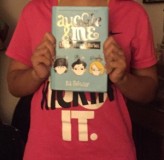 She was holding, not Bridge to Terabithia, but R.J. Palacio’s Auggie & Me. We’d read Wonder together with her siblings a few years ago, and she’d liked it, but she self-selected and read this companion title independently. She loved it.
“What about it made you cry?” I asked her.
“Everything. Just how they all feel their own ways, and how they all have things that can make them sad, because that’s real.”
“Was it hard for you to read all those real feelings in a story?” I asked, thinking about how overwhelming her own emotions have been recently.
“No. I loved it,” she said. “It was like they were my friends.”
There’s a quotation from Shadowlands, a biopic about the life of C. S. Lewis, that says, “We read to know we are not alone.” I thought of this line when my daughter held the book to her chest, right in front of her own bruised heart. As my sense of kinship with Jess’s dad in Bridge to Terabithia reveals, I am woefully aware of the limits of what I can do to ease her hurts. But I took some small comfort in the fact that although Palacio’s book wasn’t solving the problems that hurt her in real life, it was giving her real reassurance that she isn’t alone in her emotions around them.


Added To Cart
RELATED


RECOMMENDED

Please register with us to continue reading.
ALREADY A SUBSCRIBER? LOG IN
We are currently offering this content for free. Sign up now to activate your personal profile, where you can save articles for future viewing.
ALREADY A SUBSCRIBER? LOG IN
Thank you for visiting.
We’ve noticed you are using a private browser. To continue, please log in or create an account.

Add Comment :-
Be the first reader to comment.
Comment Policy:
Comment should not be empty !!!