


2018 School Spending Survey Report
Jason Reynolds in Conversation with The Horn Book
In Conversation with The Horn Book is a sponsored supplement to our free monthly e-newsletter, Horn Book Herald.

In Conversation with The Horn Book is a sponsored supplement to our free monthly e-newsletter, Horn Book Herald. This interview originally appeared in the October 2025 Horn Book Herald. To receive the Herald, sign up here.
Sponsored by

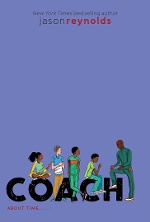 Horn Book Editor in Chief Elissa Gershowitz: Grownups/authority figures as kids can be mind-blowing to young readers. Did you always know you would want to revisit Coach's story from childhood?
Jason Reynolds: No, I always said that I would never expand on it only because to write Coach's story is to eliminate the other kids due to the fact that they weren't alive when Coach was a child. And because those other kids have become so beloved, it felt precarious to try to explore a world without them. But because of the space — it's been a long time — it feels like I could do it now and not feel weird about it. This story feels more like its own thing, but in the same world.
EG: Do you remember the first time you saw Jordans in real life OR the first time you saw Michael play?
JR: The first time I really became aware of Air Jordan sneakers, it was the Jordan 4s and 5s. We all knew Michael Jordan, but it was around 1990, for me at least, when the sneaker went from athletic wear to popular culture. And it was like, “Oh, this is something that you have to have.” The ad campaign, including the Spike Lee commercial, made the sneakers seem magical. So we're talking about the power of propaganda. Because we all started to wonder, “Is it the shoes?” And at the time, you have to remember, we're stepping into what's going to become a phenomenon, where Michael Jordan has his own theme song, “Be like Mike.” I think, from that point on, he (and the sneakers) became an object of a lot of our obsessions.
I saw him play, I don't remember exactly when, but I couldn't have been older than maybe nine or ten. I was with my dad, and I sat right on the tunnel. I remember seeing Michael Jordan run through and what it was like to hear the intro music for the Chicago Bulls. And when they say Michael Jordan's name how it didn't matter which team you were rooting for, when Jordan came out, almost everybody cheered as if he was on their team. It gave me goosebumps and still does to this day. As a matter of fact, that memory is so embedded in me that when, maybe three years ago, I was in Chicago and went to a Bulls game, I got just as excited when I heard the intro music, when the lights went out and I heard that sound, that synth come in, that dee-doo-dee-doo-dee. Gave me chills. It still has an effect on me and, arguably, a whole generation.
EG: For all the talking and words of wisdom throughout, so much is left unsaid, even at the end. Did you go in knowing what you'd keep back or did you edit as you went? And when in the process did those wise/hilarious/poignant "moral of the story" lines come in?
JR: If you've read the other books, you kind of know what happens. You know that basically Coach’s father relapses and doesn't stay clean. And, you know that Coach goes on to win a gold medal and his father steals the gold medal for drugs. So we — the readers — get all that already. We know what happens. For me, it wasn't that I don't know what happens next, it’s that I've already written it. No need to write it all again. If you read them all, it’s all there.
As for the “Moral of the story” chapter titles, I think it was just me poking fun at the way we all talk about these books and children’s books in general. We, as in adults, are always wondering what the books are trying to teach. And to me, they don’t need to teach anything. They may, as a byproduct of a complex story, offer perspective, but I’m careful about making sure my work is not chock full of morals. So this is me using Coach to poke at that a bit.
That being said, I think that we learn a lot from sport. I think there's a tragic dismissal of what sports teach us about life. If there's anything that any of these five books show us, it’s that the value of sports is that they can show what it is to be alive. Like, what does it mean to jump far knowing that you will land on your butt and that that's part of it? What does it mean to not put too much stock in what you have on? Rather, what’s in you? And what does it mean to have grace for people who are ill? Like, just because someone is an addict, doesn’t mean they’re bad. It means they’re sick. Coach's father is actually awesome in the book. He's a pretty cool guy. He’s just sick. What does it mean to have backups, right? We all need a backup coach. We all need a backup dad. We all need other adults in our lives just in case our fathers or our mothers exhibit humanity. I don’t necessarily think those are “morals to the story.” They're more like things I've learned as a young athlete, things I think we all could learn from sport or from art or from being musicians. Whatever we're doing in our lives, there is something to learn from it to be used in our every day.
Sponsored by


Added To Cart
RELATED


RECOMMENDED

Please register with us to continue reading.
ALREADY A SUBSCRIBER? LOG IN
We are currently offering this content for free. Sign up now to activate your personal profile, where you can save articles for future viewing.
ALREADY A SUBSCRIBER? LOG IN
Thank you for visiting.
We’ve noticed you are using a private browser. To continue, please log in or create an account.

Add Comment :-
Be the first reader to comment.
Comment Policy:
Comment should not be empty !!!