



2018 School Spending Survey Report

The Adventures of Beekle: The Unimaginary Friend
It’s Boxing Day, friends.
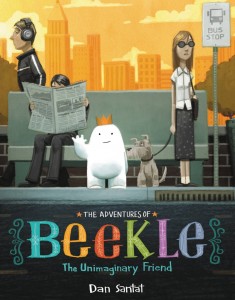 It’s Boxing Day, friends. Time to talk about a sweet gift of a book. Because I know many of you are sneaking a peek at your phones and computers in between holiday cleanup, entertaining relatives, and furtive trips to the mall, I will make it a quick review.
Beekle is an extremely adorable imaginary friend who resembles a marshmallow, only with a dear little crown and a chubby three-fingered hand (plus thumb). The problem with Beekle is that no one imagines him, so he goes off on a journey to find a friend.
I am going to say right off that the first time I met Beekle, I thought, “Kids will like this, and adults who evaluate books will find it a bit too sweet.” But as I read it over and over, I found the first part to be true: kids love Beekle; and the second part to be true and false. Yes, it’s very sweet, but it has enough of the “real world” to take away the cloying quality that often accompanies a book about making friends. And there are some clever bits, too.
- The endpapers show kids with their imaginary friends. Only Beekle is alone on the opening end pages. On the closing pages, Beekle and bespectacled Alice are together.
- When Alice meets Beekle for the first time, it’s clear that she has imagined him because she has a picture of him in the tree with the star-shaped leaves.
- I love the spread that says, “Until he reached the real world.” Santat’s use of grays is spectacular. The only speck of color is Beekle in his sailboat. I can’t wait to get my second graders to talk about this page!
- Santat holds firmly to Beekle’s view of the world for the whole book, but the page where Beekle is observing the adult world (where only adults are eating cake, walking grimly through a subway station, and sleeping on the subway) will make a lot of adults stop and pause.
- The bright and colorful world of the playground, where the children from the endpapers are playing with their imaginary friends, is perfectly placed in the book. I was feeling a little downhearted after all that gray and gloom.
- Santat is not afraid to make the child feel Beekle’s emotions, and I like that, though I am pretty sure some folks are going to find some of these images manipulative. I dare anyone to see Beekle in his tree, all alone with the falling leaves, and not feel something, especially when you read the words, “But no one came.” When Alice passes the picture to Beekle, is there anyone who will not feel the drama of the first moments of friendship?
- The choice of colors — grays for the friend-free world, browns and oranges for the first moments of friendship, and bright yellow circles bathing the comic-strip scenes where Alice names Beekle — all add to the emotional punch.
Will this book get any attention from the Caldecott committee? I don't know. I imagine it will be talked about and nominated for sure. And no matter what happens to it with the committee, young readers will love it. It has that “read it to me over and over” quality that parents and kids love.



RECOMMENDED

Please register with us to continue reading.
ALREADY A SUBSCRIBER? LOG IN
We are currently offering this content for free. Sign up now to activate your personal profile, where you can save articles for future viewing.
ALREADY A SUBSCRIBER? LOG IN
Thank you for visiting.
We’ve noticed you are using a private browser. To continue, please log in or create an account.

Add Comment :-
Comment Policy:
Comment should not be empty !!!
Linda
I like Beekle, and I'm seeing it pop up on lots of Mock Caldecott lists, but wonder if it's even the best book Dan Santat has illustrated this year. Has anyone seen Ninja Red Riding Hood? Or the re-illustrated Ricky Ricotta books?Posted : Jan 09, 2015 05:25
Sam Juliano
Santat's work in THE ADVENTURES OF BEEKLE evokes the surrealism of Japanese master Hayo Miyazaki, and children's literature icon Maurice Sendak. His art is imbued with the colors of the rainbow. It is bold, phantasmagorical, and astonishingly diverse. It is multi-textured, buoyant and wholly ebullient. It brings together elements of netherworld camaraderie, menace, loneliness and romance in a way that will spur the minds of children. It is funny and festive, with its glorious colorful design utterly exquisite. The big set pieces - the sea encounter with the dragon, the playground with merriment running rampant, and the tee, bathed in mahogany star-shaped leaves show an artist at the peak of his game, and this book is surely one of the most imaginative of the year in every sense. Excellent thoughts and analysis, and a terrific comment section!Posted : Dec 29, 2014 10:34
Minh
Robin, so glad to hear/read your thoughts on Beekle! As I said before, I don't know about the Caldecott, but Beekle is definitely the book I've found myself talking about/recommending/giving the most this year.Posted : Dec 29, 2014 06:30
Joanne Rubenstein
This book is certainly worn out from flipping back to look at the pages as the listeners in 30+ classes of kindergarten though sixth graders puzzled out the story. After the big aha moments, smaller ones occurred. The children wondered why Alice imagined Beekle imagining the boy as his friend. Some kids said that Alice felt it was unimaginable that she would be worthy of friendship, so she picked the nicest boy she knew to imagine as Beekle's friend. After many discussions on the nature of imaginary friends, many of the kids picked up the early picture of Beekle's longing reveals her own. This book was one of the most engaging books I read this year. I hope it gets a good strong look from the committee.Posted : Dec 27, 2014 12:20
Thom Barthelmess
I hope that the committee will look closely, for there is so much to see. I love the way the playground where all of the kids are playing with their imaginary friends mirrors Beekle's journey. This book offers so many careful details like that. Happy stuff.Posted : Dec 26, 2014 06:23