



2018 School Spending Survey Report

Find more great Horn Book content at these links:
Recommended books: reviews and themed booklists
App and e-book reviews
Movie reviews
Event news and recaps
Events calendar
Bellydance Evolution: Alice in Wonderland
You may be wondering, "What the heck does bellydancing have to do with children's books?" Having seen Bellydance Evolution's production of Alice in Wonderland on Wednesday night, I can assure you that the two do play together nicely when brought together in a thoughtful way.
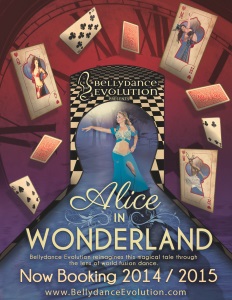 You may be wondering, "What the heck does bellydancing have to do with children's books?" Having seen Bellydance Evolution's production of Alice in Wonderland on Wednesday night, I can assure you that the two do play together nicely when brought together in a thoughtful way.
According to the mission statement on their site, dance company Bellydance Evolution "explores, celebrates, and re-imagines Middle Eastern dance for the 21st century. By fusing bellydance with dance forms more specific to the West, Bellydance Evolution takes you on a spectacular journey that will excite both mainstream audiences and bellydance enthusiasts." The company — led by director Jillina — tours its productions with a small core cast, filling out the ensemble cast by video-auditioning local dancers at each stop. The Boston performance on Wednesday, January 7th included two Boston dancers (one a troupemate and dear friend of mine) and several NYC dancers.
"Evolution," indeed: Alice in Wonderland was one of the most innovative and truly fusion dance productions I've ever seen. The dance forms showcased ranged from traditional Middle Eastern dance to contemporary styles including tribal fusion bellydance, hip-hop, and breakdance. Much of the score was symphonic-plus-electronic music, composed specifically for the show by Paul Dinletir; other pieces were classical Arabic, Arabic pop, or played live by drummer Issam Houshan. (The dancers also contributed drumming for a handful of scenes.)
The story line followed Disney's animated adaptation more than the original Carroll novel. All the various styles of music and dance were well integrated, both "bellydancey" and serving the narrative with a playfulness appropriate to the source materials. A quarrelsome duet by Tweedledee and Tweedledum paid homage to raqs al assaya, a folkloric cane dance, with the spinning of the dancers' canes reflecting that of the propellers on their caps — and, of course, every so often one twin using her cane to wallop the other. The virtuosic, breakdancing White Rabbit almost stole the show. He was pursued through the audience at various points by (bellydancing) Alice and the Queen of Hearts.
The use of (lots of) props and costumes was especially well considered and creative. In one scene, dancers with parasols milled around the stage, then came together into a phalanx-like formation with the parasols' tops facing the audience... suddenly creating the gigantic, grinning, floating face of the Cheshire Cat. In the croquet scene, dancers in pale pink, flapper-inspired costumes sported one beaked glove and one feather fan to represent the flamingos-cum-croquet mallets.
These are just a few of Alice in Wonderland's many inspired moments; see more in the trailer. I'm familiar with the story, but without a program I still occasionally found it difficult to follow the narrative and to identify minor characters — "Oh, she's the March Hare!" (It seems programs were available at a merch table downstairs from my ticketed seat.) The caliber of dancing and staging was so high that even when I was a bit confused I was having a blast. I'm an aficionado of both bellydancing and kids' books, but you needn't be a super-fan of either to enjoy this immensely entertaining production.
And if you're intrigued by the idea of bellydancing children's books, come on down to the Geeky Bellydance Show at Arisia sci-fi and fantasy convention on January 17th! I'll be performing as Sabriel from Garth Nix's Old Kingdom Chronicles; other dancers will pay tribute to Tolkien and Gaiman, as well as many other geek-culture icons.



RECOMMENDED

Please register with us to continue reading.
ALREADY A SUBSCRIBER? LOG IN
We are currently offering this content for free. Sign up now to activate your personal profile, where you can save articles for future viewing.
ALREADY A SUBSCRIBER? LOG IN
Thank you for visiting.
We’ve noticed you are using a private browser. To continue, please log in or create an account.

Add Comment :-
Be the first reader to comment.
Comment Policy:
Comment should not be empty !!!