


2018 School Spending Survey Report

Our Lake
Julie Hakim Azzam makes the case for Angie Kang's Our Lake: "Its quiet, tender, and profound brilliance is wholly desiring of Caldecott recognition."
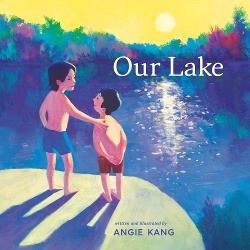 Angie Kang’s Our Lake is a quiet, luminous meditation on grief, memory, and the enduring presence of love. When I read Our Lake, I was unexpectedly transported back to the loss of my own father, to summers on a lake in upstate New York; a grief I thought I had made peace with bubbled back to the surface. The book didn’t reopen a wound, but it reminded me how deeply love and absence can coexist.
Let’s start with the book’s cover. Two brothers stand on a rock, gazing at each other, the lake shimmering beneath them. It could be a story of summer fun. But remove the dust jacket, and the scene shifts: the same lake, the same rock, but now the boys flank a man we presume is their father. The sun is lower, the shadows longer, the season changed. In this quiet contrast, Kang signals the emotional depth to come.
This visual shift from presence to absence sets the emotional tone for what follows and is part of what makes Our Lake “distinguished.” The book manages to tell a complicated, deeply emotional story of loss through a sequence of simple images about something seemingly unrelated: jumping into a lake from the top of a rock.
Kang’s illustrations make use of several powerful double-page spreads to tell a story of bodies moving through space, from land into water. And this book cleverly plays on the reflectiveness of water and the way it can play tricks on our perception.
Kang’s gouache illustrations use water not just as a setting, but as a metaphor for memory itself, reflective, refractive, and elusive. In one spread, the older brother dives low into the lake, his submerged body blurred and uncertain. Will he resurface? He does, “wet and triumphant.”
In a parallel moment, the father dives in, and the memory of his joy ripples through the younger boy, feeling “Father’s laugh leap...through my bones, making them bird-light.” The boy summons the courage to dive. Arms bent like bird wings, surrounded by swirling blues and greens, he becomes a bird in flight — transformed by memory and love.
As he hits the water, he sees a figure: his father? A reflection? A memory? The ambiguity is tender and profound. As he dives into the water, he “see[s] someone coming toward me, reaching for me as I reach for him.” The underwater figure has softer features, is fainter, barely there: he is present enough to be a comfort but absent enough to summon grief.
Turn the page, and there is another double-page spread, this time just a big splash of water. The only words on the page read, “...we meet in the middle.”
Our Lake stands out for its emotional subtlety, visual storytelling, and thematic depth. Kang uses the picture book form masterfully — the interplay of text and image, the pacing of spreads, and the symbolic use of water all contribute to a story that lingers long after the final page.
Grief is strange: it’s not linear and doesn’t follow a prescribed timeline. Reading Our Lake reminds us that love doesn’t end with loss, and that memory can be both painful and comforting. Kang’s book creates a space to feel, to remember, and to imagine reunion in the ripples of a lake. Its quiet, tender, and profound brilliance is wholly desiring of Caldecott recognition.
[Read The Horn Book Magazine review of Our Lake]


Added To Cart
RELATED


RECOMMENDED

Please register with us to continue reading.
ALREADY A SUBSCRIBER? LOG IN
We are currently offering this content for free. Sign up now to activate your personal profile, where you can save articles for future viewing.
ALREADY A SUBSCRIBER? LOG IN
Thank you for visiting.
We’ve noticed you are using a private browser. To continue, please log in or create an account.

Add Comment :-
Be the first reader to comment.
Comment Policy:
Comment should not be empty !!!