



2018 School Spending Survey Report

Find more great Horn Book content at these links:
Recommended books: reviews and themed booklists
App and e-book reviews
Movie reviews
Event news and recaps
Events calendar
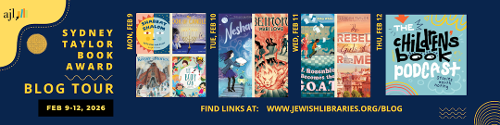
The Book of Candles: Sydney Taylor Book Award Blog Tour 2026
Welcome to our stop on the Sydney Taylor Book Award blog tour! Author Laurel Snyder and illustrator Leanne Hatch were kind enough to answer our questions about The Book of Candles: Eight Poems for Hanukkah (Clarion/HarperCollins, 4–8 years), which received a Sydney Taylor Honor in the Picture Book category.
Welcome to our stop on the Sydney Taylor Book Award blog tour! Author Laurel Snyder and illustrator Leanne Hatch were kind enough to answer our questions about The Book of Candles: Eight Poems for Hanukkah (Clarion/HarperCollins, 4–8 years), which received a Sydney Taylor Honor in the Picture Book category. This warm, atmospherically illustrated picture book–length collection offers a poem and a “thought” in prose for each night of Hanukkah, embracing the ways the holiday fits in with daily life.
Shoshana Flax: Laurel, why did you choose free verse for this topic?
Laurel Snyder: Oh, good question! And it has a bit of a long answer.
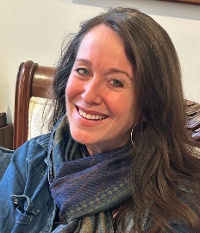 When I wrote the first draft of The Book of Candles, I was in a total slump. It was the fall of 2021, so I'’d just come through a year of distance learning, pandemic living, etc. I’d been struggling to write anything at all for months and months, and now finally, my kids were back at school, and I had time and space to write again, but I was still stuck.
Then, miraculously, my agent called and told me that a wonderful editor was interested in a Hanukkah picture book, if I had one. That felt like just the kind of prompt I’d been needing to jumpstart me, so I dug in and did my very best to write a Hanukkah picture book. I tried over and over, and produced four different manuscripts, if memory serves. (You can read one of them here). But none of them was quite what the editor was looking for, and I got pretty frustrated.
Then my wise agent said something like, “Just go write a poem! Stop thinking about it like a picture book. Poetry is your home base, so go there.”
And she was right.! Poetry is indeed my home base, so I sat down with my notebook and started scribbling, musing on light and darkness, and how the Hanukkah candles feel to me. But once I had a few spare lines on the page, I was struck by the usefulness of the number eight, and that made me think of the Wallace Stevens poem “Thirteen Ways of Looking at a Blackbird,” which gave me a form to use. So that’s what I did. My poem doesn'’t exactly follow the Stevens, but I used it as a sort of road map, made the book a sort of exercise in perspective and context.
Once I was done with a good draft, I wasn’t sure what to make of it. I liked what I’d written, but I wasn'’t sure that it was a picture book. In the end, it was! And I’m so pleased and grateful.
SF: How did the idea to accompany each poem with an informational/reflective “thought” come about?
LS: Well, when I was writing the poems, it felt important to me that this be a book that any family could appreciate. I wanted to establish low barriers to entry, in terms of Jewish observance or background. I liked thinking that a non-Jewish kid might, through reading this book, get a sense of what it feels like to celebrate the holiday. And that Jewish kids whose parents (like mine, and like me as a kid) sometimes forget to light the candles until late at night would see themselves in this book.
At the same time, I love learning about Jewish tradition myself. I think our heritage and laws and customs are beautiful and important. In fact, it’s my belief that Jewish knowledge is actually a huge equalizer, a way of including kids whose families may not always be traditionally observant. When I was little, growing up in an intermarried and non-traditional home, I always felt like I knew about a third of what I was supposed to know. As a result, I was very hungry for information, wherever I found it.
Also, just in general, I think kids like lore and details. Especially when they can collect them in digestible bites.
SF: Leanne, how did you decide on the color palette?
Leanne Hatch: I wanted the book to have a very wintry feel. When I referenced images of snowy evenings online as well as photos taken from my own neighborhood, I noticed this magical purple cast in all of them. The soft golden glow from the streetlamps and the candles complemented the twilight shades perfectly and really highlighted the warmth coming from inside the home. While creating the art, I could just imagine the way the fresh snow absorbs the street sounds, creating this intense sense of peace.
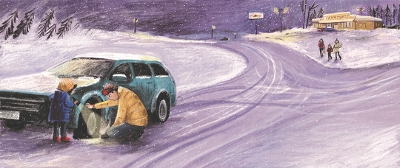 |
| The Book of Candles. Illustration (c) 2026 by Leanne Hatch. |
SF: What was important to you both to capture in the book’s tone and atmosphere?
LS: I’d love to know what Leanne has to say about that! I wanted the book to glow. I wanted it to feel both mundane and sacred. But I’m not a very visual thinker, and I didn’t have any sense for what the book should look like, really.
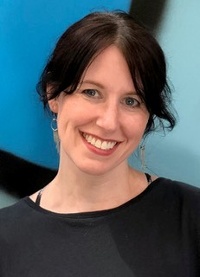 LH: I really wanted to capture the comfort and coziness of being with loved ones as they celebrate, whether being bundled up outside sharing donuts, having a casual pizza dinner on the floor, or listening to the chatter of extended family and friends coming together. I wanted readers to be able to experience the excitement of the holiday and the feelings, sights, sounds, and smells through the pictures.
SF: What were some Hanukkah details, either traditional or unusual, that were especially important to you to include? (We liked the detail of using the hair dryer to clean the hanukkiah!)
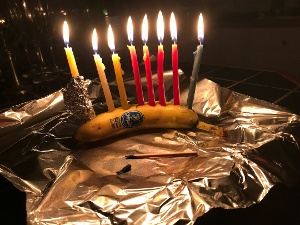
LS: Well, it was important to me that we include the bananukkiah! This is something my family developed about a decade ago (though I now see that people can buy ceramic ones online) as a result of winter travel to visit non-Jewish family members, and it'’s become a really sweet/silly tradition in our house. But as a metaphor, it feels so apt to me. We make do with what we have, try not to let best be the enemy of good. The light is what matters. You know?
 |
| Photo courtesy of Laurel Snyder. |
And in a similar way, the pizza was important to me. Around here, we often skip a formal dinner and have “Shabbacos” for dinner on Friday night, because it’s an easy meal to make, and allows me to be more fully present with my family and embrace the “rest” aspect” of Shabbat. The pizza in the book feels like that to me too. Imagine how little attention the family in the book would have been able to pay to their candles if they were trying to fry up latkes after running late.
Also, I guess, it was important to me to include a few bits of Hebrew, without translating them in the text. In part, this worked because these words and phrases were mysterious to the main character too. But also, one wonderful thing about a poem is that it wants us to enjoy language as sound and music, even when we don’t know what a word means.
LH: Of course, the traditional hanukkiah is a very important part of the story as the child learns the meaning of the candles, but the bananukkiah is such a fun detail. It shows how, with a little creativity, you can create a makeshift version that is just as meaningful as the real thing when you’re in a bind. I wanted to focus the art more on family and being together and less on decorations and gifts, which is what I think Laurel’s intent also was; however, you do get to see the family getting the decorations out at the beginning and putting them away at the end. No matter what holiday you’re celebrating, bringing out the decorations is always something to look forward to.
SF: Laurel, I love the point you make in your author’s note about how Hanukkah, more than some other Jewish holidays, exists within our daily lives. What are some ways Hanukkah has fit into daily life for you?
 |
| The author's son Lewis with all the hanukkiot the night his friends came over. |
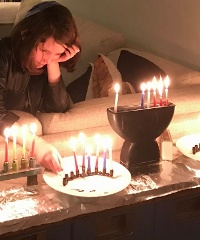
LS: One of my favorite things about Hanukkah is that it happens in the home. And as a result, uninvited guests often appear! I remember one especially sweet Hanukkah, years ago, when some neighbor kids stopped over mid-afternoon, to play with my sons. It began to get dark, and we still had a full house, so we dug out all the candles, gave each kid a hanukkiah to light, and ended up having a rollicking game of dreidel, which turned into board games and dinner. That’s something that happens much more easily when the holiday is celebrated in and around your regular life.
SF: Leanne, you also create textiles, which reminds me of Sydney Taylor–winning illustrator Paul O. Zelinsky’s All-of-a-Kind Family Hanukkah shirt (see the last question here). Have you ever combined your book illustration work with your textile work? If you created a pattern based on this book, what would it be?
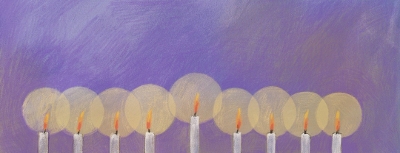
LH: I’ve never created textiles based on my book illustrations before, although some of my endpapers would make great fabric prints. And once I created a book inspired by a pattern that I’d made. I think the title page of The Book of Candles turned out particularly beautifully, so I could imagine it being made into a woven blanket or wall hanging.
 |
| The Book of Candles. Illustration (c) 2026 by Leanne Hatch. |
SF: What does the Sydney Taylor Honor mean to you?
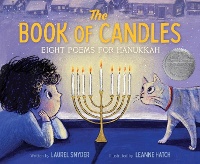 LS: You know, I was one of those dorky kids who went to the library and searched for books with the shiny stickers on them. And of course, there are so many wonderful books that don’t get a sticker! But it does feel really special to have a book recognized in this way. So much work and care are involved in the process, and it feels like such a gift of time and attention from these librarians I respect so much. But I guess the main thing is that I know there’s some kid out there who will see that shiny sticker and pick up the book, when they might have otherwise walked past it.
LH: I knew this was a special book when I first received Laurel’s manuscript and was already honored to be asked to illustrate it. This honor means so much to me. My goal was to create artwork that is engaging and authentic, and for this book to be recognized by the Association of Jewish Libraries and the STBA committee tells me that I did what I set out to do. It’s very encouraging. I hope The Book of Candles brings joy to young readers for years to come! Side note: I devoured Sydney Taylor’s All-of-a-Kind Family series when I was little. I especially loved Ella!
Visit the Association of Jewish Libraries website to see where the other gold and silver medalists will be interviewed over the next few days.


RECOMMENDED
Please register with us to continue reading.
ALREADY A SUBSCRIBER? LOG IN
We are currently offering this content for free. Sign up now to activate your personal profile, where you can save articles for future viewing.
ALREADY A SUBSCRIBER? LOG IN
Thank you for visiting.
We’ve noticed you are using a private browser. To continue, please log in or create an account.

Add Comment :-
Be the first reader to comment.
Comment Policy:
Comment should not be empty !!!