


2018 School Spending Survey Report
Reviews of the 2016 Newbery Award winners
Winner:
Last Stop on Market Street
by Matt de la Peña; illus.
Winner:

 Last Stop on Market Street
 by Matt de la Peña; illus. by Christian Robinson
Primary Putnam 32 pp.
1/15 978-0-399-25774-2 $16.99
CJ, a young black boy, has a flurry of questions for his grandmother one rainy day: “How come we gotta wait for the bus in all this wet?” “How come we don’t got a car?” “How come we always gotta go here after church?” Only at book’s end do readers learn that “here” is a soup kitchen in a hardscrabble part of town (“How come it’s always so dirty over here?”) where CJ and Nana work every Sunday. Nana has a bottomless supply of look-on-the-sunny-side answers (“Sometimes when you’re surrounded by dirt, CJ, you’re a better witness for what’s beautiful”), but she isn’t dispensing bromides; the economical, exquisitely composed collage illustrations showing the pair in a glamour-free urban setting forbid a glib reading. CJ and Nana develop a fellowship with the bus driver, Mr. Dennis, and with the other passengers (a blind man and his dog; an old woman holding a jar of butterflies; a man playing the guitar), and it takes just a gentle nudge from Nana for CJ to unhesitatingly drop the coin Mr. Dennis gave him into the musician’s hat. De la Peña and Robinson here are carrying on for Ezra Jack Keats in spirit and visual style. This quietly remarkable book will likely inspire questions of a sort less practical-minded than CJ’s; it will also have some adult readers reaching for a tissue. NELL BERAM
From the March/April 2015 issue of The Horn Book Magazine.
Honor Books:
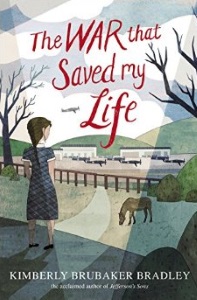 The War That Saved My Life
by Kimberly Brubaker Bradley
Intermediate Dial 316 pp.
1/15 978-0-8037-4081-5 $16.99 g
e-book ed. 978-1-101-63780-7 $10.99
Ten-year-old Ada has suffered almost unimaginable deprivation and abuse due to an unrepaired clubfoot: she has never been outside her squalid London flat; she’s hit, underfed, belittled, and locked inside a dark cupboard whenever she disobeys her cruel, ignorant mam. Ada can’t walk (scooting around on all fours; shades of L’Enfant sauvage), can’t read or write, and relies on her younger brother Jamie entirely for her limited exposure to the world. So when — with World War II imminent and bombs expected to fall on London — Jamie is slated to be evacuated to the countryside, Ada determines to escape the prison of her life and go with him. The siblings are placed with a reluctant guardian, Miss Susan Smith, a self-declared “not a nice person” mourning the death of the woman she lived with (and clearly loved). The remainder of the novel is an involving, poignant, nuanced portrait of healing and rebuilding, focusing on Ada but encompassing Susan’s recovery as well. The plot at times stretches credulity — spunky Ada nabs a Nazi spy — but the emotional content feels completely true, especially in the recognition of how deeply Ada has been damaged and just how far her journey will be to both physical and mental health. This is a feel-good story, but an earned one; and though there are echoes of such classics as Magorian’s Goodnight, Mr. Tom (rev. 6/82) and Bauden’s Carrie’s War (rev. 6/73), this is distinct and powerful in its own right. MARTHA V. PARRAVANO
From the January/February 2015 issue of The Horn Book Magazine.
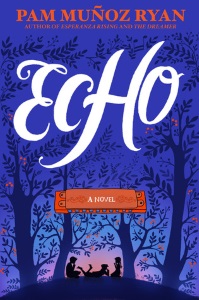 Echo
Echoby Pam Muñoz Ryan; illus. by Dinara Mirtalipova
Intermediate, Middle School Scholastic 590 pp.
2/15 978-0-439-87402-1 $19.99 g
e-book ed. 978-0-545-57650-5 $19.99
Lost in the forest, a boy is mesmerized by a story about three princesses trapped under a witch’s spell until they save a life through a special harmonica. This story within a story is prelude to a set of three more: young Friedrich, working in a harmonica factory in 1933 Germany, watches as his sister joins the Hitler Youth and his father endangers the family by speaking out against the Nazis, sending Friedrich on a desperate plan of rescue. Two orphaned brothers with musical talent in 1935 Pennsylvania struggle to stay together, resting their hopes on a rich widow and a traveling harmonica band. In 1942 California, Ivy Lopez’s family takes over the farm of an interned Japanese family, where Ivy finds herself for the first time in a segregated school. She strives to bring three families together — white, Latino, and Japanese American — who all have sons in the armed forces. Ryan fluidly builds setting, character, and drama for each story and then leaves each on a knife’s edge; the expected yet compelling epilogue winds all stories together, on one splendid postwar night at Carnegie Hall. The harmonica and the love of music serve as the unifying threads for these tales of young people who save the lives and spirits of their families and neighbors, each in a time marked by bigotry and violence. It’s an ambitious device, but Ryan’s storytelling prowess and vivid voice lead readers expertly through a hefty tome illuminated by layers of history, adventure, and the seemingly magical but ultimately very human spirit of music. NINA LINDSAY
From the March/April 2015 issue of The Horn Book Magazine.
 Roller Girl
by Victoria Jamieson; illus. by the author
Intermediate, Middle School Dial 240 pp.
3/15 978-0-8037-4016-7 $12.99
When Astrid’s best friend Nicole starts harping on ballet, fashion, and dating, Astrid is left behind (read: not interested). She’s behind on the roller derby track, too, where she’s signed up for summer boot camp even though she can’t do a crossover to save her life or skate five seconds without disaster. Practice makes better, and Astrid’s skills and cred build with every bruise and scrape. Coaches, teammates, and celebrity roller Rainbow Bite cheer Astrid on as she faces the challenges of derby as well as tweendom — including mean-girl moments, changing friendships, and the worst of the worst: clothes shopping with Mom. When the time comes for her big end-of-summer bout, “Asteroid” is blue-haired, brimming with confidence, and ready to roll. This graphic novel also serves as a surprisingly informative derby primer. Jamieson’s dialogue captures coming-of-age within a subculture so authentically that readers will forgive the art’s occasional inconsistencies in draftsmanship. The comics format is used resourcefully, with the artist occasionally placing Astrid before exaggerated, out-of-this-world backdrops (a desert on a long, hot walk home, for instance) and pausing action to address readers directly. Tweens and young teens will identify with Astrid’s journey to find her unique voice in the world and derby name on the track. Have it at the ready for Telgemeier fans racing to find something new. ELISA GALL
From the March/April 2015 issue of The Horn Book Magazine.
For more, click on the tag ALA Midwinter 2016.


Added To Cart
RELATED


RECOMMENDED

Please register with us to continue reading.
ALREADY A SUBSCRIBER? LOG IN
We are currently offering this content for free. Sign up now to activate your personal profile, where you can save articles for future viewing.
ALREADY A SUBSCRIBER? LOG IN
Thank you for visiting.
We’ve noticed you are using a private browser. To continue, please log in or create an account.

Add Comment :-
Be the first reader to comment.
Comment Policy:
Comment should not be empty !!!