


2018 School Spending Survey Report

Broken
Dean Schneider champions X. Fang's Broken. Will the Caldecott committee?
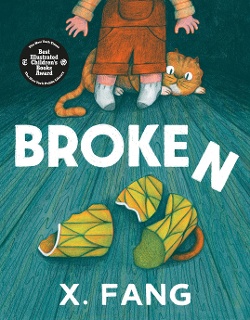 “Let me tell you the story of the day I broke Ama’s cup.” So begins Mei Mei’s emotional odyssey through fear, guilt, confrontation with a menacing beast (cat), a dark underworld (closet), a River Styx (tears), and a return to the love of her grandmother. (I know I am overdoing the literary allusions here, but it’s fun.)
I see Broken as a classic picture book, with enough text to tell a substantial story and lively illustrations (graphite pencil on paper colored digitally) that interplay with the text. The dust jacket illustration is one of the best of the year. A pleasing greenish-blue palette for the background, a wide-eyed cat looking at a broken cup, and the title cleverly broken too. The front endpapers take the reader back in time to a sleeping cat and a pretty cup still intact. The title page emphasizes the family — a young girl in one picture frame, a grandmother holding a baby in the second frame. Turn the page and see a double-page spread that shows a girl named Mei Mei. She’s at Ama’s house and is bored so she decides to sneak up on her cat, Mimi — by hiding behind a cabinet, wearing a lampshade, peeking through a plant and then a coat rack, until she’s right behind that cat’s chair. There are words on the spread, but I’m not sure they’re needed; the illustrations tell the story.
When Mei Mei jumps out and yells “BOO!” at Mimi, the girl bumps the table, the cup flies into the air, and it takes the whole next page for the cup to cross the gutter, continue rising, then follow a trajectory laid out by large black dashes, before crashing on the floor. Again, the illustrations tell the story, but the text makes such fun for reading aloud, adding to the drama of the moment: “Ama’s cup flew up, then down, down, down, until CRASH!” Each word after “up” appears on a separate line, as if the action is happening in slow motion. Mei Mei tells us, “I felt so bad. I didn’t know what to do!” The illustration doesn’t just illustrate Mei Mei running, it shows her bewildered, mortified expression as she skedaddles, and we begin to realize how good Fang is at showing facial expressions and gestures as Mei Mei ponders her fate in a triptych of images of her grandmother’s possible reactions to the broken cup: getting mad at Mei Mei, yelling at her, maybe even kicking her out!
But Ama says, “Mimi, you naughty cat...You broke my cup!” Mei Mei begins to feel guilty, especially when she thinks, “Mimi stared at me. Mimi knew the truth. Mimi was taking the blame.” Here the text is essential. The interior monologue shows what Mei Mei is thinking, feeling so guilty she can’t eat her cake. But then the illustrations take over as Mimi stares at Mei Mei, and as Mei Mei’s guilt grows, so does the size of Mimi’s head, growing and growing, page by page, until the head is too big for the page, expanding into a full-bleed illustration. What a clever visual way of showing the growing guilt Mei Mei is feeling. She thinks, “I couldn’t take it anymore!” and blurts out, “NO! NO! NO!” Then she runs out of the room and hides in the closet. The illustration shows Ama’s startled expression, no words needed. Fang keeps the story tight by returning to Mei Mei’s original fear of Ama’s reaction, except that now “Ama wasn’t angry. She didn’t yell. She didn’t kick me out of her house. She just hugged me...” Ama and Mei Mei repair the cup and have cake and tea, while Mimi sleeps on the couch. All is well. But check out the back endpapers, with Mimi, whose stares caused Mei Mei such anguish, giving that broken cup a swat off the table...If the cup breaks again, I’m not sure that Mimi the cat will suffer the same pangs of remorse that Mei Mei did, but then who knows what goes on in the mind of a cat?
Broken certainly satisfies the five criteria on page 12 of the Caldecott Manual, but I especially like how it satisfies the fifth: “Excellence of presentation in recognition of a child audience.” Every child will identify with Mei Mei’s situation, running from the scene of the crime and ultimately finding comfort in a grandmother’s hug.
If I were on the committee, I would champion Broken, and I know from experience that a champion, someone who loves a book and knows it so well he can make a cogent argument for it, makes a big difference. But I would have to add to the discussion that the resolution of the story seems abrupt to me. Right after the line, “She just hugged me,” is a page turn and the very next line “My ama is a fixer!” And three pages later, “The End.” An abrupt transition and a quick conclusion. If the committee agreed with me on this, would it be a fatal flaw? I would say no; I wouldn’t champion a book with a fatal flaw. This is a wonderful book, and I would be perfectly happy to see a sticker on it, gold or silver, though I wonder where it would be placed on the dust jacket!
[Read The Horn Book Magazine review of Broken]


Added To Cart
RELATED


RECOMMENDED

Please register with us to continue reading.
ALREADY A SUBSCRIBER? LOG IN
We are currently offering this content for free. Sign up now to activate your personal profile, where you can save articles for future viewing.
ALREADY A SUBSCRIBER? LOG IN
Thank you for visiting.
We’ve noticed you are using a private browser. To continue, please log in or create an account.

Add Comment :-
Be the first reader to comment.
Comment Policy:
Comment should not be empty !!!