



2018 School Spending Survey Report

Calling CaldeNott
For years I’ve been running a Mock CaldeNott, in various contexts, applying the Caldecott terms and criteria to books ineligible for the Medal itself because their illustrator is not American.
So, when I was asked to write about international picture books for Calling Caldecott, I immediately started thinking about exceptional books published in 2017 that might help focus our attention on some of the stickier wickets of Caldecott Medal selection.
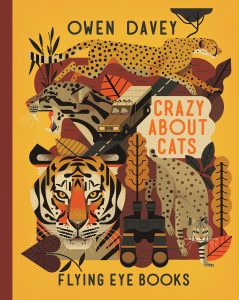 The first wicket I’d like to investigate is the question of what actually constitutes a picture book. According to the Caldecott Terms and Criteria, “A ‘picture book for children’ as distinguished from other books with illustrations, is one that essentially provides the child with a visual experience. A picture book has a collective unity of story-line, theme, or concept, developed through the series of pictures of which the book is comprised.” To poke at this question, let’s look at Crazy about Cats by Owen Davey, published by Flying Eye Books, the latest in his series of informational animal books. There is much to admire in Davey’s content, from the structural arrangement of his well-researched information to the punny section headings ("Eat, Prey, Hunt"; "Pride and Predators"). But the images here are the real star, delivering at least as much information as the words, in exciting ways. The two-page spread called "Hide and Seek" subtly employs color and pattern to demonstrate exactly how camouflage works, with different cats in an amalgamation of different habitats. And the spread on scale — with eight cats lined up beside one another, behind a woman, each identified on a line demarking the tip of the nose — beautifully and clearly makes its point with almost no text at all. I know some would argue that without a narrative structure an informational book like this is not really a picture book. But, for me, these images are undeniably “a series of pictures” and their excellence is impressive. That they recall the elegant mid-century geometry and grace of Charley Harper is simply a bonus.
 Another informational book worthy of our attention is Taro Gomi’s I Know Numbers, originally published in Japan (in 1985) and published in the United States this year by Chronicle Books. Why a concept book hasn’t won the Sibert is a question for another forum, but this exploration of simple numeracy ticks lots of Caldecott criteria boxes. The structure is simple enough: a series of spreads showcases all of the different ways numbers make a difference in our everyday lives, from measurements to addresses, sizes to scores. In some cases situations seem to have been Americanized (prices at a vegetable market are calculated in dollars, by the pound), but by and large the numbers function in Japan in exactly the way we’re accustomed to. Gomi’s saturated watercolors echo the simplicity of the concept, with straightforward compositions (that make the most of the wide landscape orientation), elegant organization, and lots of white space for thinking. Plus, in almost every case, a child is actively engaged in the counting, whether dialing a telephone or calculating sums at a chalkboard. Even the endpapers, with those at the front featuring numerals 1 through 10 on an emerald green ground and those at the back featuring 1-100, subtly signal progress.
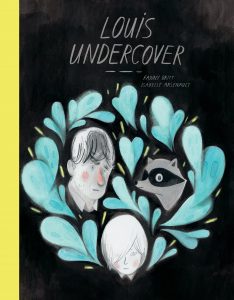 Like nonfiction, graphic novels may be subjected to the same “is this really a picture book for children?” scrutiny. But to discount them would be to miss Isabelle Arsenault’s stunning work illustrating Fanny Britt’s text in Louis Undercover, published by Groundwood Books, translated from the original French. The book chronicles young Louis’s life, his family cracked open by his father’s alcoholism; his heart attached to Billie, the new girl at school; and his spirit connected to Michael Jackson, the wounded raccoon he finds in the brush. These circumstances converge in the messy ways we’d expect them to, and Arsenault’s smudgy charcoal work, embellished with spots of transparent color, expresses their complexity and fragility. A couple of gut-punching spreads, detailing his father’s fall(s) from grace, pack a real wallop, but there are a thousand tender moments of sweetness, too, and we should judge the book not by the difficulty of the things it has to say but by the glory with which it says them. And it’s hard to find any fault with Arsenault’s accomplished illustration in that regard.
 Another of the criteria that is harder to nail down is “Excellence of presentation in recognition of a child audience.” That can mean very different things to different people. Does that recognition take the form of accommodation, making complex concepts more easily accessible? Is it about respect, acknowledging children’s general intellectual prowess and superior comfort with ambiguity? When We Were Alone, illustrated by Cree-Métis artist Julie Flett, written by Norway House Cree member David A. Robertson, published by Highwater Press, challenges its young audience with its unflinching look at the history of First Nation children forced into residential schools in Canada. A little girl asks her grandmother a series of questions and her grandmother replies with stories of her boarding school childhood. She wears her hair long now, because her hair was forcibly cut as a child. “They didn’t like that we were proud.” She speaks Cree, because as a child her Native language was forbidden. The girl’s kókom offers no details about her transition to the school, referring to it each time as “the school I went to, far away from home,” but the images subtly and powerfully communicate the violence and cruelty of the program. The spread showing the haircut positions the child on a chair, off to the side of the frame, small and bowed, her back to us, while a large woman chops. The composition reflects her alienation and isolation with graphic brutality. Each response to one of the girl’s questions includes both the hurtful imposition of the cultural erasure, followed by a moment of resilience, when the children rolled in autumn leaves to return color to their clothes, or separated siblings held hands in a wintry field, to connect, momentarily. Flett makes the most of these juxtapositions, reinforcing the hard cold of the school setting and the vibrant color of home.
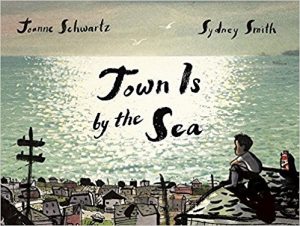 The last element of Caldecott selection I’d like to examine is not codified in the terms and criteria, but in the process itself. The medal is chosen by committee, with 15 individuals coming to consensus, and that kind of agreement cannot happen without each member working hard to set aside personal responses to books to focus on more professional assessments. It’s the hardest part of the process, without question, and perhaps the most illuminating, as it allows for each of us to see and appreciate things we can’t find on our own. But it can require letting go, and the book I’d struggle to let go of, this year, is Town Is by the Sea by Joanne Schwartz, illustrated by Sydney Smith, published by Groundwood Books. This quiet, melancholic look at the life of a boy growing up in a Cape Breton mining town expresses both the joys of a quiet seaside town and the foreboding of a life underground. Smith’s loose, luminous watercolor paintings alternate scenes along the shore, washed in light, with overwhelming scratchy black scenes underground. The pictures here are everything, establishing setting, tone, pace. They also communicate the deepest truths of the story. The book ends at the close of day, when the darkness overtakes the light. The boy contemplates his own eventual life underground and the final spread echoes the transition, blending the brilliance of the town with the black beneath. Everything, I tell you.
These are but a few of the extraordinary international picture books I’ve come across this year. What are some of your favorites?



RECOMMENDED

Please register with us to continue reading.
ALREADY A SUBSCRIBER? LOG IN
We are currently offering this content for free. Sign up now to activate your personal profile, where you can save articles for future viewing.
ALREADY A SUBSCRIBER? LOG IN
Thank you for visiting.
We’ve noticed you are using a private browser. To continue, please log in or create an account.

Add Comment :-
Comment Policy:
Comment should not be empty !!!
Susan Dailey
Thom, thanks so much for your insights! I create presentations for the Mock Caldecotts I conduct each year. I shared your comments about the winners being selected by committee and what that means for individual's favorites. I also ask the attendees to fill out a "Personal Choice Survey" this year. I asked what book they would LIKE to win the Caldecott, what book they thought SHOULD win and what book they thought WOULD win.Posted : Jan 28, 2018 02:09
Aaron Becker
Town is By the Sea and On A Magical Do-Nothing-Day were my favorite picture books of 2017, and perhaps the best picture books I've seen in a long, long time. It's a shame that neither are eligible for the award, but if memory serves me, they did both get listed in the NYTimes Best Illustrated.Posted : Dec 30, 2017 10:02
Sam Juliano
Thom, I feel I must add another comment to this truly motivational post, having now done some further investigation. My wallet took another hit, but heck there are some titles one simply must own. Ha! A few more treasures here on the international scene methinks: A Walk in the Forest (Maria Dek) Poland My Dog Mouse (Eva Lindstrom) Sweden Only in My Hometown (Arnakuluk Vuriisan) Lappland, Canada Walk With Me (Jairo Buitrago/Rafael Yockteng) Columbia The Buitrago/Yockteng collaboration has produced yet another masterpiece by the pair who are arguably the greatest in the world. (Really adored TWO WHITE RABBITS). Ms. Lindstrom's beautiful book captivated my classes, and they voted it their favorite book of the week. Spare and sublime. The Lappland book is quite unique and artful, and Ms. Dek's Polish work is a masterpiece.Posted : Dec 06, 2017 04:02
Molly Watkins
Thank you very much for this post. I recently added Town Is by the Sea and When We Were Alone to my collection, but I've been struggling with how to present them to 7-9 year olds. The content is so moving, so important. I'll put them on my desk again and start thinking! Perhaps I'll start with a Visual Thinking Strategies lesson.Posted : Nov 27, 2017 11:50
Laura Harrison
I truly love Hortense and the Shadow by Natalia and Lauren O'Hara. A fun and interesting story with some of the best illustrations I have ever seen. It's fabulous!Posted : Nov 19, 2017 12:12