



2018 School Spending Survey Report

Mock Caldecott Catch-up, part 1
In a recent post we asked for your local school and library Mock Caldecott lists, and several titles came up that we wanted to add to the Calling Caldecott conversation.
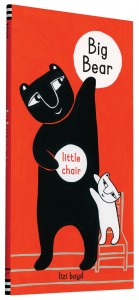 Boyd's Big Bear little chair was named a NYT Best Illustrated book this year, along with others we're discussing this fall (A Fine Dessert; The Skunk; Tricky Vic; Leo; Funny Bones). Here's what the NYT said about Big Bear little chair: "This ingenious take on the 'opposites' book shows the youngest children that big, little and tiny are all in how you look at things. Using just black, white and a velvety gray, with a bit of red, Boyd’s delightful cut paper compositions juxtapose the large and the small in unexpected ways: a 'big meadow' is big because it’s full of small flowers; a 'big seal' towers over a 'tiny castle' that’s made of sand."
It is an opposites book, but it also encompasses the concept of relative size (big, little, and tiny). So it's clever-clever. And as you can see from the cover, it has a striking shape and an equally striking palette (red, black, white, and gray) with the promise of strong, eye-catching compositions. Each individual page is striking. The art is stylish; so is the book design. The juxtapositions (of large and small) are indeed unexpected. The gouache illustrations are sometimes delicate; sometimes bold; always beautifully composed. It's easy to see why the judges chose this book for the best illustrated list.
But who is the intended audience? The interspersed bears' story (in which two bears eventually get matched up with her appropriate chair —and with each other) is clearly for very young readers, but the "opposites" in the intervening pages are sometimes quite sophisticated in concept. See Big Elephant/little trick. "Trick"? That's an idea, not an object — different from and more advanced than most of the other pairs (Big Moon/little star; etc.). Visually, the use of red is inconsistent. Red almost always spotlights the "little" item on each page, but not always. Crucially, it isn't used for the first example, where we see a "Big Plant" and a "little cocoon." On this page the red highlights berries on the plant, not the cocoon. For the rest of the first section, though, and into the next section, red will be used for the "little" item on each page. This wouldn't be a problem in a book for sophisticated readers, but — see the young-ish interspersed bear-chair story...
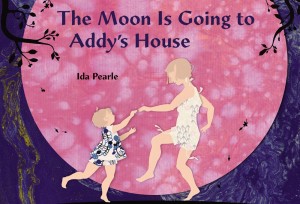 The Moon Is Going to Addy's House is not your typical, sleepy looking-at-the-moon story. This is, rather, an ecstatic, intoxicating experience: a bacchanal for the picture-book set. In tour-de-force cut-paper collages, Pearle uses a controlled riot of vivid colors and patterns to evoke intensity and emotion. The text is much less emotional; all the feeling here is in the illustrations.
The Kirkus review said that the book is "exquisite, electrifying, soothing, and soporific, brilliant in color"; that the landscapes "throb with vitality." The use of bright pink and deep purple is unusual and intense. Some of the double-page spreads take one's breath away with their sheer beauty: such as the one where a striated purple sky and pink moon above and their reflection below (in a body of water) are separated by a thin stretch of dark-brown road. Other illustrations capture that universal human sense of connection with the moon: such as the one in which the girl sees the moon reflected in the car's rear-view mirror and feels as if she could catch it in her hand (echoes of Thurber's Many Moons?).
But in some illustrations, it's difficult to know where to look; and although the way the moon sometimes seems to jump around in the sky may be realistic, it can be disconcerting. The book's horizontal shape sometimes works in its favor (as in the gorgeous spread mentioned above) and sometimes to its disadvantage: see the "Look way up high / and way down low" spread, where the "high" and "low" aren't that different.
So. Will the Real Committee have these two (very beautiful) books on its radar? Do you?


RECOMMENDED

Please register with us to continue reading.
ALREADY A SUBSCRIBER? LOG IN
We are currently offering this content for free. Sign up now to activate your personal profile, where you can save articles for future viewing.
ALREADY A SUBSCRIBER? LOG IN
Thank you for visiting.
We’ve noticed you are using a private browser. To continue, please log in or create an account.

Add Comment :-
Comment Policy:
Comment should not be empty !!!
TK
Count me among the intoxicated by THE MOON. As for the moon changing positions, I took that as completely from the child's perspective rather than astronomically accurate.Posted : Dec 15, 2015 02:42
Susan Dailey
In regard to "The Moon Is Going to Addy's House," the illustrations are beautiful and intriguing, as stated above. However, I questioned the location of the moon. I can't say I've spent a lot of time studying the moon, but does it really move around the sky as it does in the book? After being enchanted by the visuals, the moon's position was my second thought. I also find it interested that the paper cover has the title and author across the moon while on the cloth cover the words are replaced by tree branches. This doesn't seem logical, but I miss the words.Posted : Dec 08, 2015 06:51
Sam Bloom
So, speaking of mocks (and Addy), we had our Mock Caldecott yesterday! Gratia Banta (of the Lane Libraries north of Cincinnati, two-time Caldecott committee member) presided over small group discussion of 25 books, which I can name if you want me to at some point in the future (I'm not at my work computer so I forget a bunch of them), but here were the results: WINNER: If you plant a seed, by Kadir Nelson HONORS: The Night World, by Mordicai Gerstein; The Moon Is Going to Addy's House; and The Bear Ate Your Sandwich, by Julia Sarcone-Roach The discussion of Addy at my table was... interesting. We wondered if maybe there was some surreal, tired/sleepy psychedelia ala the Piper at the Gates of Dawn chapter from Wind in the Willows-type stuff going on. Anyway, the majority of the group was intoxicated by the swirling colors, the motion inherent in the illustrations, the magnificence of the cut-paper collage. (Really, just the fact that Pearle was able to achieve what she achieves with this particular medium. It's pretty stunning when you think about it.) Anyway, it's not my favorite, but I certainly appreciate what she's accomplished with this one.Posted : Dec 04, 2015 02:49
Sam Bloom
I've only taken a cursory look at Big Bear Little Chair, so I don't know what I think. I was definitely struck by it, and liked it more than any of Boyd's previous books (I know, I know, the Real Committee will have their wrists slapped should they make reference to non-2015 books... but I'm just sayin') As for Moon, I'm a big fan. But the concerns you've brought up, Martha, are worth noting. I want to take another look at the book before I speak to them... more later.Posted : Nov 30, 2015 04:49
Sam Juliano
Without any question. Ms. Perle's book is a sublime masterpiece that has even received glowing praise by none other than film director Martin Scorsese. Scorsese, a visual storyteller extraordinaire, knows what it is like to bring a visceral children’s picture book to the cinema, and asserts the aesthetic kinship between page and screen when it comes to elements like color, texture and movement. Acclaimed award-winning illustrator Brian Selznick, who wrote the book upon which Scorsese’s Hugo was based, is attuned to Brown’s 1983 work by opining that Pearle’s “cut-paper collages dance and play and come to life” in an equally spectacular response to the book. Yet Brown’s specter is one that unflinchingly shows the side in us we’re afraid to confront, whereas Pearle’s celestial spheroid is as reassuring as a guardian angel, one that engenders both glowing cognizance and a measure of celebratory veneration. Whereas the poet Alfred Noyes once wrote “the moon is a ghostly galleon tossed upon cloudy seas” its role in The Moon Is Going to Addy’s House is far more thematically benign, one that recalls the friendship between the young French boy in Albert Lamorisee’s The Red Balloon, who evinces a human connection to a supposed lifeless entity. The metaphysical tale is launched as Addy and her younger sister run towards her waiting father who awaits his darlings while kneeling with arms outstretched next to his parked automobile. The swirling expressionist art includes a grayish obscured moon that only seems to want to make its presence unobtrusively. A phantasmagoria of clothing, dogs on leashes and textured murals usher off the family who can see the moon above a building and then under a bridge where it is just as visible...... Later, a mountain gets in the way – “Where did it go?” It is then that Addy makes claim to having discovered the moon’s real intent – it is going to her house! This part of the book contains come of the most breathtaking picture book imagery you are likely to see. First up is the final, revelation: “Oh, now I know,” as the car proceeds over a rock formation, visualized in a bath of pink, blue and purple. The moon is then seen in a pinkish orange, by then having taken over the visual scheme as the girls take their baths. To the poetic passage “It waited to light up my nighttime dance” Pearle then showcases her piece de resistance – a grand pinkish-orange sphere, which serves as a ravishing burst of illumination for Addy to strut her stuff. This is followed by another stunning tapestry of the moon in the yard that recalls Van Gogh’s Starry Night, though cinema fans will note the brush stroke turbulence suggests something out of Von Trier. Pearle uncannily speaks the language of children with her animated images, fluorescent colors and richly designed simplifications. The astounding bridge double spread with the embroidered boat sails bring the scene to life, while still feeding the embers of imagination, and all the possibilities one can conjure up while under the spell of one of nature’s most constant tenants, one who will never balk at playing referee when the mind’s eye is at its most acute. The Moon Is Going to Addy’s House is one of the most extraordinarily sublime picture books of the year, and a textbook example of how sparing poetic text can be perfectly wed to some of the most brilliant and suggestive imagery the form can offer up. Pearle has created an irrefutable masterpiece, and it seems like a Caldecott acknowledgement is at least as likely as spotting the moon in a cloudless sky. As to BIG BEAR LITTLE CHAIR I am still gathering my thoughts together, but I do heartily support the idea that it well belongs in any Caldecott discussion. It is a remarkable book, and a huge classroom favorite. Boyd once again demonstrates why she one of the most creative people out there.Posted : Nov 27, 2015 06:10