



2018 School Spending Survey Report

Come Home, Angus
I have never been on a Caldecott committee (and nor will I ever be, since I write publicly at more than one place throughout the year about picture books), and I have a deep reverence for the work these committees do annually.
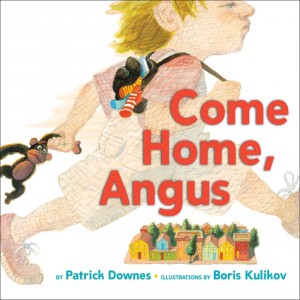 I have never been on a Caldecott committee (and nor will I ever be, since I write publicly at more than one place throughout the year about picture books), and I have a deep reverence for the work these committees do annually. But I admit to a sort of hushed reverence, because it's all rather cryptic to me. Even though the criteria are laid out for everyone to see and we know the committee members are devoted to these guidelines, I've never been in the room where the big decisions happen. For that reason, I always imagine a Great and Thrilling Mystery swirling about the whole thing. I can't help it.
However, I would like to think that Patrick Downes's Come Home, Angus, illustrated by Boris Kulikov, could be a serious contender this year, because it is a book that does a handful of things I would think the committee likes to see. (See my word acrobatics here — a lot of "I would like to think"s? It's that mystery again.)
If you haven’t seen the book, it tells the story of a boy who wakes up angry, gives his mother some serious what-for, and storms out of the house with his backpack. I wrote about this book over at Kirkus earlier this year, and I talked about how it's striking that the mother in this book doesn't let the boy speak rudely to her without reprimanding him. "That’s no way to behave. You’ll have to apologize," she tells him. She also says (in a way that manages to avoid coming across as didactic): "In this house, being angry doesn’t let you be rude." Are we going to see an increase in picture books with parental responses like this, while we simultaneously see in the culture-at-large more articles that question helicopter parenting? Will we see a departure from the anything-goes, unconditional-love-trumps-the-harried-parent themes of books like No, David!? That, sociologically speaking, is something noteworthy to me about Come Home, Angus — though, to be clear, the mother follows the boy on his angry stomp into the city, even if he doesn't realize it till the end, and is there to greet him with a hug. So, a bit helicopter-y. (As I wrote at Kirkus, it's unconditional love for the win after all, but at least the mother attempts to remind her child what it means to be courteous in this world.)
But the illustrations! Boris Kulikov — as I understand it, he is eligible for this award because he lives in the United States, though he was born and raised in Russia — plays with scale and color in effective ways all throughout this book. When we first meet Angus and read that he "woke up angry," this small boy is over-the-top large, and he overpowers his twin bed. His tousled, bed-head hair leaves spiky shadows on the wall behind him, as if he physically is a monster (and not just feeling like one). Everything in his room is also upside down; anger can make your world feel topsy-turvy.
Over the next few full-bleed spreads, he stomps his way angrily over white space, Kulikov letting the boy's very bad mood take the stage. If you look closely at these early spreads, you'll see Kulikov paints the boy with a type of large crosshatching, as if he is one big eggshell about to crack. The boy gets paler as his frustration grows, while the colors around him grow more intense. Interesting choice, huh? Is Kulikov also trying to say it's as if he is disappearing into his own anger?
As his temper calms and his apprehension increases on his journey into the city — again, look closely and you'll see that his mother is always a few steps behind him, Kulikov hiding her in crowds and behind buildings — he shrinks in size, and the scary, confusing city gets larger and more imposing around him. Kulikov successfully crowds these spreads, pairing the chaos of the city with Angus's inner chaos. The colors on the boy's skin and clothing also return to a regular saturation; on one spread, you can see the metamorphosis happen, a rich red sliding down his T-shirt sleeve.
In the end, boy and mother sit on a park bench. Reunited, and it feels so good. She's even brought him his favorite sandwich. "The bread was mushy; wheat not white, but Angus ate and ate" brings to mind a certain bowl of hot soup, waiting for a child who has misbehaved but is still loved.
Who else has read this one? What do you think? Do you think this relatively under-the-radar book will drown in a sea of other picture book titles discussed way more often this year?


RECOMMENDED
Please register with us to continue reading.
ALREADY A SUBSCRIBER? LOG IN
We are currently offering this content for free. Sign up now to activate your personal profile, where you can save articles for future viewing.
ALREADY A SUBSCRIBER? LOG IN
Thank you for visiting.
We’ve noticed you are using a private browser. To continue, please log in or create an account.

Add Comment :-
Comment Policy:
Comment should not be empty !!!
Hadssah Tannor
I fell in love with this book for so many reasons. Playing with scale, texture and color, the illustrations punctuated the story giving it the nuances missing in so many children's books. What I liked best was the way the mother handled her son's anger without judgement.,"You must be in a bad mood." When her son states that he is leaving ,she simply says. I'll miss you." But most importantly, she gives him the space to deal with his anger following him unseen as he wanders alone outside.She models responsible parenting.Posted : Oct 23, 2016 03:03
Julie Larios
I'm pleased, too, to see someone suggest this book for consideration. As Uma says, Patrick Downes is a writer to watch (with a strong range of talent, from YA to picture book) and the pairing of his text with Kulikov's illustrations is perfect (or, to use the Caldecott criteria, the result is definitel "distinguished.")Posted : Oct 14, 2016 04:33
Uma Krishnaswami
A beautiful book from a writer to watch and an illustrator who has brought additional meaning and magic to the story. Much to love herePosted : Oct 14, 2016 02:30
Robin Smith
I loved this one the second you showed it to me. Boris Kulikov has written many notable books, and I hope his appreciative audience continues to grow. This reminded me of a number of very good books: Where the Wild Things Are, When Sophie Gets Angry...very, very Angry. The kids in my class love to read stories of kids getting mad--they will welcome this one, for sure!Posted : Oct 14, 2016 03:41
Tess Prendergast
I was on last year's committee so had to refrain from all the discussions that took place about last years books which was very difficult! Not so this year - I can say what I want and here's what I want to say: I love this book for all the things you have so clearly pointed out Julie. I especially love the way it harkens back to Where the Wild Things Are without being at all derivative - it is more homage, whether the creators intended that or not doesn't matter at all, but it made the book more meaningful to me as a Sendak fan. Also, set against the very specific Caldecott criteria (I find I can no longer spout them all from memory!) I think this book is most definitely a standout.Posted : Oct 13, 2016 09:53