


2018 School Spending Survey Report
Comics Are Picture Books: A (Graphic) Novel Idea
Comic books are everywhere.
The Caldecott criteria define a children’s picture book in part as “one that essentially provides the child with a visual experience.” In Children’s Picturebooks: The Art of Visual Storytelling, Martin Salisbury and Morag Styles write that a picture book is “defined by its particular use of sequential imagery, usually in tandem with a small number of words, to convey meaning.” According to comics theorist Scott McCloud (inspired by the work of comics legend Will Eisner), comics have a similar definition: they are “sequential art.” Definitions aside, picture books (including comics) share characteristics: they use the momentum of the page-turn, they have moments where text and image are interdependent (if there is text at all), and they afford readers the opportunity to construct meaning when words and images clash.
 Picture books (including comics) come in various sizes, genres, styles, page lengths, color palettes, and intended audience age ranges. A single title can fall into multiple categories. Anna Kang and Christopher Weyant’s Geisel-winning You Are (Not) Small is both a picture book and an easy reader in the same way that Eleanor Davis’s Stinky, which was a Geisel honor book and an Eisner Award nominee, is both an easy reader and a comic. A book’s nominal literary format doesn’t limit its ability to succeed in another.
Picture books (including comics) are worthy of serious analysis. Whether they’re full-fledged graphic novels or thirty-two-pagers, whether they’re for teens or toddlers, rendered digitally or hand drawn, we evaluate comics using the same questions we ask when critiquing all picture books. We don’t ignore the pictures or read the text in a vacuum. We look at the styles used by the artists and question if they feel appropriate to the stories’ themes. We consider how each book does its job given its audience, genre, and format.
And so it surprises us when picture book–loving colleagues say that reading comics feels like foreign territory. We’ve thought long and hard about what conventions might feel exclusive to comics—and perhaps intimidating to picture book traditionalists — and have arrived at two: paneled layouts and visual text features (the latter including word balloons, thought bubbles, and the like). By spotlighting how these conventions are used successfully in a variety of books (including true-blue comics and picture books not classified as such), we hope to show that through close reading they can be recognized and understood by even the most reluctant comics reader.
Paneled Layouts
A panel often represents one moment in time, defined by a border. The sizes, shapes, and relationship of panels within a page and the relationship of that page to what came before and comes after are all part of layout. Panels can guide the reader through a story so subtly that they go unnoticed, while others are intended to be seen, emphasizing setting, characterization, and more. To illustrate this point, we will highlight compelling panel use in three picture books: a comic, a wordless picture book, and an easy reader.
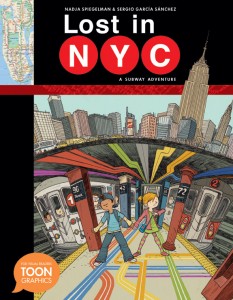 In Nadja Spiegelman and Sergio García Sánchez’s comic, Lost in NYC: A Subway Adventure, innovative page layouts inform readers about the characters’ roundabout paths, the city, and its subway. In a scene featuring narrow vertical panels running the length of the page, the two main characters, en route to the Empire State Building, hold on to the tall, skinny gutters as if they were subway poles. In moments of the story when the characters are in the midst of the chaos of New York City, time and movement are not expressed through numerous panels or page-turns; instead, the story advances via multiple images of the same characters thinking, talking, and moving about within one double-page spread. This complex, winding layout reinforces the kinetic energy of the setting as well as the characters’ experience of being overwhelmed by it.
 A mixture of panels and full-page illustrations are used in JonArno Lawson and Sydney Smith’s wordless picture book Sidewalk Flowers. As a child picks wildflowers, shares them with others, and brings color to a black-and-white urban landscape, information is relayed through the ebb and flow of color between panels. This is especially effective in a scene featuring three panels stacked from top-to-bottom across a page. A distant house in the middle of the center panel (peach-colored, it is the first use of color on a building) cues readers that more color will be forthcoming after new flowers are picked; predictions are confirmed in the bottom frame by a sidewalk speckled with blues, reds, and oranges. The use of many panels within a single page allows for subtle shifts in color to be recognized immediately, as images can be compared simultaneously. In this instance, the paneled layout focuses readers’ attentions on a shift that might have gone unseen over the course of several page-turns.
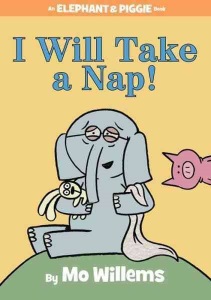 In Mo Willems’s Elephant & Piggie easy readers, whole pages function the way panels in a comic do. In I Will Take a Nap!, for example, the page-turns and gutters imply passage of time in an immediately connected sequence. In a scene in which Piggie reveals to Gerald that the two are actually in a dream (“if you are not napping, how can I be floating?”), her statement — divided between two connected word balloons — crosses the gutter, bridging the gap between two separate moments as she begins floating away. Because the size of the pages is consistent, the passage of time between pages can be intuitively understood. This predictable, linear, left-to-right reading experience is akin to reading a newspaper comic strip, and it frames the brisk pace and page-turning dynamic that emergent readers crave.
Visual Text Features
Many think of visual text features — including word balloons, captions, thought bubbles, and sound effects — as the meat and potatoes of comics. Visual text features can elevate dialogue and establish atmosphere — pulling readers further into the narrative. The following three books — a young adult comic, a nonfiction picture book, and a traditional picture story book — include visual text features that achieve this effect.
 In the YA comic March: Book Two by John Lewis, Andrew Aydin, and Nate Powell, word balloons and sound effects don’t merely communicate what is said or overheard; they also enhance meaning through their physicality. In moments of duress, word balloons become buzz saw–edged, while cold dismissals received by civil rights workers appear frozen over, like icicles. When Aretha Franklin sings “America” during the 2009 presidential inauguration, the lyrics dominate the double-page spread, contained within curvy, robust, heavy-lined word balloons that convey her emotive performance. Powell runs the “BRRRIIINNNNG” of a ringing telephone and the “VRROOMM” of a speeding pickup truck off the page, representing sounds that carry. When fire hoses are used against civil rights protesters, it is not the streams of water or the protesters that are reflected in Bull Connor’s glasses; it is letters in the sound (“FFSSHHHHHHHH…”) of the water. The sound effect no longer just supports the action; instead, it is an integral part of the action. How a sound effect is illustrated can carry as much meaning as the letters or words chosen to express the sound.
 Borderless word balloons, with color-coded stems connecting text to each character, carry moments of dialogue in Mara Rockliff and Iacopo Bruno’s nonfiction picture book, Mesmerized: How Ben Franklin Solved a Mystery That Baffled All of France. The absence of attributives (such as “he said” and “she said”) throughout the book allows for seamless transitions between conversation and exposition in the true tale of how the scientific method was used to debunk Dr. Franz Mesmer’s pseudoscience. On a twisting and turning banner that weaves through a double-page spread, behind a character’s leg and out over a bridge, the murmurings of a crowd are featured (“HA HA HA MESMER HA HA HA BZZ BZZ BZZ”); part of the banner is blocked, evoking moments when one hears only bits and pieces of what is being said in a large group. When Franklin’s “blind”-test methodology is explained, the process is described within labels on old-timey medicinal jars and tubes. This presentation not only communicates the facts but also adds context and brings the historic setting to life.
 In Audrey Vernick and Matthew Cordell’s picture book, First Grade Dropout, thought bubbles house the young protagonist’s memories, including the embarrassing moment when he accidentally called his teacher “Mommy.” While these memories are communicated mostly through pictures (and are sometimes enhanced by word balloons and sound effects of their own), the present-tense narration occurs in the form of traditional expository text. This approach clearly separates past and present, and it allows readers to interpret all that the boy remembers, thinks, and does. When a chorus of obtrusive “HA! HA! HA!”s spread across the page in multiple colors and sizes, the sound effects reinforce the boy’s inescapable shame. The “HA!”s break free from their thought-bubble boundary: the boy’s feelings of humiliation cannot be contained. Here, visual text features provide added insight into the character’s state of mind.
Comics might be where paneled layouts and visual text features are most commonly found, but these features are not unique to comics. The conventions (and definitions) of picture books and comics overlap greatly because they are part of the same whole. That’s why it is hard for us to separate comics from the rest of the picture book world. As Charlotte Zolotow wrote in the March/April 1998 Horn Book Magazine, “There are all sorts of picture books. There is a place for them all.” Zolotow was writing about diversity in content rather than format, but we like to think that the spirit is the same. The picture book umbrella is broad. That’s a good thing, because even though they may not know it, those who evaluate picture books have the skillset to read comics critically. They only need to recognize the value of their experiences, approach every work with an open mind, and think outside the panels once in a while.
From the November/December 2015 issue of The Horn Book Magazine.


Added To Cart
RECOMMENDED

Please register with us to continue reading.
ALREADY A SUBSCRIBER? LOG IN
We are currently offering this content for free. Sign up now to activate your personal profile, where you can save articles for future viewing.
ALREADY A SUBSCRIBER? LOG IN
Thank you for visiting.
We’ve noticed you are using a private browser. To continue, please log in or create an account.

Add Comment :-
Comment Policy:
Comment should not be empty !!!
Elisa Gall
Here is the link to purchase First Grade Dropout from IndieBound (if you're still interested in doing so): https://www.indiebound.org/book/9780544129856 You can also search for it on other sites using ISBN # 9780544129856Posted : Mar 19, 2019 03:18
Jason Pelish
The book First Grade Dropout seems pretty funny. I can't find it on Amazon. Is it still available in print?Posted : Mar 19, 2019 03:49
Elisa and Patrick Gall
A book can be more than one thing: a picture book and a comic book, a picture book and an early reader—or all of the above. We chose to use “comics” when we were talking about comics specifically. When we say picture books, comics are included. We prefer “beginning readers” (or “early readers”) too, but we were being consistent with the terminology used elsewhere in the Horn Book. We agree that it is useful to talk about specific format norms with teachers, caregivers, and children; however, we perceive all types of visual storytelling books (including readers, comics, and so on) to be under a vast picture book umbrella. Thanks for sharing your ideas!Posted : Nov 07, 2015 12:37
Megan Dowd Lambert
To play the devil's advocate, I find distinctions in format useful when considering form and function. The beginning reader book (I resist the term easy reader because--easy for whom?) implies an independent reading transaction, the picture book form implies a shared reading transaction, the graphic novel implies an independent reading transaction. These are general statements, of course, and I don't deny overlap, but I think one reason some people resist picturebooks with comic art conventions (intraiconic text, panels) is that they can be harder to share with a group.Posted : Nov 06, 2015 02:39
Bradin
Yes! Keep up the good fight, Elisa and Patrick! I can't wait for the day when we can drop confusing and antiquated terms like "comic books" and "graphic novels," and just call everything by one big umbrella term: picture books. Then we can stop pretending that separate unique histories of this art form exist and just combine them into one great history of the picture book. Maybe then libraries and bookstores will put all picture books onto one proper shelf. (I can't tell you how tired I am of being told the book I'm looking for is NOT in the picture book section, BUT ALL THE WAY ACROSS THE LIBRARY in the "graphic novel" section!) Then, at last, mock Caldecott lists and actual Caldecott committees will have to drop their attitudes of tokenism towards picture books and actually include all picture books worthy of the name in their deliberations. It seems every year now they choose just one great picture book out of tons of really great picture books and throw it in with the rest of the "traditional" picture books, as if that were sufficient to keep us happy. Thank goodness the Caldecott committee last year took the much needed step in recognizing ALL picture books by awarding that one an honor. I wish they would've awarded one or two more, though, to really drive home our message, amirite? (I can't wait to see the look on the traditionalists' faces when a picture book actually wins the medal!) While I love, love almost everything about your post, please allow me to point out one thing that's bothering me. Now, it may seem sort of nit-picky, but it's actually important. I had a hard time with some of the language you used, because at certain points you kept calling picture books "graphic novels" and "comics!" That makes sense at the beginning of your post, maybe, since so many people still maintain that dumb distinction between picture books and "traditional" picture books. But why did you keep referring to them as "comics" throughout the rest of the article?! That's the last thing we want to do when trying to convince traditionalists (I love that you called them that. Let's keep calling them that, okay?) that they need to "think outside the panels once in a while." One example: "We believe that comic books and graphic novels (which we’ll refer to as “comics” from here on out) are picture books." You should've written: "We believe 'comic books' and 'graphic novels' (which we'll refer to as 'picture books' from here on out) are picture books." Another example: "That’s why it is hard for us to separate comics from the rest of the picture book world." You should've written: "That’s why it is hard for us to separate picture books from the rest of the picture book world." See the difference? We want to avoid using traditionalist terminology whenever possible. Also, for some reason, you put "comics" in parentheses in a few spots: "picture books (including comics) share characteristics" "Picture books (including comics) come in various sizes, genres, styles, page lengths, color palettes, and intended audience age ranges." "Picture books (including comics) are worthy of serious analysis." Don't you see how confusing that is when we're trying to convince people that picture books are picture books? Just drop the parenthetical statements altogether and it will make our case much stronger, okay? Is it possible to make these changes to this post now or is it too late? If it's too late, no problem. The powers-that-be will no doubt keep giving us a platform to proselyte our message to the uninformed. Maybe we'll get more chances soon if another picture book wins the Caldecott (fingers crossed!). And if not, there's always next year, and the year after that, and the year after that, and the year after that, forever and ever.Posted : Nov 06, 2015 01:09