


2018 School Spending Survey Report
Experiments and Science Projects
Bardhan-Quallen, Sudipta Kitchen Science Experiments: How Does Your Mold Garden Grow?
Gr.
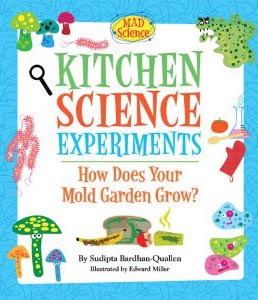 Bardhan-Quallen, Sudipta Kitchen Science Experiments: How Does Your Mold Garden Grow?
Gr. 4-6 64 pp. Sterling 2010
Illustrated by Edward Miller. Mad Science series. Experiments exploring onion cells, yeast, bacteria, and mold found in homes are interspersed with scientific information about the underlying biological and chemical principles. The experiments are more advanced than your typical do-at-home recipes, requiring a microscope and chemicals not typically found in the house (but easily obtained). The cartoonlike illustrations include anthropomorphized microorganisms as well as realistic depictions of the required materials. Bib., ind.
Subjects: General Science and Experiments; Science projects
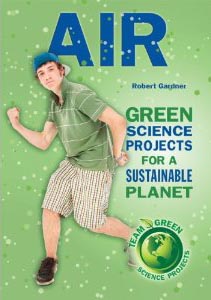 Gardner, Robert Air: Green Science Projects for a Sustainable Planet
Gr. 4-6 128 pp. Enslow 2011
Gardner, Robert Earth's Cycles: Green Science Projects About the Water Cycle, Photosynthesis, and More
Gr. 4-6 112 pp. Enslow 2011
Gardner, Robert Energy: Green Science Projects About Solar, Wind, and Water Power
Gr. 4-6 128 pp. Enslow 2011
Gardner, Robert Recycle: Green Science Projects for a Sustainable Planet
Gr. 4-6 128 pp. Enslow 2011
Gardner, Robert Soil: Green Science Projects for a Sustainable Planet
Gr. 4-6 128 pp. Enslow 2011
Gardner, Robert Water: Green Science Projects for a Sustainable Planet
Gr. 4-6 128 pp. Enslow 2011
Team Green Science Projects series. Gardner takes familiar experiments geared toward motivated science learners and gives them an eco-twist. Some are straightforward demonstrations of basic science while others explore aspects of alternative and sustainable science and technologies. Sections of background information further expand the green science coverage. Photographs and diagrams help illustrate the necessary equipment and setups. Reading list, websites. Glos., ind.
Subjects: General Science and Experiments; Air pollution; Science projects; Environment--Pollution; Earth science; Environment--Conservation; Energy; Environment--Recycling; Soil; Environment--Conservation--Natural resources; Water
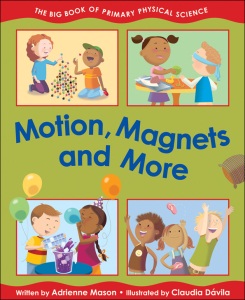 Mason, Adrienne Motion, Magnets and More: The Big Book of Primary Physical Science
Gr. K-3 128 pp. Kids Can 2011
Illustrated by Claudia Dávila. Children can develop basic understanding of physical science through this collection of well-designed experiments on materials, structures, matter, and motion. The concepts carefully build across the activities and are appropriately targeted to the intended audience. Cartoonlike children in the illustrations model the experiments or demonstrate the ideas. Tips for adults to help deepen learning are appended. Glos., ind.
Subjects: General Science and Experiments; Science projects; Physics
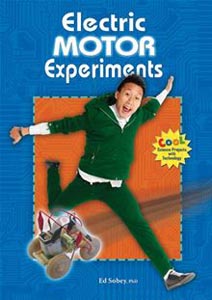 Sobey, Ed Electric Motor Experiments
High school 128 pp. Enslow 2011
Sobey, Ed Radio-Controlled Car Experiments
High school 128 pp. Enslow 2011
Sobey, Ed Robot Experiments
High school 128 pp. Enslow 2011
Sobey, Ed Solar Cell and Renewable Energy Experiments
High school 128 pp. Enslow 2011
Cool Science Projects with Technology series. Each collection of experiments encourages science aficionados to explore in-depth such items as motors and electrical circuits along with forces and motion. Straightforward scientific information and color photographs and diagrams are integrated into the projects (most of which require more than just household materials). Questions throughout encourage deeper thinking and engineer-type problem solving. Reading list, websites. Glos., ind.
Subjects: General Science and Experiments; Science projects; Technology; Electricity; Vehicles—Automobiles; Robots; Energy
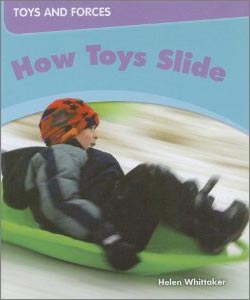 Whittaker, Helen How Toys Slide
Gr. K-3 32 pp. Smart Apple 2012.
Whittaker, Helen How Toys Bounce
Gr. K-3 32 pp. Smart Apple 2012
Whittaker, Helen How Toys Float
Gr. K-3 32 pp. Smart Apple 2012
Whittaker, Helen How Toys Fly
Gr. K-3 32 pp. Smart Apple 2012
Whittaker, Helen How Toys Roll
Gr. K-3 32 pp. Smart Apple 2012
Whittaker, Helen How Toys Spin
Gr. K-3 32 pp. Smart Apple 2012
Toys and Forces series. Readers are encouraged to use their toys to examine basic relationships between forces and the movement of objects. Each book features the motions exhibited by everyday items to explore how exerting a force can move, speed up, slow down, or stop things. The concepts are reinforced through color illustrations, diagrams, and appended simple experiments in each book. Glos., ind.
Subjects: Physics and Chemistry; Toys; Force; Motion; Water; Flight
From the October 2012 issue of Nonfiction Notes from the Horn Book.


Added To Cart
RELATED


RECOMMENDED

Please register with us to continue reading.
ALREADY A SUBSCRIBER? LOG IN
We are currently offering this content for free. Sign up now to activate your personal profile, where you can save articles for future viewing.
ALREADY A SUBSCRIBER? LOG IN
Thank you for visiting.
We’ve noticed you are using a private browser. To continue, please log in or create an account.

Add Comment :-
Be the first reader to comment.
Comment Policy:
Comment should not be empty !!!