



2018 School Spending Survey Report

Cat Nap
"I love an ambitious picture book, and Brian Lies's Cat Nap is that and then some."
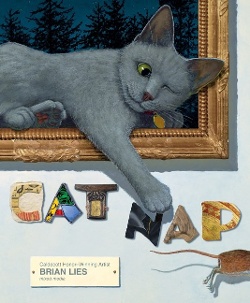 I love an ambitious picture book, and Brian Lies's Cat Nap is that and then some. When I wrote The Horn Book Magazine review for this book, I knew it then that it would be a Calling Caldecott candidate. The illustrations stand out in terms of the diverse media used and the technical skill necessary to work in these many different forms.
Caldecott Honor recipient Brian Lies outdid himself with this offering about a most unusual game of cat and mouse. Kitten’s nap on the back of a couch is interrupted by a mouse that then climbs into a print from the Metropolitan Museum of Art. Kitten follows, and an epic chase ensues through nine other pieces from the Met’s collection. Each one comes from a different country and time period. As I wrote in my review, “Lies's illustration style morphs to match whatever piece Kitten is in; e.g., Kitten is portrayed as a ceramic sculpture while interacting with a ceramic dog from Mexico; in carved wood when encountering a mask created in Côte d’Ivoire; and in glass in a fifteenth-century German stained-glass panel.” This spread is probably my favorite in the whole book. The colors in the stained glass are so vivid, the details so rich. It’s a recreation of Gathering Manna, a piece that depicts Moses and Aaron in a biblical scene. The brothers watch as two men use bowls to collect manna, the food that fell from the sky to feed the Israelites during their forty-year journey through the wilderness. Kitten can’t help but try out this “flat and dry” miraculous food, which upsets a bird who yells, “Put it back! Put it back!” A couple of pictures in the author’s note reveals how Lies created this: “fitting stained glass pieces into frame” and “joining stained glass with hot iron and solder.”
Some page-turns in this book also stand out for their ingenuity. For example, when Kitten and the mouse jump out of the stained-glass panel, they are no longer depicted as glass. They’re rendered in ink as the duo ventures into a recreated version of Tortoise Suspended by String, a Japanese piece created sometime in the eighteenth or nineteenth century. Throughout the book, Kitten maintains propulsive energy, whether it’s during the chase or his run for home as the book draws to a close. His face is also always expressive. Sometimes showing wonder and determination, other times apprehension and fear. Lies does all this through Kitten’s eyes and ears. The way Lies was able to successfully work in all of these different styles is amazing.
Cat Nap celebrates artistic creation, and I appreciated Lies’s work even more after reading his detailed author’s note that includes photos of several of his illustrations in progress and explains why he decided to recreate actual works of art. As Lies wrote, “it would have been easy to create the illustrations in this book on a computer — to take a photo of an original artwork and edit Kitten in digitally. It was a greater challenge, and a whole lot more fun, to see if I could actually make pieces of art that looked like the originals.”
I’m so glad he was up for the challenge, and I think his efforts should be rewarded with a Caldecott Medal.
[Read The Horn Book Magazine review of Cat Nap]


RECOMMENDED

Please register with us to continue reading.
ALREADY A SUBSCRIBER? LOG IN
We are currently offering this content for free. Sign up now to activate your personal profile, where you can save articles for future viewing.
ALREADY A SUBSCRIBER? LOG IN
Thank you for visiting.
We’ve noticed you are using a private browser. To continue, please log in or create an account.

Add Comment :-
Be the first reader to comment.
Comment Policy:
Comment should not be empty !!!