


2018 School Spending Survey Report
Five questions for Ibi Zoboi and Juanita Londoño
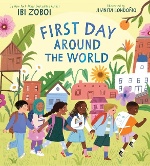
In the picture book First Day Around the World (Versify/HarperCollins, 4–8 years), Ibi Zoboi’s verse and Juanita Londoño’s illustrations allow readers to travel from one place to another, exploring various aspects of the first day of school — from transportation to lessons to meals — in a world of ways.
In the picture book First Day Around the World (Versify/HarperCollins, 4–8 years), Ibi Zoboi’s verse and Juanita Londoño’s illustrations allow readers to travel from one place to another, exploring various aspects of the first day of school — from transportation to lessons to meals — in a world of ways. See also our list “Learning from each other” for picture books whose social-emotional learning themes might be useful for those starting school. And for illustrated stories of school for a slightly older audience, see our intermediate and middle-school list “Learning visually” in this Back-to-School edition of Notes.
 |
| Photo: Nicole Mondestin. |
1. Ibi, the book’s dedication reads: “For all the children who dream of school in spite of everything.” Was there a particular event or experience that inspired this story?
Ibi Zoboi: Absolutely. I wrote the first draft during the early weeks of the COVID-19 lockdown in 2020. I was watching a docuseries about how children go to school around the world. I watched as the tiniest humans navigated crossing rivers, scaling mountainsides, and walking through dense forests. At the same time, I was unpacking boxes and found my very first school uniform. I started preschool in Haiti and left for America in the middle of the year. I started kindergarten in Brooklyn, New York. So I had started school in two different countries.
2. How did you each research what the first day of school looks like in different places? Did you learn anything that surprised you?
IZ: I researched photos first. I looked for pictures of children at school and was able to see similarities. There are school lunches, desks, notebooks, pencils, and sometimes uniforms. But there are also huge differences in cultures, landscapes, and climates. What we learn about our world as children depends on where we are. I learned that some children return home for lunch and there are morning classes and afternoon classes. I also learned that free education isn’t accessible to all. Add in conflict areas and places affected by climate change, and school can be an unattainable dream for children around the world.
 Juanita Londoño: My research started from a visual storytelling perspective. I gathered as much reference as I could from things like school uniforms, classrooms, interactions between kids and the spaces, and any other details. But I’ve also been lucky enough to travel to many of the places that were shown in the book, and although I didn’t go to school in those places, I tried to infuse each illustration with the feeling I had when I was there. Things like lighting, textures, the energy of the people, etc.
3. Ibi, what led you to use verse for this book?
IZ: Verse is my favorite way to tell a story. I’m able to say so much with so few words. Song and rhyme are how many children around the world learn their lessons. Everything from math equations to astronomy can be put into a lyrical song to enable memory and retention.
4. Juanita, what factors determined for you when to show scenes as vignettes or as full pages or spreads?
 JL: After carefully reading the text, I realized I wanted to make sure I represented some of the images suggested. It’s a very rich story, full of detail, and I wanted kids to be able to anchor some of that information visually. I remember craving that feeling when being read to as a child. At the same time, I wanted to leave enough space for imagination.
When deciding between vignettes and full spreads, I selected moments based on what I felt needed to be highlighted, making sure I represented everything I wanted while also giving the book a natural rhythm.
5. Where in the world would each of you like to go to school?
IZ: I would love to start kindergarten in Cap Haitien, Haiti. There’s a lot of news about Haiti’s instability. But most of the violence is happening in the capital, many miles from Cap Haitien. I’ve seen such beautiful schoolchildren wearing their matching uniforms and smiling and singing in the streets. A stark contrast to what is portrayed on the news.
JL: I’d say Spain or Italy. Having a siesta or riposino on a long school day sounds so good right now!
From the July 2025 issue of Notes from the Horn Book.


Added To Cart
RELATED


RECOMMENDED

Please register with us to continue reading.
ALREADY A SUBSCRIBER? LOG IN
We are currently offering this content for free. Sign up now to activate your personal profile, where you can save articles for future viewing.
ALREADY A SUBSCRIBER? LOG IN
Thank you for visiting.
We’ve noticed you are using a private browser. To continue, please log in or create an account.

Add Comment :-
Be the first reader to comment.
Comment Policy:
Comment should not be empty !!!