


2018 School Spending Survey Report

Find more great Horn Book content at these links:
Recommended books: reviews and themed booklists
App and e-book reviews
Movie reviews
Event news and recaps
Events calendar
Five questions for Mike Curato
In support of the Massachusetts Freedom to Read bill, author Malinda Lo spoke with author and illustrator Mike Curato about his experiences with challenges to his graphic novel Flamer, whose protagonist realizes his queer identity during an intense summer at Boy Scout camp.
In support of the Massachusetts Freedom to Read bill, author Malinda Lo spoke with author and illustrator Mike Curato about his experiences with challenges to his graphic novel Flamer, whose protagonist realizes his queer identity during an intense summer at Boy Scout camp. See also our recent Banned Books Week 2025 post for more information and links to more resources about this timely and important issue.
1. You and I both live in Massachusetts, which is a blue state, but your graphic novel Flamer has actually been banned in our state. According to The Boston Globe, in Medfield, Massachusetts, Flamer was challenged and banned from the middle school library, but retained in the high school library. Medfield is a majority Democratic town in a blue state, but obviously that doesn’t stop people who want to ban books. Were you surprised to see this ban in Massachusetts, and what would you say to people who think book bans are only a red state phenomenon?
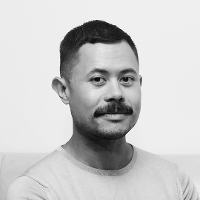 |
| Photo: Paul Specht. |
Mike Curato: Unfortunately, I was not surprised. I don’t believe ignorance belongs solely to one political affiliation. I also live in a very blue town, but that doesn’t mean I don’t experience homophobia and racism here. Also, while Massachusetts has very few book bans, there have been many book challenges. There is a danger in single narrative thinking. Everyone is capable of ignorance and malice. Everyone is capable of courage and grace. How do we find common ground? How do we recognize each other’s humanity?
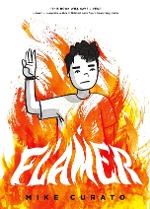 2. Flamer has been on the ALA’s Top 10 Most Challenged Books list and in PEN America’s Index of School Book Bans several times. One of the biggest myths is that getting your book banned leads to the bestseller list, when in reality, the vast majority of book bans simply lead to the book being taken away from readers. It also can lead to soft censorship, lower book sales, and for children’s and YA authors, it can lead to fewer paid school visits. There is always the exception that proves the rule, of course. If The New York Times covers your book getting banned, that might actually lead to more people buying your book, but very few banned authors get that kind of media attention. How have all of these book bans affected your career as a writer?
MC: It’s been quite a roller coaster. I don’t possess enough metrics to be able to measure total losses or gains, but I know I’ve experienced both. When censorship of this book began, I saw a dip in sales. Perhaps because Flamer was in the political discourse for so long, I began to see sales rise. That said, Flamer has never hit a bestseller list. I am definitely not rich!
I used to get invited for elementary school visits regularly. They contributed to about a third of my livelihood. Authors who regularly did school visits lost that income during prevaccination COVID times. Since then, school budgets have been cut significantly, but I also see some fellow authors getting school visit requests again. I now average one elementary school visit a year. Meanwhile, I’ve seen an uptick in visit requests from colleges, universities, public libraries, festivals, and other adult forums. I have also done a handful of high school visits, but all of those were through a private nonprofit organization that assists Title 1 schools with author visits.
On that note, I also experience soft censorship. There’s no way to measure the visits that would have been requested, or the books that would have been sold, except that some librarians are too scared to bring in a “controversial” author or title. I have spoken with librarians who have been harassed, their livelihoods threatened, just for trying to keep my book on their shelves.
There are also vigilantes who take matters into their own hands and remove my book from libraries without due process. I even met one of these people, who waited a long time in a book signing line to meet me. He then tried to “save me” by proselytizing in front of teens who were at the event with supportive family members. One of those teens handed me a note telling me how Flamer helped them get through some really dark times. On several occasions, the Proud Boys have shown up to this same library in an effort to intimidate people attending storytimes. I now need to take security into consideration when I do events. With online harassment comes the implied or direct threat of violence. My physical safety and the safety of people attending my events supersedes any financial considerations. I wince when people congratulate me on being on lists of challenged books because I know they do not understand that this isn’t just about my livelihood, it’s about my life; it’s about the lives of my readers. I have become both beloved and reviled, welcomed in and cast out. But I’d like to believe there’s more love for Flamer (and me) than not. Regardless, I’m still working.
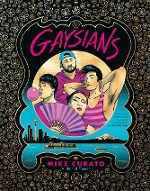 3. Your latest graphic novel, Gaysians, is published for adults. I thought it was so moving and wonderful, and I loved that you seem to have taken the experience of getting banned for writing about queer experiences and doubled down. I can see that you have not been cowed by the book banners. If you could speak directly to the people who want to ban your work, what would you say? Would you speak to them at all?
MC: Instead of speaking to them, I would rather ask book banners questions, such as: did you ever feel utterly alone as a teenager? Did you have a book that helped you? What if someone took that book away from you? Do you really care about all children, or just the ones that live according to your values? If I disagree with your values, does that mean I can deprive you of your liberties the way that you’ve deprived me of mine? Can you explain why most of the first targeted books are by and/or about LGBTQ people or people of color? Why don’t you think LGBTQ identities should be allowed to exist in the context of education? Did you ever read books about heterosexual characters in your youth? (I know the answer to that one.) What is controversial about books about people of color? Did you have books about white characters in your youth? (I also know the answer to that question.) What makes your lived experience more valid than mine? Do you think I should be allowed to tell you what books you can or cannot read? What does “freedom” mean? Please list the exceptions in the phrase “liberty and justice for all.”
4. I’ve heard from younger or debut writers, especially queer writers of color, who are afraid to write about their experiences given all this book banning. What kind of advice would you give them about being a queer writer of color in this time?
MC: At the height of the AIDS crisis, there was an organization called ACT UP (still active today). Their slogan was “Silence=Death.” The point of book banning is erasure and intimidation. When we stop sharing our stories, we are letting book banners win. When we keep our trauma to ourselves, we help validate our perpetrators; we give them motivation to continue. As we queer people of color know, we have always been here and will always be here. We deserve a place in this world. My advice is to keep telling your truth, keep showing up for one another, and collectively our voices will be heard.
5. Finally, I want to say thank you for writing about queer Asian experiences. I don’t want to brag, but you and I are two of a very few queer Asian writers publishing stories in the YA space. I could count us Gaysian authors on one or two hands. Proportionally, we are a minority among a minority. Why do you think two of our books — your Flamer and my Last Night at the Telegraph Club — are so widely banned? I mean, are we really that scary?
MC: I think our books are powerful in that they lend voices to people who have not been centered before. Our characters are people who have traditionally been relegated to the background. They have been, at best, supporting characters who only exist to affirm the main character’s existence. We’re saying, no, there are no supporting characters. We are all main characters, if we choose to come forward and claim that. Perhaps we are scary because we are showing the world that even the voiceless can claim space. Even the disenfranchised can find love, community, and happiness on our own terms. I would imagine that kind of power makes others nervous, namely people who have always enjoyed being the main character, who gets to dictate how the story plays out for everyone else. The truth is, we all have our own story. We all deserve a spot on the shelf. We all deserve to be seen and understood fully.

Added To Cart
RELATED

RECOMMENDED
Please register with us to continue reading.
ALREADY A SUBSCRIBER? LOG IN
We are currently offering this content for free. Sign up now to activate your personal profile, where you can save articles for future viewing.
ALREADY A SUBSCRIBER? LOG IN
Thank you for visiting.
We’ve noticed you are using a private browser. To continue, please log in or create an account.

Add Comment :-
Be the first reader to comment.
Comment Policy:
Comment should not be empty !!!