


2018 School Spending Survey Report
Freedom Summer and Black History
This year marks the fiftieth anniversary of Freedom Summer, a touchstone in the civil rights movement.
 Freedom Summer: The 1964 Struggle for Civil Rights in Mississippi by Susan Goldman Rubin provides a useful and informative look at the event's organizers, the volunteers, the voter registration drives, etc. Rubin conducted many interviews, in person, by telephone, and by e-mail, with people who were directly involved, and their firsthand accounts — along with copious archival black-and-white photographs — bring the events to life. (Holiday, 11–15 years)
 The Port Chicago 50 was a group of navy recruits at Port Chicago in California doing one of the few service jobs available to black sailors at the beginning of the Second World War: loading bombs and ammunition onto battleships. When there was an explosion that left more than three hundred dead, fifty men refused to go back to work, occasioning a trial for mutiny. Steve Sheinkin's 2014 Boston Globe–Horn Book Nonfiction Award winner The Port Chicago 50: Disaster, Mutiny, and the Fight for Civil Rights focuses the events through the experience of Joe Small, who led the protest against the dangerous and unequal working conditions. This is an unusual entry point for the study of World War II and the nascent civil rights movement. (Roaring Brook, 11–15 years)
 According to Albert Marrin's A Volcano Beneath the Snow: John Brown's War Against Slavery, Brown's raid at Harpers Ferry helped "set the stage for the Civil War." The book begins with a chapter on Brown's life, then takes a broader look at the history of slavery. The final chapter, "Legacy," offers a brief commentary on Brown's influence on the militant arm of the American civil rights movement. His violent actions raise an issue that still resonates today: to what extremes may a person go to change an unjust law? (Knopf, 11–15 years)
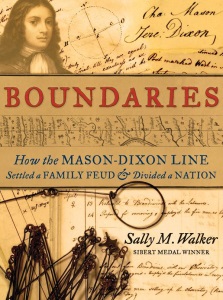 The Mason-Dixon Line dates from colonial times: while the Calverts and Penns left England to found religiously tolerant colonies (Maryland and Pennsylvania, respectively), they feuded about the border's exact location. The surveying team of Charles Mason and Jeremiah Dixon was hired in 1763 to solve the problem once and for all. In Boundaries: How the Mason-Dixon Line Settled a Family Feud & Divided a Nation, Sally Walker provides meticulous detail about surveying and about colonial-era sociopolitics. She ends with a discussion of the cultural relevance of the Mason-Dixon Line to the North and the South, and modern-day interest in the preservation of its history. (Candlewick, 11–15 years)
From the June 2014 issue of Notes from the Horn Book.


Added To Cart
RELATED


RECOMMENDED

Please register with us to continue reading.
ALREADY A SUBSCRIBER? LOG IN
We are currently offering this content for free. Sign up now to activate your personal profile, where you can save articles for future viewing.
ALREADY A SUBSCRIBER? LOG IN
Thank you for visiting.
We’ve noticed you are using a private browser. To continue, please log in or create an account.

Add Comment :-
Be the first reader to comment.
Comment Policy:
Comment should not be empty !!!