


2018 School Spending Survey Report

Find more great Horn Book content at these links:
Recommended books: reviews and themed booklists
App and e-book reviews
Movie reviews
Event news and recaps
Events calendar
Freedom Summer reading
This year marks the 50th anniversary of Freedom Summer, the 1964 grassroots campaign to register black voters in Mississippi — the state with the lowest percentage of black voters registered and a history of disenfranchisement through intimidation and violence.
Fiction
 Protagonist Glory doesn't understand what's happening in her Mississippi hometown during the "Freedom Summer" of 1964 in Augusta Scattergood's novel Glory Be. Difficult and changing relationships with her sister Jesslyn and friend Frankie mirror the swirling upheaval. The hotly debated closing of the segregated community pool both serves as a snapshot of the tumultuous era and illustrates Glory's realizations about the power of her own convictions. (Scholastic, 2012; intermediate)
 In 1964, two young friends — Joe, who is white, and John Henry, who is black — find the town pool being filled with tar to avoid enforced integration. Their disappointment is palpable — and galvanizing. John Henry decides to enter a previously forbidden store, and the friends join arms and go in together. Deborah Wiles's text for picture book Freedom Summer, though concise, is full of nuance, and illustrator Jerome Lagarrigue's oil paintings shimmer with the heat of the South in summer. (Atheneum/Schwartz, 2001; new ed. Atheneum, 2014; primary)
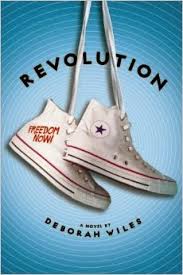 In Revolution [Sixties Trilogy], also by Deborah Wiles, twelve-year-old Sunny Fairchild (who is white) tells of Greenwood, Mississippi during Freedom Summer: a town turned upside-down, in need of change but resistant to it. As in the previous volume, Countdown, a "documentary novel" format intersperses all manner of documents with Sunny’s first-person narrative and occasional chapters narrated by black teen Raymond Bulliss. It's an ambitious, heady endeavor that succeeds in capturing the atmosphere of that pivotal and eventful summer, with the documents offering a broader context. An author’s note and a solid bibliography round out this innovative work commemorating the fiftieth anniversary of Freedom Summer. (Scholastic, 2014; intermediate, middle school)
Nonfiction
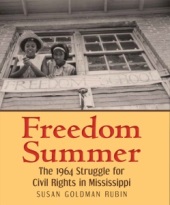 Freedom Summer: The 1964 Struggle for Civil Rights in Mississippi by Susan Goldman Rubin provides a useful and informative look at the event’'s organizers, the volunteers, the voter registration drives, etc. Rubin conducted many interviews, in person, by telephone, and by e-mail, with people who were directly involved, and their firsthand accounts — along with copious archival black-and-white photographs — bring the events to life. (Holiday, 2014; middle school, high school)
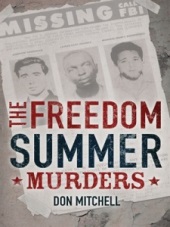 For The Freedom Summer Murders, author Don Mitchell conducted a number of interviews with close friends and family members of slain civil rights workers James Chaney, Andrew Goodman, and Michael Schwerner. Fascinating biographical sketches of the three men, based on these interviews, give readers insight into their deep commitment to social justice. Mitchell also provides a thorough account of the search for their bodies, and of the years of investigation that culminated in the 2005 trial of one of the murderers (at that time eighty years old). This book will grab you from its opening paragraphs and won’t let go until justice is served. (Scholastic, 2014; middle school, high school)

Added To Cart
RELATED


RECOMMENDED

Please register with us to continue reading.
ALREADY A SUBSCRIBER? LOG IN
We are currently offering this content for free. Sign up now to activate your personal profile, where you can save articles for future viewing.
ALREADY A SUBSCRIBER? LOG IN
Thank you for visiting.
We’ve noticed you are using a private browser. To continue, please log in or create an account.

Add Comment :-
Be the first reader to comment.
Comment Policy:
Comment should not be empty !!!