


2018 School Spending Survey Report

Gender by the numbers
A poster in our office lobby for the upcoming Simmons International Women's Film Forum alerted me to the interestingly low--29%--number of female protagonists in films for children.
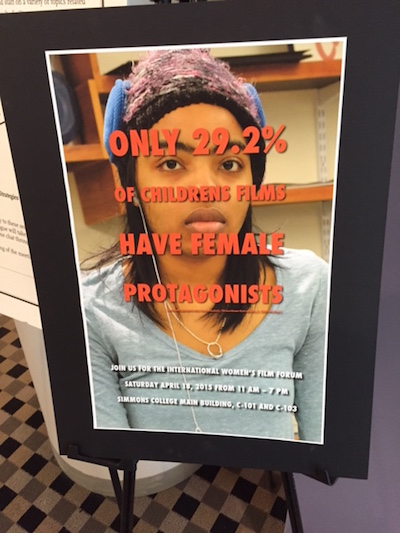 A poster in our office lobby for the upcoming Simmons International Women's Film Forum alerted me to the interestingly low--29%--number of female protagonists in films for children.* I guess it ain't all Disney Princesses after all.
How does this compare with the numbers in books for children? I asked myself. The gender disparity had been on my mind ever since I got sucked into the Bookriot discussion about girls and YA spurred by the Andrew Smith drama of a couple of weeks ago. Somebody on the thread was vociferously decrying the lack of female protagonists in YA novels, which made me think what you all are probably thinking: Wait, wut?
But the poster and the discussion made me think it was a good time to do some arithmetic. Or, more precisely, engage our talented Emerson College intern Mariesa Negosanti in researching the question of gender representation in youth fiction via our ever-handy Horn Book Guide.
Our sample was limited to the Fall 2014 issue of the Guide, which reviewed all hardcover books published in the first six months of 2014 by U.S. publishers listed in LMP. Mariesa coded each fiction review in the Intermediate and Older Fiction sections for gender of protagonist(s): male, female, both, neither. The numbers for Older (books for 12-18-year-olds) were not surprising, except maybe to that zealot at Bookriot: 65% of the protagonists in YA novels were female, 22% were male, boys and girls shared main-character duties in 13%. I thought the numbers for Intermediate (roughly 9-12-year-olds) would be about the same but NO: 48% boys, 36% girls, 16% both.
I'm guessing the greater numbers of boy-heroes in fiction for these younger readers is probably attributable to our conventional wisdom that pre-teen girls are more likely to read about boys than the other way around, so a book about a boy is more likely to garner more readers. And that--conventional wisdom again--teen boys are less likely to read for pleasure than teen girls are, period, and that those boys who do read tend to prefer nonfiction.
Down at the other end of the age spectrum, we've been thinking about gender from a completely different angle: is it fair to label as male or female a character in a wordless picture book? Because, who knows?
*The poster is actually putting an optimistic gloss on what looks to be the study from which it is drawn. According to the Geena Davis Institute on Gender in Media, which conducted the original research, the 29.2 percentage refers to speaking parts, not protagonists!


Added To Cart
RELATED


RECOMMENDED

Please register with us to continue reading.
ALREADY A SUBSCRIBER? LOG IN
We are currently offering this content for free. Sign up now to activate your personal profile, where you can save articles for future viewing.
ALREADY A SUBSCRIBER? LOG IN
Thank you for visiting.
We’ve noticed you are using a private browser. To continue, please log in or create an account.

Add Comment :-
Comment Policy:
Comment should not be empty !!!
Wendy
Roger, you asked way up there about gender of protagonists in Newbery winners. I did statistics on this a few years ago: http://sixboxesofbooks.blogspot.com/2008/09/newbery-report-part-2-of-3.html I post this with several caveats. I was just beginning my foray into the world of serious children's literature scholarship and was naive about a lot of things. My original audience was a bunch of friends on my livejournal (the post was copied to my blog from there). I might have said things very differently even a few months later, but I've chosen to leave it as it is. I also have chosen not to update the statistics every year, though I do it in my head with each new winner. Not long after, someone else published a more scholarly take on the matter which was picked up by the Boston Globe or something, but it was FULL of factual errors; the author had not actually read all the books. I stand by my statistics, which I fact-checked many times, though of course there's always a possibility of error. There's also disagreement about some books; some of them are maybe reasonable, such as where I classify The Westing Game as a book with multiple protagonists and was surprised to hear others reading it any other way, others classify it as a book with a female protagonist (Turtle). But there's no question about, say, Criss Cross in my mind (ensemble book, and I think attempts to classify it as "female protagonist" are rooted in sexism, i.e. "it feels like a girl book"). Last caveat: several times people have discounted these statistics because they look at the entire history of the award. I prefer to take a long view. I don't think looking at only the last few years says anything particularly meaningful other than "lots of girls in the last few years". Anyone who whines that all the Newbery winners are "girl books", without a qualifying range of years, is going to get called out. tl;dr: contrary to popular assumption, by 2008 53% of Newbery winners had male protagonists, and 34% had female protagonists. Since then I count four male protagonists (including Ivan) and three female.Posted : Apr 06, 2015 04:48
Roger Sutton
Thanks for that VIDA report, Sarah--I hadn't known about it. It's at http://www.vidaweb.org/vida-count-childrens-literature/. I think a crucial number missing there is the number of books published, so I'll plug again for hornbookguide.com, which reviews every hardcover book published by publishers listed in LMP for the past twenty-five years. You can search by year, but then you would have to do a hand count, as we don't have fields for gender of author or characters. But doesn't CCBC also keep a count? They might have some numbers.Posted : Apr 06, 2015 02:58
Sarah
Sorry, hadn't seen the link to Maggie Stiefvater's post. What she said.Posted : Apr 04, 2015 07:46
Sarah
Just wanted to second Laura's comment, and Debbie, think gender is a really interesting component of "playing Indian". Know you've discussed this in relation to Mark Twain as well, and think this is very much related to the discussion as a whole. I'd also be curious about starred reviews...etc. (does the VIDA count include this?) and would love to see how those statistics have shifted and tracked over time, too. Kelly Jensen's analysis of recent NYTimes bestseller lists also fits here. Regarding characters, there was a broader study published in Gender and Society, which looked at 100 years in children's books (limited to British and American literature) http://www.theguardian.com/books/2011/may/06/gender-imbalance-children-s-literature I think it does look at some trends, but I haven't spent much time with it-- and it both has a funny time frame (1900 to 2000) and also leaves out upper ages. For myself, I have a *completely* unsubstantiated theory that there have been demographic shifts after breakout, commercially successful books like Harry Potter and Twilight/Hunger Games (which I might interpret as financial success bringing more mainstream cultural recognition to a profession lacking in it because of its association with women... and this mainstream recognition then being more readily available to some-- white cishet-- men entering the field.) As others have said, this may not necessarily relate to characters but to authorship. Or both. Think there are also maybe some interesting differences and parallels between middle grade and YA. Again, this is based purely on observation, not at all on empirical data... but think in middle grade, gender can relate to a divide between books that are seen as "literary," as someone mentioned above, and those people view as books boys want to read. Do think "literary" used have a cultural equation with importance in the profession (and is maybe still associated with awards) and for periods this has skewed towards female authors more generally. But as you and many others note, there's also been a shift tied up with (valid!) concerns about boys and reading, so that books seen as encouraging boys to read now have a greater association with mainstream cultural importance? And maybe these are posited as being in opposition? With all of the concerns that relate to and stem from this, including which/whose books are seen as (appropriately) engaging to whom, and whose engagement is valued... including which boys'. Can't help seeing a connection between this and some of what Debbie's discussing regarding ideas about gender and "civilizing" boys vs. "wildness," too. In YA, think popularity is of course broadly associated with teen girls, and teen girl enthusiasm has to be one of the most derided sentiments in our culture. Lots to say about how an author like John Green brought this under the rubric of "nerd," or intellectual culture, and the dynamics and Effects thereof. (And also think there's a vital conversation to be had here about the commodification of teen girl audiences. Have long been frustrated at the lack of traction for that discussion-- a shout out to Liz Burns for keeping it at the forefront.) I can never quite get a handle on the ways teen boys are imagined as audiences for YA more generally, which also maybe feeds into recent discussions, and would love to hear more about that, too. And of course there are also picture books, illustration, nonfiction, graphic novels, histories of kidlit written for adults...etc, which have been discussed here and elsewhere... Anyway, as usual this is already way too long, but also wanted to emphasize (especially since I was the one who brought up research into the glass escalator phenomenon!) that in looking at studies and statistics and cultural trends, it's of course impossible to separate male/female from other variables like race, sexuality, inclusive gender identity, physical ability, class, religion...etc. As with the overall US pay gap, where a general comparison of wages for "women" and "men" obscures the fact that white women earn more on average than black men, for example, I think there are complexities in these studies and arguments that also need to be kept at the forefront.Posted : Apr 04, 2015 07:39
Mike Jung
Maggie Stiefvater posted on the topic of rage today: http://t.co/DYOmZie8WbPosted : Apr 04, 2015 07:35