


2018 School Spending Survey Report
Getting creative
March is Women’s History Month, and in these six picture-book biographies we’re celebrating women in arts professions, educators, and activists whose passion and creativity are an inspiration.
March is Women’s History Month, and in these six picture-book biographies we’re celebrating women in arts professions, educators, and activists whose passion and creativity are an inspiration. For more, see the Women’s History Month tag on hbook.com and the Guide/Reviews Database section The Arts and the Women--Biographies tag.
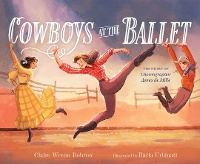 Cowboys at the Ballet: The Story of Choreographer Agnes de Mille
by Claire Wrenn Bobrow; illus. by Ilaria Urbinati
Primary Atheneum 48 pp.
3/26 9781665957878 $19.99
Under California orange trees, young Agnes de Mille (1905–1993) dances freely with sagebrush flowing in the breeze; however, when she is transplanted into a formal ballet class, traditional technique does not come naturally. Instead, she favors storytelling with “everyday, ordinary gestures” and familiar motions. Moving to New York to become a professional dancer, Agnes does not find her niche easily. “She’s not a classical dancer, or a modern dancer, or a folk dancer. What is she?” De Mille continues to explore a variety of genres, striving to compose a style all her own. But something is missing from her choreography. She eventually discovers it in an unlikely place: a rodeo. Captivated by the cowboys’ movements that she sees as emulating dance, de Mille brings her childhood range to the stage, positioning herself for future success as the first female Broadway musical choreographer and director. Through lively, folksy text, and by sharing de Mille’s unique vision, Bobrow may inspire readers to follow genuine paths of their own. Urbinati’s digital illustrations are fluid, employing delicate, graceful lines and a warm color palette of dusty rose, burnt orange, and deep mahogany reds. Back matter expounds on de Mille’s innovative style and includes selected source material. EMILY BRUSH
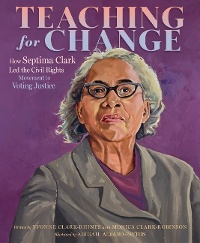 Teaching for Change: How Septima Clark Led the Civil Rights Movement to Voting Justice
by Yvonne Clark-Rhines and Monica Clark-Robinson; illus. by Abigail Albano-Payton
Primary, Intermediate Quill Tree/HarperCollins 40 pp.
1/26 9780063251601 $19.99
Born female, Black, and poor in the Jim Crow South, Septima Clark (1898–1987) had parents who wanted “more for their daughter…than the white world wanted her to have.” Believing that education was key, her mother provided babysitting and laundry services to a neighbor who in exchange taught Septima to read. In turn, Clark herself became a teacher, first in a segregated school in her native South Carolina, then moving to Tennessee to work with adults in “citizenship schools,” teaching them reading as well as preparing them to vote and fight for their rights as citizens. Her successes, and her indominable spirit, caught the attention of Dr. Martin Luther King Jr., who asked her to work with teachers to prepare additional adults to vote. By 1969, over seven hundred thousand citizenship school graduates could legally vote. Strains of the civil rights anthem “Ain’t Gonna Let Nobody Turn Me ’Round” (with each refrain substituting nobody with Clark’s challenges, such as poverty, jail, and racism) float throughout the text, underscoring her determination. The oil on canvas illustrations often extend the narrative, showing other African Americans experiencing similar circumstances, and a double-page spread shows some of the people seen as carrying on Clark’s work (e.g., Barack Obama, Stacey Abrams). The story, cowritten by Clark’s granddaughter Clark-Rhines, is a fitting tribute to an often-overlooked Black woman of the civil rights movement. Appended with authors’ notes and a timeline. BETTY CARTER
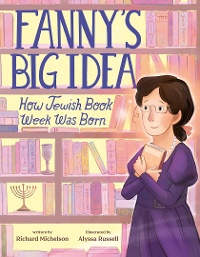 Fanny’s Big Idea: How Jewish Book Week Was Born
by Richard Michelson; illus. by Alyssa Russell
Primary Rocky Pond/Penguin 40 pp.
11/25 9798217003259 $18.99
This amiable picture-book biography introduces librarian Fanny Goldstein (1895–1961) with a focus on her youth and early career, leading up to her 1925 conception of Jewish Book Week. Young Fanny, a Russian Jewish immigrant living in Boston, proudly studied and shared Jewish traditions despite admonitions to be “more American.” The cheerful (if at times oversimplified) text continues to emphasize Goldstein’s pride in her heritage along with her welcoming spirit toward other immigrants as she is appointed a Boston Public Library branch director. The story culminates with Goldstein, after noting that “the great mass of Jewish people [were] not interested in books written by Jews, or about Jews,” hosting a week-long celebration of Hanukkah at her library, which included a display of Jewish books, the first-ever to be exhibited in a U.S. public library. She encourages Jewish and non-Jewish readers alike to read these books, echoing a lesson from her bubbe: “The more you know about someone’s life, the harder it is not to like them.” Michelson (What Louis Brandeis Knows, rev. 11/25) offers a positive portrayal of a Jewish figure’s contributions, with Russell’s winsome digitally created illustrations reflecting “period-specific research.” Back matter picks up where the main text leaves off, citing Goldstein’s further work, often celebrating other underrepresented cultures. A bibliography is also appended. SHOSHANA FLAX
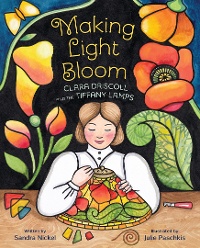
 Making Light Bloom: Clara Driscoll and the Tiffany Lamps
by Sandra Nickel; illus. by Julie Paschkis
Primary Peachtree 32 pp.
6/25 9781682636091 $18.99
This picture-book biography of stained-glass artist Clara Driscoll (1861–1944) opens on a bucolic scene of the gardens and “the house on a hill” in Ohio where she grew up. In the foreground, apple blossoms, morning glories, daffodils, and a dragonfly foreshadow motifs in her iconic work — work attributed to Louis Tiffany until years after Driscoll’s death. That idyllic setting was never far from her mind after she moved to New York City and began working for Tiffany’s stained-glass window company. Nickel follows the path of Driscoll’s career from selecting and cutting glass for windows, to being put in charge of “a new workshop of women,” to her innovative design for her butterfly-and-primrose lamp. Paschkis’s luminous, cheerful illustrations, rendered in pen-and-ink and gouache, appropriately resemble stained glass with their thick black lines, geometric shapes, and bright, rich colors with “dappled and streaked” effects. The engaging text provides an accessible overview of the labor-intensive stained glass–making process and insight into Driscoll as a person (e.g., she read nature poetry to her “Tiffany Girls” to inspire them). An author’s note provides more information about Driscoll’s life, her legacy, and the five design steps involved in producing her lamps; a selected biography and source notes are also appended. See Rubin’s recent Dragonflies of Glass (rev. 5/25) for another portrait of this long-overlooked artist. KITTY FLYNN
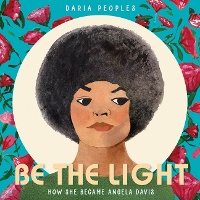 Be the Light: How She Became Angela Davis
by Daria Peoples; illus. by the author
Primary Greenwillow 56 pp.
6/25 9780063206786 $19.99
This picture-book biography of the educator and “passionate activist for equality and justice for all” emphasizes how the events of Davis’s (b. 1944) early life growing up in 1940s and 1950s Birmingham, Alabama, had a profound impact on her later work fighting segregation and racism. Bombings in her neighborhood by the Ku Klux Klan and “whites only” signs at the library, the amusement park, and the movie theater reminded her of societal restrictions, and she became angry. In a spiritual revelation following the death of her grandmother, she let go of her anger and acquired a special power: “the ability to see new freedoms and new futures.” Davis could envision a new world “where segregation, like slavery, was abolished, where God ordained love, and all were welcome.” During adulthood, she became a professor, a political activist for prisoners, and a prisoner herself. While incarcerated, she shared her power with the other women; after her acquittal and release, she became an abolitionist and remains one today. Peoples’s reverent narrative and evocative digitally rendered gouache-like illustrations vibrantly convey the essence of Davis’s unwavering activism and resolute optimism for a new world. Back matter includes an author’s note and a timeline. PAULETTA BROWN BRACY
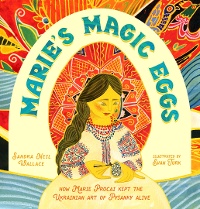 Marie’s Magic Eggs: How Marie Procai Kept the Ukrainian Art of Pysanky Alive
by Sandra Neil Wallace; illus. by Evan Turk
Primary Calkins/Astra 48 pp.
2/26 9781662680694 $19.99
This picture-book biography, illustrated with the bright yellows, reds, and blues of Ukrainian folk art, tells the life story of Marie Procai (1897–1994) and relates her role in preserving the tradition of colored eggs known as pysanky. As a young girl, Marie learns from her baba how to make dye from sunflowers and beets and to use warm beeswax to paint pictures on chicken eggs. These cozy springtime scenes are followed by a grim time of “fighting and famine,” and soon thirteen-year-old Marie flees to the U.S., eventually settling in Minneapolis. Passages with short, rhythmic sentences capture her experiences getting to know her new community (“Mechanics and mill workers. Builders and bakers. All born in Ukraine like Marie”) and explain how she improvised a way to continue making pysanky. Meanwhile, back in Ukraine, pysanky were being destroyed by Russian soldiers, making Procai’s artistry all the more important. Procai uses her art to teach others and to deal with her sorrow, including founding a gift store that continues to this day. Wallace’s tender language (“Every day, like a perfect kind of magic — steeped in the sweet-honey scent of beeswax — Marie created pysanky as beautiful as her baba’s”) and Turk’s gouache, resist, and colored-pencil illustrations combine for an engaging look at a folk artist who accomplished something meaningful for her people. Back matter includes more information about Procai and pysanky as well as a bibliography. SUSAN DOVE LEMPKE
From the February 2026 issue of Notes from the Horn Book.


Added To Cart
RELATED


RECOMMENDED

Please register with us to continue reading.
ALREADY A SUBSCRIBER? LOG IN
We are currently offering this content for free. Sign up now to activate your personal profile, where you can save articles for future viewing.
ALREADY A SUBSCRIBER? LOG IN
Thank you for visiting.
We’ve noticed you are using a private browser. To continue, please log in or create an account.

Add Comment :-
Be the first reader to comment.
Comment Policy:
Comment should not be empty !!!