


2018 School Spending Survey Report
#HBBlackHistoryMonth18
Our commemoration of Black History Month continues with the following new picture books for older readers that recognize African American, Afro Caribbean, and South African trailblazers and pioneers.
 With Before She Was Harriet, the Ransomes (author Lesa Cline-Ransome and illustrator James E. Ransome) have crafted an evocative life story of Harriet Tubman, framed by her travels. On the first page, Tubman gazes out at the reader as an elderly woman. In free verse, the text tells of her past roles (in reverse chronological order) as suffragist, abolitionist, Union spy, nurse, conductor on the Underground Railroad ("Before she was Aunt Harriet / she was Moses"). Arresting watercolors highlight Tubman's face from different angles, always emphasizing her undaunted determination amidst obstacles, as she moves from place to place. (Holiday, 5–8 years)
 Growing up in Puerto Rico, Arturo Schomburg (1874–1938) asked his teachers why his textbooks omitted black people. He knew their contributions mattered, and ravenously read to learn more. At seventeen, Schomburg immigrated to New York, and collecting books became his passion; he became a prominent figure among New York's black literati, and in time his voluminous Africana collection became the foundation for Harlem's Schomburg Center for Research in Black Culture. In Schomburg: The Man Who Built a Library, Carole Boston Weatherford's free-verse text and Eric Velasquez's richly detailed oil paintings aptly capture Schomburg's zeal for learning and for teaching others. (Candlewick 7–10 years)
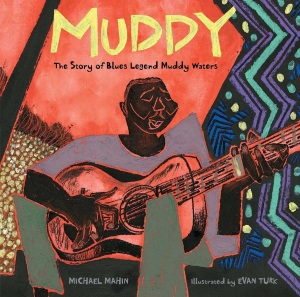 McKinley "Muddy Waters" Morganfield (1915–1983) is known for his role in establishing the musical genre known as the "Chicago blues." Muddy: The Story of Blues Legend Muddy Waters begins with his childhood in Mississippi and his fondness for music — the blues in particular. His grandmother told him that he couldn't "eat the blues for breakfast" and that he shouldn't waste his time on music. "But Muddy was never good at doing what he was told." Michael Mahin's text is engaging, rhythmic, and soulful; and Evan Turk's expressionistic mixed-media illustrations aptly convey the emotions associated with Muddy Waters's music. (Atheneum, 7–10 years)
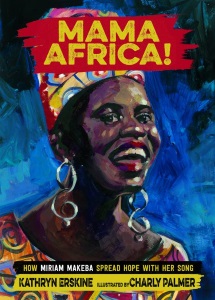 Mama Africa!: How Miriam Makeba Spread Hope with Her Song introduces the remarkable life of the South African apartheid fighter and world-famous singer Miriam Makeba. Kathryn Erskine's prose style is expressionistic and powerful as she provides details about Makeba's life and activism; potent quotes and song lyrics keep the intensity high, as does the occasional use of red to highlight certain words and ideas. Illustrator Charly Palmer's vivid paintings pulse with color, movement, and emotion. The connection between the fight against apartheid and the American civil rights movement is emphasized by the inclusion of both in the substantive back matter. (Farrar, 7–10 years)
From the February 2018 issue of Notes from the Horn Book.


Added To Cart
RELATED


RECOMMENDED

Please register with us to continue reading.
ALREADY A SUBSCRIBER? LOG IN
We are currently offering this content for free. Sign up now to activate your personal profile, where you can save articles for future viewing.
ALREADY A SUBSCRIBER? LOG IN
Thank you for visiting.
We’ve noticed you are using a private browser. To continue, please log in or create an account.

Add Comment :-
Be the first reader to comment.
Comment Policy:
Comment should not be empty !!!