



2018 School Spending Survey Report

Find more great Horn Book content at these links:
Recommended books: reviews and themed booklists
App and e-book reviews
Movie reviews
Event news and recaps
Events calendar
How Many Saturdays? app review
What if we measured our lives in units other than hours, days, months, and years? Would life "feel shorter? Longer? More absurd? More precious?" The Exploratorium's app How Many Saturdays? (2015; iOS only) considers this idea by comparing the number of Saturdays in one’s lifespan to other, less common measurements of time.
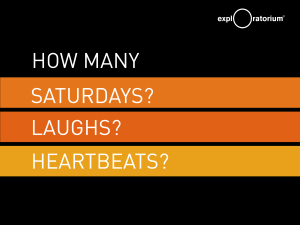 What if we measured our lives in units other than hours, days, months, and years? Would life "feel shorter? Longer? More absurd? More precious?" The Exploratorium's app How Many Saturdays? (2015; iOS only) considers this idea by comparing the number of Saturdays in one’s lifespan to other, less common measurements of time.
After a brief paragraph on how a lifespan can be difficult to conceive of in numbers alone (sound familiar?), the app invites you to input your birthday. This "curious clock" then estimates, based on birthdate, the date of your death — which some users may find a bit morbid. Horizontal bars indicate how many specific units of time are likely remaining “until you die” (displayed on orange); slide to see different units of measurement or toggle to view the passage of time “since you were born” (shown on blue).
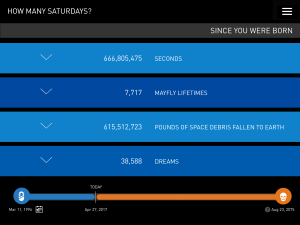
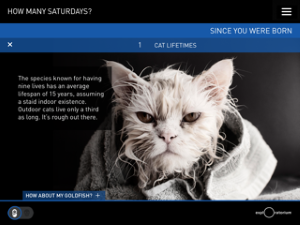
How many blue moons are you likely to see? How many times have you probably laughed? The scenarios include the number of dreams you’ve had/will have in your lifetime, how many Bristlecone Pine lifetimes you’ve lived/will live (at 21, I’ve lived through a mere .004 of one), and how many chickens will be or have been killed for food (it’s…a lot). Tap on a down-arrow icon on any bar to see additional information about that unit of time: under "cat lifetimes," for example, you will learn that "The species known for having nine lives has an average lifespan of 15 years, assuming a staid indoor existence. Outdoor cats live only a third as long. It's rough out there." Tap on "How about my goldfish?" to see the average lives of other pets.
The various means of comparing time draw on a wide range of disciplines, from scientific facts to the ins and outs of presidential elections. Some sections are unfortunately a bit outdated — the one about Halley’s Comet shows its position for 2016, and the presidential election section still has Barack Obama as president. Straightforward text and easy-to-parse, appealing graphics present big ideas about time in an accessible way (the accompanying sound effects are occasionally jarring). With the large number of subjects touched upon, the app appropriately feels like a stroll through a museum's galleries.
Available for iPhone, iPad, and iPod touch (requires iOS 7.0 or later); free. Recommended for intermediate users and up.

Added To Cart
RELATED


RECOMMENDED

Please register with us to continue reading.
ALREADY A SUBSCRIBER? LOG IN
We are currently offering this content for free. Sign up now to activate your personal profile, where you can save articles for future viewing.
ALREADY A SUBSCRIBER? LOG IN
Thank you for visiting.
We’ve noticed you are using a private browser. To continue, please log in or create an account.

Add Comment :-
Be the first reader to comment.
Comment Policy:
Comment should not be empty !!!