


2018 School Spending Survey Report
I Know How to Draw an Owl: Hilary Horder Hippely’s 2025 BGHB Picture Book Award Speech
Thank you to the Boston Globe–Horn Book Awards Committee for this wonderful and completely surprising award, and to the brilliance of Neal Porter and Matt James. Congratulations to everyone who is being honored here today and, as well, to all the authors and illustrators who have had the joy of seeing their beloved books published.
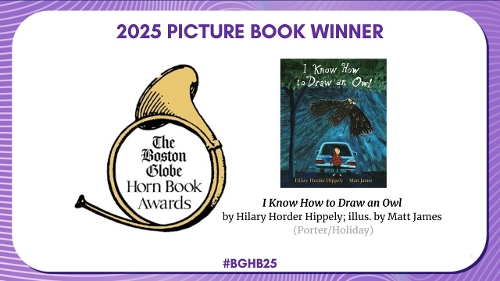
Thank you to the Boston Globe–Horn Book Awards Committee for this wonderful and completely surprising award, and to the brilliance of Neal Porter and Matt James. Congratulations to everyone who is being honored here today and, as well, to all the authors and illustrators who have had the joy of seeing their beloved books published.
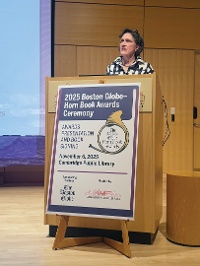 |
| Photo: Cynthia K. Ritter. |
A few years ago, on a gray November afternoon, I was walking by a park on Lake Washington across from a row of lovely old Seattle homes when I saw a young woman folding blankets into the trunk of her overloaded car. I instantly recognized her as unhoused and as the mother of a little girl in my Head Start class. And there was her daughter, running on the beach.
I quickly turned away, not wanting them to see me, and spent all weekend imagining what it must be like for the two of them to live in a car. How did they sleep? What was it like to lead a five-year-old to a smelly, grimy restroom in the middle of the night? The next week at parent-teacher conferences, the mother told me that they had in fact been living in this park for four months, after falling into the spiral we so often hear about: a lost job, lost apartment, living with extended family, and finally, living in a car. But just the day before, they had been able to move into a shelter. “Oh, I am so happy for you!” I said. “It must be warm and safe, and do you each have your own bed to stretch out in?”
“Yes,” the mother said. “But the first night we had to sleep together.”
In recent years I had had other students in my preschool class living in shelters, and as this mother described their life, I was once again struck by the remarkable resilience and bravery these families needed just to make it through another day. Finding places to take showers and wash clothes was hard enough. But how did these parents find ways to keep their hope, their spirits alive — both for themselves and for their children, who looked to them to feel seen and worthy in an unfair, often unkind world?
[Read Horn Book reviews of the 2025 BGHB Picture Book winners.]
They told me how, both in their own words and through their children. They slept wrapped in each other’s arms. They kept home-like rituals and routines; once, after I talked about the importance of reading to your child, a sheltered mother said, “Oh, every night after we brush teeth and put on pajamas, I read her favorite book.” And I’ll never forget the day I read John Burningham’s Cannonball Simp to my class. When I came to the page about the little dog, Simp, being left at a dump by her owner, where she found an old chair to sleep in and a crust of bread, I asked, “How do you think Simp felt?” “Sad,” the children said. “Sad.” “Sad.” But the child living in her car, who had been listening with such intensity, raised her hand and said, “At least she had a chair to sleep in. At least she had a crust of bread.” Clearly her mother’s words, when asked why others had a home and they did not. At least they had their car.
In an earlier life I read a good deal of Shakespeare, particularly King Lear, and in preparing this talk I thought of Shakespeare’s use of the word unnatural. The series of events that led Lear from a castle to no home at all was unnatural and struck terror in him as well as in us, for home is one of our most primal needs. Lear found “home” in the arms and encouragement of other outcast characters, but that was no complete answer. A sense of home may be a spiritual need — home is where the heart is. But it’s also a physical need…come the storm, we need a roof over our heads.
When the time came to retire from my career as a Head Start preschool teacher, I wanted to create a story that would somehow bring to life the poignant realities I had witnessed when parents and children must make “home” out of blankets, gestures, and words.
Writing picture books had always been my life’s dream, and many years earlier that dream had been realized — I had experienced the joy of seeing a few stories become actual books. But while for the past twenty-five years I had tried and tried, nothing had crystallized into that magical, miraculous under-five-hundred-words art form that I — and so many of you — hope to create. And one reason for my becoming a preschool teacher was feeling that even if I never wrote another picture book, I could spend my days reading them, acting them out, and reveling in their language, their stories, their illustrations. Most of the children I taught were from immigrant families — one year my class had twenty students and seven languages. Several times a day they each chose a book from the huge basket on the floor, and nothing is more wonderful than watching a roomful of little children in rapt attention as they turn those pages. “Now tell me the story,” I would say. And finding the words to retell a favorite story was one way these very young children learned to speak their new language.
So for years I had borne witness to the extraordinary power of picture books — to demonstrate wonderful language, to lead children to find themselves in characters, to bring to life the complexities of the world. We are living in unnatural times. But I wondered if I could tell a story of an unhoused mother and child that would convey the beauty in the midst of the grime and unnaturalness and shame. I wanted to find a way to show it and to honor it — both for these children and their parents and for the rest of us who know so little about their lives. I am so grateful to the members of the Boston Globe–Horn Book Awards Committee for suggesting that I may have succeeded.
From the January/February 2026 issue of The Horn Book Magazine. For more on the 2025 Boston Globe–Horn Book Awards, click on the tag BGHB25.
 Single copies of this issue are available for $15.00 including postage and may be ordered from:
Horn Book Magazine Customer Service
magazinesupport@mediasourceinc.com
Full subscription information is here.

Added To Cart
RELATED


RECOMMENDED

Please register with us to continue reading.
ALREADY A SUBSCRIBER? LOG IN
We are currently offering this content for free. Sign up now to activate your personal profile, where you can save articles for future viewing.
ALREADY A SUBSCRIBER? LOG IN
Thank you for visiting.
We’ve noticed you are using a private browser. To continue, please log in or create an account.

Add Comment :-
Be the first reader to comment.
Comment Policy:
Comment should not be empty !!!