



2018 School Spending Survey Report

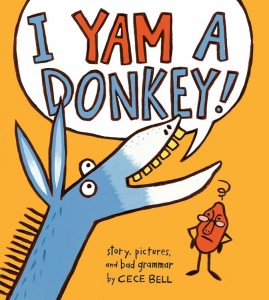
I Yam a Donkey!
Who remembers a little book from last year called El Deafo? Graphic novel memoir? About growing up deaf? Won a Newbery Honor and an Eisner Award — that one.
 Who remembers a little book from last year called El Deafo? Graphic novel memoir? About growing up deaf? Won a Newbery Honor and an Eisner Award — that one.
Cece Bell's follow-up to El Deafo — that smart, witty, sensitive, unique, personal story — is a picture book about … a dumb-ass (literally!) donkey and the pompous yam who tries to school it.
This book is a joke about language in the who's-on-first? tradition, and it's a hilarious one from start to finish. Who knew grammar could be so funny? But this is Calling Caldecott, so let's leave Heavy Medal to talk about the text (hint, hint) while we talk about the pictures.
Can you talk about these pictures without the words? Do the illustrations take a backseat to Bell’s laugh-out-loud text? Plus, come on, those characters are kind of gross: that lumpy tuber, the weird-looking green beans, the horizontal carrot. Worst of all, those yellow donkey-teeth. *Shudder*
From the perspective of how well these pictures tell this silly story, Bell's book is a rollicking success. The art was done in china marker and acrylics on vellum (per the copyright page), and it looks like something a child might draw, with that asymmetrical yam and that simple-looking donkey made up of recognizable shapes. The thick outlines, too, are childlike, but look at the shades and textures in them, also in the word-bubble outlines. And look at how the yam has slight dimension to its skin, and how the donkey's muzzle draws your attention straight to those teeth. There's more going on here visually than first meets the eye, both in the art itself and — again, in a book about grammar — in the way a sentence looks. If you didn’t know before what quotation marks were for, or bold font, or ALL CAPS, you probably do now.
The scenery doesn’t change much throughout the book; the characters are basically standing in one place, arguing (again: about grammar). How do you make that interesting to look at? One way is by changing the characters' facial expressions and postures. You can tell that Donkey is having a grand old time from beginning to end — look at its eyes (alternating between wide-open curiosity and closed in satisfaction or laughter) and at the ever-changing angle of its ears. And as the yam's fury grows, its eyebrows change shape, its glasses come off — classic temper tantrum.
The use of panels and frames also shape the story with pacing and humor. There are a lot of spreads in a row, then when the argument really gets going, we get to those panels, which accelerate things even more.
The background colors, too, shift, but they're subdued so as not to compete with the mayhem. Light green, light blue … then orange? Uh-oh. Those pages really call attention to the action — that funny "sniff," that grammar lesson, complete with diagram, the light bulb starting to go off in Donkey's brain, the final CHOMP!
And *finally* we get that great payoff for having suffered through those yucky-looking teeth. "OH! You is LUNCH!"
Humor doesn’t usually win the Caldecott. Hard-to-quantify things (such as page-turns) don't usually win. Come on, Donkey. Prove 'em wrong. Show 'em how smart you are.



RECOMMENDED
Please register with us to continue reading.
ALREADY A SUBSCRIBER? LOG IN
We are currently offering this content for free. Sign up now to activate your personal profile, where you can save articles for future viewing.
ALREADY A SUBSCRIBER? LOG IN
Thank you for visiting.
We’ve noticed you are using a private browser. To continue, please log in or create an account.

Add Comment :-
Comment Policy:
Comment should not be empty !!!
Susan Dailey
Love this book! Thanks for the great review, Elissa. Although the text is what captured my attention first, you did a fantastic job of pointing out how effective the illustrations are. Could there be a better style for this book?Posted : Nov 12, 2015 04:24
Allison
GREAT review! I am impatiently waiting for our copy to come in to share with my kids and our students at school. Will try to pop back to say more after I've seen it!Posted : Nov 08, 2015 08:28
Elissa Gershowitz
I think *this* would be my kids' Calde-tot pick.Posted : Nov 06, 2015 07:39