


2018 School Spending Survey Report
In and around the sea
Here are six nonfiction picture books for the marine maven in your life.
Here are six nonfiction picture books for the marine maven in your life. For more, see our Five Questions interview with Michelle Cusolito and Jessica Lanan about In the World of Whales, and the Animals--Marine animals tag in the Guide/Reviews Database.
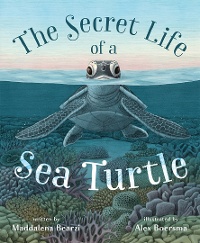 The Secret Life of a Sea Turtle
by Maddalena Bearzi; illus. by Alex Boersma
Primary Roaring Brook 48 pp.
5/25 9781250901675 $19.99
e-book ed. 9781250430571 $11.99
In a narrative beginning and ending at the Ría Lagartos nature reserve on the Yucatán Peninsula, readers follow the perilous and often enigmatic life of a single green sea turtle from birth to egg-laying adult. A cross-section image of a tiny green turtle still peacefully tucked away in its eggshell provides a moment of reprieve prior to the dangers that the hatchling (and siblings) will soon face. Circumstances for a newborn sea turtle are immediately perilous, with threats including everything from hungry predators to misdirecting light-pollution. Once in the ocean, and after a mysterious stretch of time in a young sea turtle’s development identified as the “lost years,” the focus shifts to sea turtle physiology, diet, defense strategies, migration habits, and other high-interest facts presented through approachable text and supportive illustrations. An emphasis on environmental protection, demonstrated by the actions of conservationists to save the turtle protagonist from a deadly drift net, adds drama. Marine biologist Bearzi skillfully balances scientific information with evocative present-tense writing: “The moon is standing witness to this astounding new chapter of our turtle’s life.” Boersma’s detailed graphite and digitally colored illustrations are accurate and expressive, with revealing depictions of life above and below the sand and waves, effective use of panels to show growth and time, and surprising shifts in perspective. Substantial back matter includes an author’s note alongside sources and additional scientific information. PATRICK GALL
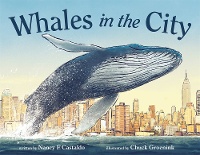 Whales in the City
by Nancy F. Castaldo; illus. by Chuck Groenink
Primary Farrar 40 pp.
3/25 9780374308568 $18.99
e-book ed. 9780374395162 $11.99
The first half of this informational picture book is narrated by the collective “we” of generations of humpback whales: “Before there were ships and streets and buildings and a city called New York, we were here.” Subsequent pages depict whales and other sea creatures cavorting in what would soon become New York Harbor, with devastating harpooning and ship traffic and choking pollution to follow. The once-rich waters are no longer habitable, and the whales take off for “cleaner waters and a safer home.” In a (somewhat abrupt) turn, the art and text shift perspective, moving onto the land, and the narrative “we” becomes the voice of New York’s human inhabitants in the decades before and after passage of the Clean Water Act in 1972. Diverse groups of New Yorkers are shown marching in support of environmental action; later, people clear litter from the river and enjoy boating, fishing, and other activities — eventually rejoined by a new generation of New York Harbor whales. Detailed back matter includes whale facts, a timeline, brief profiles of significant activists, and calls to action. Castaldo’s text, accompanied by Groenink’s detailed and expansive gouache and graphite illustrations, offers hope for aspiring citizen activists and makes a compelling case for taking the long view and not giving up the fight. NORAH PIEHL
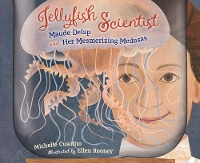 Jellyfish Scientist: Maude Delap and Her Mesmerizing Medusas
by Michelle Cusolito; illus. by Ellen Rooney
Primary Charlesbridge 32 pp.
4/25 9781623545819 $18.99
e-book ed. 9781632894526 $9.99
Maude Delap (1866–1953) lacked a formal education, but that didn’t stop her from pursuing a life of science. From her island home off Ireland’s coast, Delap conducted pioneering research into the jellyfish life cycle, raising the creatures in captivity and observing them carefully as they grew. Cusolito sets her story from June 1899 to September 1900. The passage of time is marked by dated entries, but the text is written in the present tense with frequent use of direct address, plunging readers into both the immediacy of science and its painstaking nature. In Rooney’s illustrations, Delap usually wears a smile — it’s obvious she’s delighted with her experiment — and is frequently accompanied by a young relative, providing a character for readers to identify with. White-on-blue close-ups of the growing jellyfish reveal a complicated, many-phased metamorphosis, their emerging tentacles and frills visually echoed in the curves of the display type. Scientific vocabulary (planulae, polyp, ephyra) is introduced and defined gracefully in context. While a closing biographical note emphasizes both the misogyny that marginalized Delap and the importance of the research she conducted within its constraints, the primary narrative emphasizes the joy of science for science’s sake. Further information about jellyfish, author and illustrator notes, and a handful of additional resources fill out the back matter. VICKY SMITH
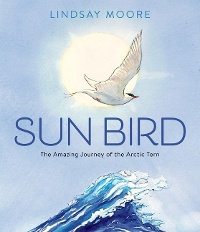 Sun Bird: The Amazing Journey of the Arctic Tern
by Lindsay Moore; illus. by the author
Primary Greenwillow 40 pp.
2/25 9780063061002 $19.99
Summer in the northern polar regions finds a pair of Arctic terns caring for their two newly hatched chicks. In lushly illustrated landscapes of sea, ice, rock, and sky, they catch fish and fend off ravens, foxes, and polar bears. By fall, the young birds are strong enough to “follow the sun” thousands of miles south, all the way to the Antarctic, on the longest known migration journey of any animal on Earth. Moore’s poetic lines, just a few on most pages, include essential scientific details about the terns (“With bodies home / to hollow bones, / and wings like sails, / they soar on the wind”) and other animals they meet on their travels. Some of these encounters, as with a fish-stealing skua, are perilous, while others, as with the minke whale, are peaceful. Moore’s delicate watercolors are a marvel of animals in motion: soaring, diving, bobbing, reaching, schooling. Some are solo close-ups; others convey the awesome sight of multiple birds in flight. Back matter provides more information about the terns’ amazing twice-a-year journey. DANIELLE J. FORD
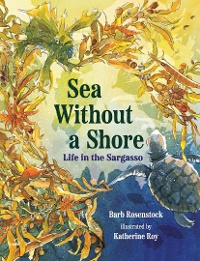 Sea Without a Shore: Life in the Sargasso
by Barb Rosenstock; illus. by Katherine Roy
Primary Norton 32 pp.
9/24 9781324016076 $18.99
The Sargasso Sea sits within the Atlantic Ocean and is home to an ecosystem centered on the seaweed genus Sargassum. To the children portrayed exploring the seashore in the opening pages (and to readers), Sargassum may look like a plant, but it is actually algae and has intriguing characteristics. The large clumps of Sargassum that float on the water and reproduce by fragmentation host a diverse array of life. Rosenstock moves across the region’s food web from the tiny to the large, beginning with microscopic life (“Crusty bryozoans / Feathery hydroids / Spiraled tube worms”) and continuing through mollusks and crustaceans to the largest fish and whales. The text is dense with descriptive words, poetic phrasing, and scientific details: “The frogfish creeps. Hanging by fingery fins. Luring in prey, darting out to swallow it whole.” A repeated phrase with slight variations at the end of each section connects each species back to its seaweed host. Roy’s lush illustrations, set in clear, deep blue waters, bring it all to life. Featured species live, hunt, and reproduce within the swirling ocher of the Sargassum fronds, while white speckles of nutrients drift by. Back matter includes a helpful map and key to major Sargasso Sea species, an afterword by marine biologist Dr. Sylvia Earle, considerations of threats from climate change, and an account of the author and illustrator’s travels to Bermuda to see the Sargasso Sea and consult with oceanographers. DANIELLE J. FORD
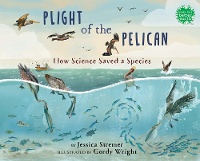 Plight of the Pelican: How Science Saved a Species [Books for a Better Earth]
by Jessica Stremer; illus. by Gordy Wright
Primary Holiday 40 pp.
4/25 9780823457038 $19.99
e-book ed. 9780823462094 $11.99
The partnership between Stremer’s expressive and suspenseful text and Wright’s evocative hand-painted gouache, ink, and acrylic illustrations (see Great Carrier Reef, rev. 7/23) gives readers an exceptionally clear picture of the discovery and correction of one historical threat to wildlife: the use of DDT on crops. The text on the opening spread is positioned like a projectile moving across the page in concert with a brown pelican pod flying together, which plunges as the birds dive for fish. Readers then discover a problem that scientists noticed in the 1950s: fewer and fewer pelicans being born. The text asks: why? Scientists find that the birds’ eggshells have become so fragile they cannot support the parents’ weight in the nest. Again, the same question: why? And again, scientists search to find the answer, eventually theorizing that DDT contaminates the food chain, leading to weakened shells. They test this hypothesis, and even though they find strong evidence of the link, these findings are rejected by farmers, the companies that produce DDT, and the government. But public protest drowns out these voices, and the use of DDT is finally eliminated. The book concludes with other concerns that threaten wildlife today. Extensive back matter offers further detail (including spelling out Rachel Carson’s role in sounding the alarm about DDT), additional brown pelican facts, a glossary, a bibliography, and an index. BETTY CARTER
From the August 2025 issue of Notes from the Horn Book.


Added To Cart
RELATED


RECOMMENDED

Please register with us to continue reading.
ALREADY A SUBSCRIBER? LOG IN
We are currently offering this content for free. Sign up now to activate your personal profile, where you can save articles for future viewing.
ALREADY A SUBSCRIBER? LOG IN
Thank you for visiting.
We’ve noticed you are using a private browser. To continue, please log in or create an account.

Add Comment :-
Be the first reader to comment.
Comment Policy:
Comment should not be empty !!!