



2018 School Spending Survey Report

Josephine
The subtitle of Patricia Hruby Powell (author) and Christian Robinson (illustrator)'s fabulous picture-book biography of the early-twentieth-century African American dancer and iconoclast is "The Dazzling Life of Josephine Baker" — and the book is truly as dazzling as its subject.
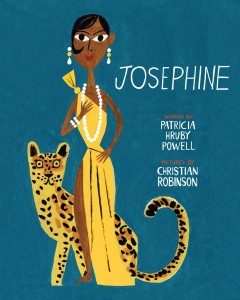 The subtitle of Patricia Hruby Powell (author) and Christian Robinson (illustrator)'s fabulous picture-book biography of the early-twentieth-century African American dancer and iconoclast is "The Dazzling Life of Josephine Baker" — and the book is truly as dazzling as its subject. So we can get that major, crucial criterion "appropriateness of style of illustration to the story, theme or concept" out of the way right off the bat; this book will be hard to beat in that category. Every adjective I can think of for the book's art — vivid, bold, electric; essential; full of verve and pizzazz and razzmatazz — applies to the book's subject as well. The saturated colors (a rainbow of them — and again, how appropriate); the visible brushstrokes — also brilliantly appropriate for a book about such an outsized and charismatic personality.
I used the word essential up above. I'm not exactly sure I'm using it correctly, but here is what I mean. On the spread where Josephine finally gets to join the chorus with the Dixie Steppers and immediately stands out from the crowd, all we see is four figures forefronted on a page of a rather neutral color — no background at all. The four figures — dancers in the chorus — are delineated about as simply as cartoons: circles for eyes, circles and lines for mouths and noses. Nobody has the correct number of fingers. This is pared-down, impressionistic painting — except that somehow artist Robinson makes Josephine Baker stand out so starkly from the others that you barely need to read the text ("The chorus kicked forward, / she kicked backward... / They strutted, / Josephine shimmied instead"). Where the other figures are basically vertical, Josephine is all curved kinetic motion — hips swinging to the side, arms outstretched. And with just a white crescent for her smile and a few lines for her rapturously closed eyes, Robinson captures her ecstatic joy in dancing.
More "appropriateness": the book uses the framing device of a stage to tell the story of Josephine's life. It opens with a double-page spread of a stage, red theatrical stage curtains pulled closed: the performance is about to begin. From then on each section ("The Beginning"; "Leavin' with the Show"; "My Face Isn't Made for Sleeping"; etc.) opens with a spread of that stage with curtains pulled to the side, a few props or pieces of scenery in place, ready for the action to begin. (I particularly appreciate "The Beginning" 's center-stage spotlight; we are clearly expecting a star to enter.) This framing device is a brilliant choice for a woman who made such an impact on performance art and who felt most alive when dancing onstage. And notice that the book's final double-page spread, after all the text has been presented, including the account of Baker's death, is an echo of the first closed-curtain one, this time with flowers strewn all over the stage floor in tribute. It's a poignant and appropriately dramatic end to a dramatic story.
There is so much more to talk about in Josephine, and I hope you'll join in the conversation about this exceptional book. I'd like to hear all the ways YOU think it's excellent in terms of the "execution in the artistic technique employed;
- Excellence of pictorial interpretation of story, theme, or concept;
- Appropriateness of style of illustration to the story, theme or concept;
- Delineation of plot, theme, characters, setting, mood or information through the pictures;
- Excellence of presentation in recognition of a child audience."
P.S. Josephine, which was published in February, is the winner of a 2014 Boston Globe–Horn Book Honor Award for Nonfiction, and the awards ceremony is tomorrow night at Simmons College, with a colloquium the next day. I don't want to spoil the surprise, but I will say that Josephine fans who attend the colloquium will be very happy with one of the treats in their goody bags.
P.P.S. I am sure I will be much more informed after listening to the illustrator and author of Josephine this weekend, and I will be sure to share all insights gleaned in the comments below.


RECOMMENDED

Please register with us to continue reading.
ALREADY A SUBSCRIBER? LOG IN
We are currently offering this content for free. Sign up now to activate your personal profile, where you can save articles for future viewing.
ALREADY A SUBSCRIBER? LOG IN
Thank you for visiting.
We’ve noticed you are using a private browser. To continue, please log in or create an account.

Add Comment :-
Comment Policy:
Comment should not be empty !!!
Linda
Not that it's definitive or anything, but the BGHB judges didn't think of JOSEPHINE as a picture book. :-( Robinson's color palette (not to mention his style) does not vary much in GASTON and THE SMALLEST GIRL IN THE SMALLEST GRADE. Can you talk about why it's more appropriate--in a distinguished way--to this particular book?Posted : Oct 14, 2014 03:23
Roger Sutton
Gee. MVP, that sounds like a vote for HUGO CABRET ;-)Posted : Oct 14, 2014 03:14
Susan Dailey
After "Hugo," I've given up trying to figure out what the committee will think is an illustrated book. I know I questioned whether this book was a picture book when I wrote comments about it. Am I remembering correctly that there are text only pages that appear on "painted" paper?Posted : Oct 14, 2014 12:50
Martha V. Parravano
Brief post- BGHB symposium report: Illustrator Christian Robinson noted that he struggled with how to tell the story of an adult's life to children, and eventually decided to concentrate on capturing the emotional content of Josephine Baker's life. And how did he do that? Through COLOR. That really makes sense to me!Posted : Oct 13, 2014 06:40
Sam Juliano
Tremendous comment Robin! :)Posted : Oct 10, 2014 08:11