



2018 School Spending Survey Report

Julián Is a Mermaid
If the Caldecott Medal is for a book that, among its other qualities, “provides children with an essentially visual experience,” then I hope the 2019 Caldecott Committee is taking a good long look at Julián Is a Mermaid, written and illustrated by Jessica Love.
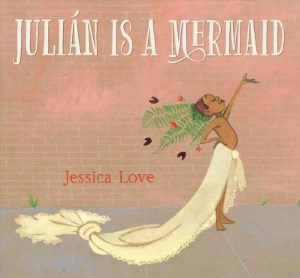 If the Caldecott Medal is for a book that, among its other qualities, “provides children with an essentially visual experience,” then I hope the 2019 Caldecott Committee is taking a good long look at Julián Is a Mermaid, written and illustrated by Jessica Love. With a text just shy of ninety words, the book’s thirty-two pages take their hero — and readers — on a quest that is both geographical (from the community pool to the subway to home to the beach) and self-actualizing (from fantasy to desire to transformation, acceptance, and community). Jung would have a field day.
While the opening text tells us that “Julián LOVES mermaids,” it is when he and his abuela are on the subway train and he sees three beautiful and friendly strap-hangers in glamorous fishtailed gowns that he becomes truly inspired. He and Abuela arrive home and, while she goes off the page to take a bath, Julián repurposes first a potted fern, then some flowers, a lipstick, and, for his final flourish, a curtain (à la Scarlett O’Hara and Maria von Trapp) to transform himself into the beautiful mermaid he knows himself to be. Abuela, returning from her bath, does not look happy, and while the text only says, “Uh-oh,” you know that Julián is wondering: Is it the flowers? Is it the drapes? Is it… me?
I’m guessing Abuela might be a little cheesed about the drapes (wouldn’t you?) but soon reveals herself to be the bigger person, exiting the page again and returning with a beautiful necklace to complete Julián's ensemble: “Come here, mijo.” Then she takes him to a parade (possibly Coney Island’s Mermaid Parade, previously celebrated in Melanie Greenberg’s picture book Mermaids on Parade), where he discovers lots of people dressed like him, including the glamazon trio he had met on the train.
The text only serves as markers or nudges; the entire story can be discerned through the pictures, painted on brown paper that makes the colors absolutely pop. And reflecting the aquatic theme, fluid lines dive and swerve, whether it’s a mermaid’s hair or tail, or a swoop of sea creatures Julián imagines himself to be swimming among, on a spread that recalls for me a similar effect Pauline Baynes achieved in her Noah’s Ark. Especially beautiful here is a large dark-purple-patterned fish, who gives Julián a sea-bits necklace; the fish’s color and patterning return in the dress Abuela puts on to take Julián to his destiny.
What’s the message? I don’t think the book has any particular gender-agenda, but it does tell adults to listen to and love the children they care for and to let them know that whoever and whatever they are, they aren’t the only one. Life is a parade. You come, too.
Bonus points for endpapers: The opening set shows Julián swimming amidst Abuela and her trepidatious water aerobics buddies, each in gorgeously colored swim gear; at the close, we see those same suits extended into mermaid tails, and Julián himself completely transformed into a sleek pink-tailed mermaid with long flowing locks, all parties confidently breathing underwater.



RECOMMENDED

Please register with us to continue reading.
ALREADY A SUBSCRIBER? LOG IN
We are currently offering this content for free. Sign up now to activate your personal profile, where you can save articles for future viewing.
ALREADY A SUBSCRIBER? LOG IN
Thank you for visiting.
We’ve noticed you are using a private browser. To continue, please log in or create an account.

Add Comment :-
Comment Policy:
Comment should not be empty !!!
Angela Reynolds
I keep coming back to this book with renewed appreciation. The spread where Julian is fully dressed, and Abuela comes into the room is masterful in design: on one page, pride and joy, the next page, faded colours and drooping ferns show us that the child is not sure what happens next. I love the swooping mermaid-tail line that appears over and over in the book. And though the palette is muted, the colours stand out and shine. I hope this book gets some extra metal on the cover!Posted : Jan 17, 2019 07:16
Sam Juliano
"With a text just shy of ninety words, the book’s thirty-two pages take their hero — and readers — on a quest that is both geographical (from the community pool to the subway to home to the beach) and self-actualizing (from fantasy to desire to transformation, acceptance, and community). Jung would have a field day." My favorite passage of all of a very great review in the service of a magnificent picture book from an author who name denotes love at first site. I can happily report that the first graders in my northern New Jersey school district were enraptured with the book, open mouthed at some of the wordless paintings, especially the first double page spread of the mermaid being swept up in a school of fish with the gouache watercolors jumping off the pastel green base (what you Roger refer to on another page as "painted on brown paper that makes the colors absolutely pop" .and that Fellini-esque party at the beach on the final two dazzling tapestries. If we are only concerned about the beauty of the art in a picture book this year, I'd say this book stands with 2018's finest, though the minimalist language is so well integrated into this phantasmagorical fable. I do agree that there isn't any deliberate gender-bending here, and that any such contention is waived into favor of life's celebration and individuality. I am in full accord with your marvelous en paper observations and feel the inside cover is one of the best we've seen this year. Ravishing. Thank you Roger for such a magisterial qualification essay for a personal favorite. (though I'm sure it is a favorite of many).Posted : Oct 17, 2018 07:49