


2018 School Spending Survey Report

Find more great Horn Book content at these links:
Recommended books: reviews and themed booklists
App and e-book reviews
Movie reviews
Event news and recaps
Events calendar
Kids Discover: Cells app review
By now, nonfiction magazine Kids Discover has adapted twenty-two (and counting) of its issues to digital, covering a wide range of natural and social science topics from the microscopic to the galactic.
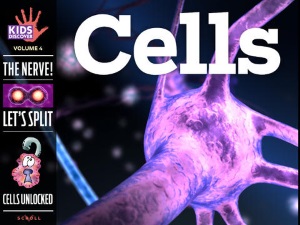 By now, nonfiction magazine Kids Discover has adapted twenty-two (and counting) of its issues to digital, covering a wide range of natural and social science topics from the microscopic to the galactic. Every issue — and by extension, every app — offers eight informational chapters, each with an introductory paragraph followed by a engaging, collagelike layout of brief facts, photos, cartoons, and sidebars.
Volume 4: Cells (Joe Zeff Design, 2013), the second Kids Discover app I've explored, includes chapters entitled "The Stuff of Life," "Zooming In," "DNA Unraveled," "What Cells Do," "Incredible Journey," "The Story of Cells," "Hand-Me-Down Genes," and "Engineering a Better World?" The app introduces intermediate users to various types of cells' structures and functions, the scientific discovery of cells, cell specialization, life span and replication (mitosis and meiosis) of cells, DNA and chromosomes, and heredity. The chapter "Engineering a Better World?" is particularly interesting, covering genetic engineering, testing for inherited diseases, and a balanced discussion of some controversial applications of genetic research (e.g., cloning, use of embryonic stem cells).
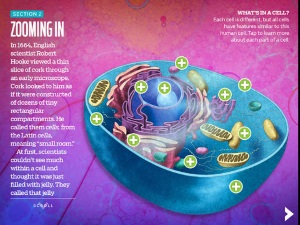
The interactivity here is minimal but well considered, with sound effects, animations, and brief videos (such as a virtual tour inside a white blood cell) extending the information offered in the text. Several potentially unfamiliar words (e.g., "eukaryote") appear in glowing red type; when clicked, they are said aloud so that users can hear their correct pronunciations. Three additional sections offer activities (a maze, a nine-piece puzzle, and a word game, all of which unfortunately feel a bit young/easy for the intermediate audience), a comprehension quiz, and print and web resources for further exploration.
The app is made for browsing, with an emphasis on breadth rather than depth. Still, this overview is fascinating and — especially accompanied, as it is, by crisp microscope photography of cells, viruses, etc. — will likely encourage kids to continue learning about cells elsewhere.
A few additional resources (lesson plans, an infographic of a cell's interior) are available for free on Kids Discover‘s website.
Available for iPad (requires iOS 6.0 or later); $3.99. Recommended for intermediate users. Also available in print; $4.99.


Added To Cart
RELATED


RECOMMENDED

Please register with us to continue reading.
ALREADY A SUBSCRIBER? LOG IN
We are currently offering this content for free. Sign up now to activate your personal profile, where you can save articles for future viewing.
ALREADY A SUBSCRIBER? LOG IN
Thank you for visiting.
We’ve noticed you are using a private browser. To continue, please log in or create an account.

Add Comment :-
Be the first reader to comment.
Comment Policy:
Comment should not be empty !!!