


2018 School Spending Survey Report

Find more great Horn Book content at these links:
Recommended books: reviews and themed booklists
App and e-book reviews
Movie reviews
Event news and recaps
Events calendar
Kiko’s Thinking Time app review
In today’s exciting installment of "Shoshana Is Bad at Spatial Reasoning"…Kiko’s Thinking Time (Kiko Labs, 2015; iOS only)! This is an app with a lot of games that help hone a lot of skills.
 In today’s exciting installment of "Shoshana Is Bad at Spatial Reasoning"…Kiko’s Thinking Time (Kiko Labs, 2015; iOS only)! This is an app with a lot of games that help hone a lot of skills. I’m sorry, did I say “a lot?” I meant “a zillion.” Approximately.
Each day, the app provides a “Daily Quest.” Complete a series of games, and move a friendly fox (Kiko?) further along a path leading to a treasure chest to collect a prize: a fish to add to your Collection pond and then feed, play with, and earn affection from in the form of little hearts. (The Collection is a little confusing — you can take fish out of the pond with a net, and the narrator tells you that you can see the fish again by tapping the green button with the net, but you actually need to tap the red button with the arrow.)
If you’d rather select your own games, just go to Free Choice, which categorizes the games by skill. When you open each game, it gives more information about the skills it teaches.
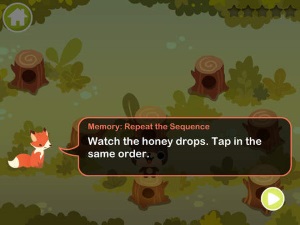
There are Memory games such as “Repeat the Sequence.” Watch the honey drops fall onto the tree stumps, and then tap the stumps in the same order. The Easy mode is indeed easy — even I can remember the locations of two stumps. But as with most of the games, there’s a huge difference between the Easy and Hard modes. Who can remember where twelve honey drops dropped? Not me, that’s for sure.
Under Focus, there’s “Popcorn Match,” which targets “selective attention, visual processing.” Two clusters of colorful popcorn must match exactly in order to fall into the bags. This one, in the Hard mode, prompted me to lament to Siân: “Why does a voice keep saying, ‘the popcorn pieces must be the same!’ Am I in a popcorn dystopia?” But that says more about my ability to notice subtle visual differences than it does about the nature of the app.
The Flexibility category has games such as “Rule Switching.” In this game, a pet tells you what it likes to eat via a speech bubble, establishing a rule for color or shape; as treats appear, you decide whether they follow the rule and should go into the pet’s mouth, or don’t follow it and should return to the cookie jar. The Spatial category has some shape-matching games, as well as the torture device known as “Donut Spin.” This game shows you a particular donut’s position in a box, closes and spins the box, then asks you to indicate where that same donut has ended up. If you’re me, that means a) you will probably get the answer wrong and b) you will crave donuts, and you won’t have any. But if you’re someone who’s good at this stuff, especially someone who doesn’t like donuts, it’s an interesting challenge.
And so on, and so forth. An Inhibition category with games where you have to stop yourself from answering too impulsively. A Reasoning category that involves completing analogies. All of the games include cute little creatures and/or appealing food motifs.

This elaborate app allows up to four accounts, and there’s plenty of information for parents, including a Progress section that breaks down the skills players have demonstrated. It all seems useful but perhaps a bit more intense than necessary. These challenges can be a lot of fun — snark about donut torture aside — but I can also imagine them becoming a chore if too much emphasis is placed on meeting benchmarks.
So sort away! Reason away! Focus away! And maybe (if you’re a neat enough eater) bring some donuts.
Available for iPhone, iPad, and iPod touch (requires iOS 6.0 or later); free preview. Monthly subscriptions for unlimited access: $7.99. Recommended for preschool and primary users.


Added To Cart
RELATED


RECOMMENDED

Please register with us to continue reading.
ALREADY A SUBSCRIBER? LOG IN
We are currently offering this content for free. Sign up now to activate your personal profile, where you can save articles for future viewing.
ALREADY A SUBSCRIBER? LOG IN
Thank you for visiting.
We’ve noticed you are using a private browser. To continue, please log in or create an account.

Add Comment :-
Be the first reader to comment.
Comment Policy:
Comment should not be empty !!!