


2018 School Spending Survey Report
Learning from each other
A new school year can mean new friendships…and it can also mean new worries. Here are eight picture books with social-emotional learning themes that new and returning learners may find helpful or reassuring when starting school (or at any other time).
A new school year can mean new friendships…and it can also mean new worries. Here are eight picture books with social-emotional learning themes that new and returning learners may find helpful or reassuring when starting school (or at any other time). For more on first days of school everywhere, see our Five Questions interview with Ibi Zoboi and Juanita Londoño about First Day Around the World.
 George & Lenny Are Always Together
by Jon Agee; illus. by the author
Preschool, Primary Rocky Pond/Penguin 40 pp.
5/25 9780593857731 $18.99
e-book ed. 9780593857748 $10.99
Lenny, a small gray rabbit, and George, a large brown bear, are an inseparable duo, until Lenny begins to ponder the idea of spending time alone. George, less enthusiastic about the proposition, anticipates feeling lonely and believes “nothing could be as much fun as being together!” Confident about wanting to experience some independence, Lenny retreats to a cozy space large enough for only a tiny rabbit. “Here I am at last. In a quiet place. Alone.” Lenny settles into an assortment of solitary activities, but eventually his thoughts return to George. And where is George, anyway? Agee’s gouache illustrations, featuring black outlining and the use of solid colors against neutral-toned backgrounds, have a minimalistic composition with substantial negative space. His thoughtful exploration of negotiating togetherness in friendship is presented simply and is approachable for young readers, yet relatable for those of all ages. EMILY BRUSH
 Bunny Made Tea
by Amanda Baehr Fuller; illus. by the author
Preschool, Primary Owlkids 32 pp.
2/25 9781771476812 $18.95
Bunny peers out into a blustery, unpleasant day and decides tea is the remedy. Gathering herbs and petals, Bunny makes some; the scent of a fresh brew attracts Opossum, also in need of a cuppa. The larger animal drinks all of Bunny’s tea, so Bunny sets out again to collect ingredients for a second pot. Just as Bunny is about to drink the tea, Opossum and her four babies arrive, startling Bunny, who spills it. Now clearly annoyed, Bunny sets out to gather more ingredients in larger quantities, but this time with the quiet assistance of one emotionally attuned Opossum baby, who senses the rabbit’s frustration. After the Opossums enjoy Bunny’s hospitality, there’s no tea left, and Bunny goes to bed without. The next day, a cheery pink teapot that matches the morning sky appears at the doorstep, and as Baby Opossum watches from a distance, Bunny finally has that elusive cup of tea. Short, direct sentences using clever repetition tell the story, while clues about the passing of time appear in the boldly textured illustrations. Readers will sense the animals’ moods through their body language and expressive eyes. Themes of sharing, gratitude, and unlikely animal gatherings call for paired readings with books such as Bear Snores On; Mine! (rev. 7/23); Mother Bruce; and The Little Red Hen, whether at bedtime or with a story-hour crowd. PAM YOSCA
 Punch!: A Story About Kindness
by Michael Hall; illus. by the author
Preschool, Primary Greenwillow 40 pp.
4/25 9780062866219 $19.99
An angry badger faces surprising consequences for his bad behavior in this multilayered picture book. Badger — red-faced, glowering, and dressed in yellow shorts and tattered socks — pulls a mysterious wagon in and out of altercations with his animal peers. Badger trips, shoves, kicks, and pokes — each violent word jumping off the page in bold red text — before skulking off into the woods. His scowling victims then craft a three-part plan to chasten their volatile peer. Their revenge, however, takes a punny turn. In a close-up spread, an oversized, looming Bear hauls back to deliver a mighty “Punch!” to cowering Badger; but after the page-turn, the view pans out to reveal that the punch is the thirst-quenching kind, perfect for sharing. Hall’s appealing digital and painted-paper illustrations add to the gag — the blocky, collaged character art lending itself to both exaggerated facial expressions and ambiguous body language. As parts two and three of the plan unfold similarly — an offering of a “Belt!” and a “Sock!” to the disheveled Badger is especially amusing — another, more heart-rending story emerges. Details in the art reveal that Badger isn’t just grumpy, he’s grieving the death of a beloved friend. Witty and offbeat, this moral tale offers an uncommonly complex lesson in practicing empathy. JESSICA TACKETT MACDONALD
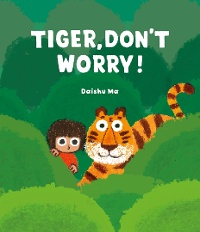 Tiger, Don’t Worry!
by Daishu Ma; illus. by the author
Primary Post Wave 40 pp.
5/25 9798895090077 $18.99
Young Mei and family live in a tea-growing village. One day, Mei and a tiger wander into the tea fields, simply looking for fun. But Tiger’s big paws and careless exuberance lead to a string of accidents: broken tools, spilled tea leaves, and chaos in the tea-making process. Worried about getting into trouble, Mei and Tiger decide to run away. “We pounce across the river…Whoosh! / leap across the railway bridge / Whee! and bound up the hill. / Whizz!” until they can’t see their village anymore. When hunger sets in, Mei convinces Tiger that they should return home together and face the consequences. “‘Don’t worry,’ I say. ‘It will be alright. You’ll see!’” And it is. After Mei apologizes for their mistakes, the family welcomes them back not with anger but rather with patience and kindness, teaching them how to make tea the right way. Ma’s gently humorous storytelling maintains a childlike voice and perspective; the text is beautifully enhanced by arresting color-saturated illustrations with an invitingly naive quality. Full-bleed spreads and bright images on white backgrounds add variety to the pages and bring the rural setting and playful main characters to life. This tender story offers a reminder that mistakes don’t have to lead to punishment — when met with honesty, they are opportunities for love, learning, and connection. WEILEEN WANG
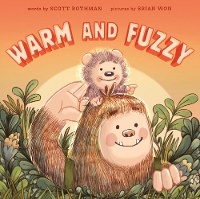 Warm and Fuzzy
by Scott Rothman; illus. by Brian Won
Preschool, Primary Tundra 40 pp.
4/25 9781774884423 $18.99
e-book ed. 9781774884430 $10.99
The book’s title might evoke comforting emotions, but (on the surface, at least) it refers to the central characters. Warm is a Bigfoot-like beast with a gap-toothed smile; Fuzzy, Warm’s diminutive companion, looks more like a bear cub with prominent ears. Fuzzy smiles, too, but more often looks anxious, especially when Warm, upon awakening, declares, “Let’s go on an adventure.” Fuzzy is immediately skeptical, peppering Warm with a litany of little-kid-appropriate concerns: “What if it’s really cold? Or super hot? What if it’s scary? What if there are no bathrooms? Or worse, no toilet paper?!” Warm calmly packs their things (including clean underwear) into a massive green backpack, all the while reassuring the youngster. The two step through a magical door and into a wordless series of silly exploits with animal friends. Rothman hits just the right tone with this ode to trust and taking (safe) chances, incorporating enough TP jokes to keep the tone from growing too earnest. At times the change in speaker might be difficult to discern — only a subtle shift in font marks a difference between Fuzzy’s and Warm’s dialogue. Won’s art, rendered digitally in a palette of soft greens, browns, and purples, is reminiscent of colored-pencil drawings; orange and yellow pastel hues create stunning sunrise and sunset skies. This one will soothe young worrywarts and empower their caregivers. NORAH PIEHL
 Bianca and the Butterfly
by Sergio Ruzzier; illus. by the author
Preschool, Primary Harper/HarperCollins 48 pp.
1/25 9780063295889 $19.99
While mother polar bear sleeps, readers meet Bianca, a cub who relishes her routines and surroundings — seeing the pale Arctic blues and greens, hearing the sounds of the ice, feeling the cold. “Bianca loves the things she knows.” Soft watercolor illustrations in Ruzzier’s trademark off-kilter style and outlined with pen and ink showcase an animated Bianca licking icicles and sledding down hills until something out of the ordinary catches her attention: a bright red, yellow, and orange butterfly on a nearby ice floe. She jumps over to investigate and, while attempting to make friends, fails to notice she has drifted too far away from home to jump back. A sea adventure ensues, and the text works together with spot art, single-page illustrations, and double-page spreads to express the range of emotions Bianca feels (sadness, worry, discomfort, curiosity). The butterfly stays with her, communicating only with gesture and proximity, until they approach a new, tropical land. While the illustrations make use of color and shape to capture the contrasting settings, the text further appeals to smell, sound, touch, and taste to fully evoke a sense of place. Bianca enjoys exploring but soon feels homesick. Opportunity, once again, comes at just the right time for her to return to the home she knows and loves — but the tantalizing ending shows that new color has entered her world, along with a curiosity for the unknown. JULIE ROACH
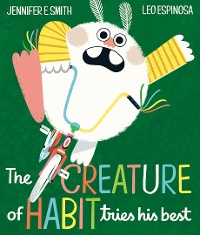 The Creature of Habit Tries His Best
by Jennifer E. Smith; illus. by Leo Espinosa
Primary Random House Studio/Random 40 pp.
11/24 9780593434611 $18.99
Library ed. 9780593434628 $21.99
e-book ed. 9780593434635 $10.99
In this companion to The Creature of Habit, the titular large white rabbit–like being and his “very small creature” friend, a blue puff with green-tinted glasses, make a newspaper sailboat (“sort of”) and set off from the tropical island of Habit. They arrive in a place filled with triangle-shaped trees, moss-covered rocks, and snow that falls “from the sky like dust, like magic, like stars.” In this new land, the possibilities seem endless. The big creature attempts to climb trees (his small friend does it effortlessly) and to make daisy chains and snowballs, but “he couldn’t do it.” When he sees his pal zipping around on a bike, however, he decides he has to learn how to ride. With his friend’s encouragement, he doesn’t give up despite many, many failed attempts. Eventually our protagonist has slow, wobbly success, and that night he dreams about “being the best at trying to ride a bike.” Espinosa’s comical digital illustrations enhance Smith’s funny, warmhearted story about a character who concludes that “maybe trying wasn’t so different from sticking with something.” EMILY REID GREEN
 Toto
Toto
by Hyewon Yum; illus. by the author
Primary Porter/Holiday 40 pp.
1/25 9780823453894 $18.99
e-book ed. 9780823462322 $11.99
“Toto” isn’t the young protagonist’s name but rather what she calls the large birthmark on her forehead. Opening lines read, “Sometimes I wonder how I would look without Toto.” Despite loving support from family who ascribe positive meaning to the birthmark — it means she has superpowers, or that an angel kissed her, and it is her grandmother’s favorite spot to kiss — the girl can tell that “sometimes people only see Toto, not me.” Yum’s limited palette of sepia, gray, black, and white in the mixed-media illustrations effectively reflects this worry by contrasting with the pink of the birthmark, making it stand out. Before school starts, the girl’s mother gives her a haircut with bangs, covering Toto. Once at school, she quickly befriends a girl named Niko, and all is well until she hangs upside down on the monkey bars and her bangs fall aside. At this vulnerable, climactic moment, Yum slows the story’s pace to devote several spreads to the narrator’s anguished embarrassment and Niko’s kind response. “The birthmark on your face means that you have another life!” Niko exclaims, sharing something that her aunt (who “knows everything”) told her. Niko’s excitement and wonder allow the narrator to adjust her perspective, rightly concluding that Toto makes her “extraordinary” and that without it, “I might not look like ME at all.” MEGAN DOWD LAMBERT
From the July 2025 issue of Notes from the Horn Book.


Added To Cart
RELATED


RECOMMENDED

Please register with us to continue reading.
ALREADY A SUBSCRIBER? LOG IN
We are currently offering this content for free. Sign up now to activate your personal profile, where you can save articles for future viewing.
ALREADY A SUBSCRIBER? LOG IN
Thank you for visiting.
We’ve noticed you are using a private browser. To continue, please log in or create an account.

Add Comment :-
Be the first reader to comment.
Comment Policy:
Comment should not be empty !!!