


2018 School Spending Survey Report
Learning from the past
These five nonfiction books tell middle- and/or high-school readers more about people and moments they might learn about in history class, or may pique their interest beyond the curriculum.
These five nonfiction books tell middle- and/or high-school readers more about people and moments they might learn about in history class, or may pique their interest beyond the curriculum.

 Death in the Jungle: Murder, Betrayal, and the Lost Dream of Jonestown
by Candace Fleming
Middle School, High School Schwartz/Random 368 pp.
4/25 9780593480069 $19.99
Library ed. 9780593480076 $22.99
e-book ed. 9780593480083 $11.99
On Saturday, November 18, 1978, more than nine hundred members of Jim Jones’s Peoples Temple died at Jonestown in Guyana. Though the event was originally described as a mass suicide, it eventually became known that many, including infants, children, and the elderly, were murdered. Early chapters present a biographical treatment of Jones, covering his boyhood, marriage, and early Christian ministry in Indiana. Uncharacteristically for the time, his congregations were racially integrated, and they appealed to many as the civil rights era dawned. Eventually, in 1965, he moved Peoples Temple to California, shed Christianity in favor of socialism, and began steadily to exert control over every facet of his group, including members’ property, income, and relationships. Jones often used gross manipulation and deception to do so, and increasing scrutiny drove him to Guyana. When Congressman Leo Ryan came for an investigative visit, it set the tragic events in motion. It’s a testament to Fleming’s storytelling prowess that the book becomes more and more compelling despite our knowledge of the outcome. If some of her recent titles have contained elements of true crime, this one (along with Murder Among Friends, rev. 3/22) also dabbles in another genre: horror. Black-and-white captioned photographs are gathered in the middle and at the end of the book. An annotated list of key people prefaces the volume, while an author’s note, sources, a bibliography, and an index are appended. JONATHAN HUNT
 A Most Perilous World: The True Story of the Young Abolitionists and Their Crusade Against Slavery
by Kristina R. Gaddy
Middle School, High School Dutton 352 pp.
6/25 9780593855522 $19.99
e-book ed. 9780593855539 $11.99
Gaddy introduces readers to four young family members of prominent abolitionists and the contributions they made in their own right. Lewis Douglass, son of Frederick Douglass, often helped those escaping enslavement (along with his siblings). George Garrison, son of William Lloyd Garrison, helped his father with his newspaper, the Liberator. Charlotte Forten was the granddaughter of a free Black man who gave Garrison (who was white) money to begin the Liberator and was the niece of Harriet and Margaretta Forten, who started the Philadelphia Female Anti-Slavery Society. Lucy McKim, daughter of Miller McKim, white president of the Pennsylvania Anti-Slavery Society, taught newly freed Black children in South Carolina (as did Charlotte) and later compiled the book Slave Songs of the United States. Lewis and George both fought with the Black regiments formed in Massachusetts. With focus alternating among the four, and occasionally overlapping, the book begins in 1854 and carries readers through the Civil War and its aftermath. Letters, newspaper articles, and journal entries add depth to this extensively researched narrative. The engaging and illuminating text, with some interspersed period artifacts and illustrations, sheds new light on the fight to end slavery in the United States, with an emphasis on the role of young people, which will likely be of special interest to its intended audience. NICHOLL DENICE MONTGOMERY
 A Dangerous Idea: The Scopes Trial, the Original Fight over Science in Schools
by Debbie Levy
Middle School, High School Bloomsbury 256 pp.
1/25 9781547612215 $19.99
e-book ed. 9781547612222 $13.99
Levy takes readers back one hundred years to the sleepy town of Dayton, Tennessee, and the historic Scopes trial. At first glance, the time period — before television, the internet, and other modern sources of infotainment — seems far removed from our own. But as Levy suggests, and then explains in detail in an insightful epilogue, the issues of the trial — racism, disinformation, journalistic integrity, a distrust of science, control over school curricula, and the separation of church and state — remain with us today. She begins with a group of community leaders who want to publicize Dayton and believe a high-profile trial will accomplish the goal. They ask high school teacher John T. Scopes to admit he taught evolution in his biology class and thus violated a recently passed law. And the circus begins. The ACLU challenges the charges, and eminent lawyer Clarence Darrow joins the defense, opposing thrice-unsuccessful presidential candidate William Jennings Bryan and the prosecution. Using a breezy, conversational tone laced with subtle humor, Levy discusses the principal players and their motivations, Darwin’s findings, the legal arguments of each team, the media frenzy, and the trial itself. Archival photographs, newspaper clippings, and political cartoons bolster the detailed text. This fine, thoroughly researched book concludes with a timeline, source notes, an extensive bibliography, and an (unseen) index. BETTY CARTER
 Fight AIDS!: How Activism, Art, and Protest Changed the Course of a Deadly Epidemic and Reshaped a Nation
by Michael G. Long
High School Norton 288 pp.
6/25 9781324053538 $19.99
In the early 1980s — following a time of political galvanization in the 1960s around sexual liberation and efforts to destigmatize gay sexual health — gay men began, mysteriously, to get sick. At first it was a few people at a time. But once the numbers reached a critical mass and friends and lovers began dying en masse, the gay community marshaled its resources to protest, to advocate, and to demand humane treatment in the face of government indifference. This book tells the story of the protest movement over the next several decades, until combination therapy finally arrived and meant that AIDS was no longer a death sentence. Long introduces readers to a panoply of activists; some make brief cameos while others play major roles in the story. They rarely agree on the right approach, but all of them demand to be heard. Numerous photographs and artifacts (posters, pamphlets, and artwork) are reproduced in black and white throughout, and source notes and an index are appended. Readers may also be interested in Viral (rev. 5/19) by Ann Bausum, which covers the same subject, and her book Stonewall (rev. 7/15), whose topic is briefly covered in the first chapter of this one. JONATHAN HUNT
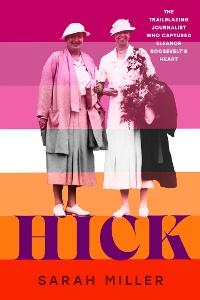 Hick: The Trailblazing Journalist Who Captured Eleanor Roosevelt’s Heart
by Sarah Miller
Middle School, High School Random House Studio/Random 384 pp.
5/25 9780593649091 $20.99
Library ed. 9780593649107 $23.99
e-book ed. 9780593649114 $12.99
Miller’s (Hanged, rev. 11/22) compelling biography charts the historic path famed journalist Lorena “Hick” Hickok (1893–1968) took from poverty and obscurity to the role of beloved confidante to First Lady Eleanor Roosevelt. Born in Wisconsin, Hick was raised by an abusive father who threw the fourteen-year-old out following her mother’s death. After a series of grueling domestic servant jobs, Hick moved to Michigan, where she graduated from high school with honors in oration and writing. She honed her considerable talent at local newspapers in several Midwest cities, despite prejudice against women in the newsroom. From there she moved to the celebrated Associated Press in New York, where she was assigned stories such as the 1932 Lindbergh baby kidnapping. But it was the interviews she conducted with Roosevelt, and their resulting intimate friendship and romance, that changed the course of Hick’s life and inextricably linked the two until Roosevelt’s death in 1962. Miller’s meticulously researched and engrossing account, based in large part on the voluminous mail correspondence between the two women, sensitively delves into the ways Hick’s traumatic childhood affected her career and personal life; it also candidly discusses her queer identity while noting what remains unknown about her relationship with Roosevelt. Back matter includes an author’s note, an extensive bibliography, and detailed chapter source notes. JENNIFER HUBERT SWAN
From the July 2025 issue of Notes from the Horn Book.


Added To Cart
RELATED


RECOMMENDED

Please register with us to continue reading.
ALREADY A SUBSCRIBER? LOG IN
We are currently offering this content for free. Sign up now to activate your personal profile, where you can save articles for future viewing.
ALREADY A SUBSCRIBER? LOG IN
Thank you for visiting.
We’ve noticed you are using a private browser. To continue, please log in or create an account.

Add Comment :-
Be the first reader to comment.
Comment Policy:
Comment should not be empty !!!