



2018 School Spending Survey Report
Mac Barnett and Shawn Harris Talk with Roger
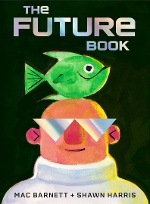
Partners in crime since childhood, now grown-up friends writer Mac Barnett and illustrator Shawn Harris collaborate on The Future Book, in which everything about tomorrow looks the same but, somewhere along the line, has acquired a new vocabulary.
Talks with Roger is a sponsored supplement to our free monthly e-newsletter, Notes from the Horn Book. To receive Notes, sign up here.
Sponsored by

Partners in crime since childhood, now grown-up friends writer Mac Barnett and illustrator Shawn Harris collaborate on The Future Book, in which everything about tomorrow looks the same but, somewhere along the line, has acquired a new vocabulary.
Roger Sutton: My friend (and your neighbor, Mac) Bruce Brooks tells me that you two have been thick as thieves since childhood. What did you do to keep yourselves and each other amused?
 Mac Barnett: Shawn and I have always been the kind of friends who made stuff together. We would go over to each other’s houses, hang out, play video games, but eventually we’d both want to do something, make something. We used to borrow his dad’s video camera and try to shoot an action movie in his yard.
RS: Like those kids who remade Star Wars.
MB: Yeah, exactly.
Shawn Harris: We just didn’t know how to publish it.
MB: We would record ourselves talking into a cassette tape for an hour and then play it back and listen to it. We invented the podcast, you know — we just didn't have distribution.
SH: Single-use.
MB: We’d make up songs. We were just always making stuff. And Shawn would always do my art projects for me, that was another thing. So that’s still going on, basically.
RS: You guys first worked together on the graphic novel series about the cat in space, right?
MB: We actually did a picture book with each other first.
SH: A Polar Bear in the Snow, which came out in spring 2020.
MB: Then came The First Cat in Space Ate Pizza. We just do an animal in a location.
SH: A polar bear in the snow, a cat in space...
RS: I have to admit that this new book irritated the [heck] out of me. I’m not sure I get it. Can you explain it to me?
MB: Absolutely not, Roger. I’m not going to sit here and explain a joke to you. That’s not the way to make it funny. Instead, try reading the book to a bunch of kids.
RS: That’s exactly what one of the other Horn Book editors said to me. She said she could see why it might drive me crazy, but I ought to read it with a kid.
MB: What we’re trying to do is to give people an ironclad funny read-aloud, whether that person feels funny or not, whether that person thinks our book is funny or not. That’s if you give the book a good reading. Because we all know you can assassinate a book you don’t like and then say it didn’t work. We’ve definitely seen that sort of approach. Not from professional reviewers, usually. We see that more often from parents. They’ll be like, “I hated this book from the first moment. I thought it was so boring and I read it to my kid and she thought it was boring too.” And we’re like, “Well, I’m sure you gave it a great reading, right?” As a dad, there are books that I absolutely hate, but when I read those books to my kid, I give that book the best version of itself.
SH: Mac, your kid does like a lot of books that you dislike.
MB: My kid loves Make Way for Ducklings. I don’t like Make Way for Ducklings.
SH: I love Make Way for Ducklings!
MB: Anyway, I think our book would become clearer to you if you read it to a few seven-year-olds. I think you’d get the rhythmic nature of it, how it works.
RS: Did you do any test driving of this story with kids?
MB: No, not really. It feels like I’ve spent the majority of my life standing in front of kids, reading picture books out loud: I was a camp counselor, I was a substitute teacher, I was a reading tutor, I ran a writing center. All standing in front of a group of kids and reading them books and seeing how they work. It is this experience with reading aloud that is primary to me when I’m composing, and so a lot of that stuff is muscle memory. But Shawn, you read this book to kids pretty early, right?
SH: I did, yeah. I had parts that I thought were going to generate reactions with the page-turns, and I knew how I wanted your words to play, so it was good to be able to turn the page and see if it elicited the reaction that I’d expected. I didn’t read the book for a “Did you like that or did you not like it?” But it helped to see where the reactions hit. But, also, I think we knew this one had legs from the very first sentence.
RS: “This book is from the future.”
SH: When we started talking about the marketing language needed to sell this book, we basically cited that first sentence. Look no further than the first page, really. Who would not pick that up?
MB: What is confounding you most about it, Roger. Can I ask you that?
RS: I think what confounded me was the progression. This book is from the future where the sun is called the moon and the moon is called the sun. And then we have night and morning switched, so I’m thinking, Okay, we’re going to flip things, but then it all just goes whoosh. And I think that’s where young me panicked a bit in this book. Seven-year-old Roger was thinking, So there are no rules? Anything could happen?
MB: But I don’t think that’s true, Roger. Structurally. There’s a very clear set of rules to this thing. This is how so many books work. You set up a pattern and then you embellish the pattern, right? You introduce new variations that don’t break the rules but change the reader’s understanding of what the rules are. Brown Bear, Brown Bear, What Do You See? does just that with the blue horse, the purple cat...
RS: Do you remember The Happy Hocky Family! by Lane Smith? It had this kind of absurd humor to it. A lot of it is what we’re not accustomed to seeing in children’s books. When old fogeys like me see something new and different, often we don’t know what to make of it.
MB: I think you’ve come to a classic difference between older people and kids. When adults see something different that they don’t immediately understand, they often push that thing aside as it makes them uncomfortable, whereas coming into contact with things that you don’t understand is the fundamental experience of being a child. It’s the daily experience, repeated again and again. And being thrown into a social situation that has a set of rules, a set of words, a set of norms, an enforced etiquette you don’t know but you must learn through observation — because probably people aren’t going to tell you — and if you don’t get it, you’re going to get a bad grade, or you’re going to get told you’re rude, or you’re going to get punished, or have your Nintendo taken away...that is the experience of childhood. You’re thrown into unfamiliar situations, and you must learn what they are very fast. I think that’s what has happened, Roger — you have taken a look at the future, and didn’t understand the norms, the rules, the words, and your brain exploded.
RS: Shawn, what was it like being the sober companion for all this?
SH: [laughs] No one has ever called me that.
RS: Well, it’s just that the illustrations are all very straightforward, recognizable, comforting, comfortable.
SH: That’s good, yeah, that’s interesting. When you said, “Then it all goes whoosh” or it goes crazy, it was my job to keep things composed and on the rails. But at the same time, while it feels like things are going crazy, what has actually changed about the future is the words for things, and is that sort of change really so wild? Is it so wild that two generations from now, there’s going to be a different word for the chair that I’m sitting on? Is that the wildest thing in the world? Or is that, in fact, pretty mild?
RS: Do you remember Frindle, the Andrew Clements novel about the kid who decides he’s going to call his pencil a frindle, and why not? “Why is it called a pencil, and does it need to be? Why can’t we call it...” — driving his teacher crazy. I guess she’s the me stand-in there.
SH: This is why it’s so fun for some people to read and study Shakespeare or Dickens because these were originally works for common people. But the language has changed, so now we have to study it. It becomes this kind of scholarly approach to something that was once just done in a town square. It’s really fun for some people, and some people absolutely hate it, but the themes in the stories are still very relevant in communities today.
RS: I think you bring up an interesting point there. When we approach the texts of the past, like Shakespeare, it is with this reverence and also thinking, Oh this is so difficult. Why is it so difficult? Why can’t they just speak plainly? But your book shows us that in the future, the way we talk could look just as ridiculous and impossible and arcane to them as Shakespeare does to us now. But you’re much more lighthearted about it.
MB: Yeah, I think that’s right. It’s about a culture clash and calibrating two sets of languages, two cultures. As for Shakespeare, I just want to say, sure he was enjoyed by everybody — but, also, some of his language was difficult even at the time. I’m obsessed with Shakespeare, so I’m caveating. But I think it’s important too that his poetry took work to understand, and we shouldn’t underestimate the intelligence of the groundlings in the same way that we so often underestimate the intelligence of children.
SH: I brought it up for a reason. I wanted to fire you up.
 RS: What was it like seeing a kid catch on to this book? Because you have to adjust your expectations as a reader as you go, right?
MB: I mean, that’s the joy of reading a picture book. “What was it like?” It was like it always is when it works. It’s the most magical experience, especially with a funny picture book. Teaching kids a set of rules and then embroidering and elaborating and subverting the pattern in a way that elicits laughter, and then hearing them incorporate it into their language and the jokes that they’re making with each other that afternoon when you’ve left and the book is closed and you’re back at your house. “What’s it like?” That’s why I’m here.
RS: And post–school visit, the kids are still yelling your immortal last line, “You smell like a baby!” to each other.
MB: That’s right! It’s so fun to watch that happen, but it’s also very apparent that kids like to play with language. What’s so fun about this is that kids are alive to the flexibility, the sounds, the rhythms, the absurdity of language in a way that is much closer to the poetic experience than most adults are. This is the stuff that Margaret Wise Brown writes about all the time. And her books work that way too. That immediate joy of experience with language. How it sounds. How it feels in your mouth. And the imperfect way in which it maps onto the world and experience — that’s the grist for poets, but it also is the experience of kindergarten.
RS: I’m thinking about a kid having the realization that words don’t have to mean what an adult tells you they mean, and how that must be quite a liberating feeling.
MB: Yeah, I hope so. Is that going to be an explicit realization that they have? Maybe, maybe not. It is the source, it’s driving the laughter here. But I think it’s something that kids know already. Young children have memory of not just a preverbal but a prelinguistic experience. Kids have ideas, emotions, experiences when they’re one, two, three — before they have words to describe these things. There is something absolutely profound about the gap between the signifier and the signified in language, and it is something that we could stroke our beards and talk about here, but it is also something that will just make us laugh. And that gap, too, is essential to how the picture book works generally. There always is a gap between words and pictures, and the most exciting picture books make something of that tension. And when you’re being read to as a kid, if the words are telling you one thing and the pictures are telling you another, which do you trust, Roger?
RS: I’m thinking about that, because one thing I love about this book is that tension between the pictures and the words.
MB: I think you always trust the pictures. The pictures, in the rules of a picture book, are the world as it exists, and the words describe the world that exists. And when there’s a gap, you trust the pictures, and the pictures really belong to the kids. The words in the picture book belong to adults, who are most often the literate ones sharing this thing. And so the experience of having a picture book read to you as a kid is the experience of an adult telling you the world is one way while you can see very clearly that the world is another way. And that is a fundamental aspect of being a child. And that realization is not something our book is bringing to them. It is the daily lived experience of kids. It animates the picture book as an art form. All picture books. And I hope we get some laughs in ours because of it.
RS: Shawn, what do you think, the words or the pictures?
SH: I was going to make the joke that I’d say the pictures and Mac would say the words, but actually I’ve never thought about it like that. And then I was trying to be a contrarian and think of a book where the pictures are inaccurate, and I can’t think of one.
MB: I’ve been trying to think of one. I think it would be an interesting thing to do. But though I’ve thought about it as an animating principle for a picture book, I haven’t figured out a way to make it work yet, because everything I’ve thought of feels like it breaks the machine. That doesn’t mean it’s impossible, but I think it will be the exception that proves the rule because you will be getting such tremendous energy from basically using the wrong fuel in your car that it’ll rattle beautifully and then explode.
SH: Ah yes, tremendous energy, yes. Apple juice.
RS: I was so happy to see you guys holding the physical book because this [holds up iPad] was your book, for me. And every time I read a PDF of a picture book, I have to figure out if I’m looking at two pages or one page, because you miss that whole dynamic of the page-turn.
MB: I think that explains your whole confusion about our book, actually.
RS: It very well might.
MB: I didn’t realize you were looking at it on some futuristic device.
RS: You don’t get that moment when you’re turning the page — however minuscule it might be — when you’re reading something electronically, and I think it makes a huge difference. The kind of story that works effectively on an iPad is very different from the kind of story that works effectively within bound covers.
MB: Especially for comedy. The page-turn is the essential timing device of the picture book as a form. To me, the page-turn is like a curtain in the theater or at the opera that rises fourteen times. It’s the most thrilling thing in the world. Even just mechanically, when you are turning a page, that excitement of being able to see if we got the spread right. The page-turn, the physical construction of it, and the slow revelation of the spread...that is how a picture book works — the same way as when the curtain rises and there’s a new set at the opera. We all pay attention and we’re like, “Oooh, we can see their feet and now we can see the bottom of the dresses,” or “We can see the door and now we can see the turrets,” and then everybody goes, “AHHHHHH.” It is why we needed that skeuomorphic page-turn sound they put in the first ebook editions, to try to re-create that experience of having things gradually revealed to us. It was so dumb, that little page-turn animation, but we needed it. It was better with it than without it. The truth is that all of it sucks — a picture book can’t become a PDF and still work — but that little animation and noise was the screen acknowledging something that it couldn’t do. It’s something that we can do better in a physical book than we can on a screen.
RS: Shawn, were the page-turns in this book up to you, or did Mac direct them?
SH: I usually page Mac’s writing. Sometimes he’ll look at my sketches and suggest something different, but I usually get first pass when we do paging. We do that when we do comics, too, so it’s pretty second nature to us.
RS: So you just do it line by line.
SH: He’ll deliver me a script or a manuscript and I’ll put the pages where I feel like they need to land. Every once in a while he’ll have a note for me, but not often.
MB: And hopefully a lot of the page-turns should be inevitable.
SH: They’re usually very, very clear. Once in a while I miss something or he intends something differently.
MB: You also find page-turns where I wouldn’t have put them, and they work too. But you have to have at least some sense of where page-turns are going to fall when you’re writing a picture book.
SH: Regarding page-turns — something that drives me up the wall when we market books or represent them online is that we often make flash animations. You’ll see characters from the book but rather crudely.
MB: Wait, who’s the “we” making flash animations?
SH: We, the publishing industry.
MB: They. They. They.
SH: I’m so allergic to these things because the picture book animates itself. Mac and I think about how the book is animated all day long and then we undo it in these flash animations by having these characters slide across the screen to sell the book, and it’s like, “Can we just turn the page of the book?” This is where the magic is. We’ve spent our entire year devising these things, and then they’re undone by these little computer things sliding across the screen when actually the book itself is all the tech it needs.
Sponsored by



RECOMMENDED
Please register with us to continue reading.
ALREADY A SUBSCRIBER? LOG IN
We are currently offering this content for free. Sign up now to activate your personal profile, where you can save articles for future viewing.
ALREADY A SUBSCRIBER? LOG IN
Thank you for visiting.
We’ve noticed you are using a private browser. To continue, please log in or create an account.

Add Comment :-
Be the first reader to comment.
Comment Policy:
Comment should not be empty !!!