



2018 School Spending Survey Report
What Makes a Good Science Book?
Google “best books for children,” and you’ll get lists of (mostly) fiction books characterized by imaginative writing and excellent pictures — great stories with captivating illustrations.
If you pay a visit to the science section of your local library’s children’s room, you’ll most likely discover that it’s one of the biggest in nonfiction, with books on such kid-friendly topics as planets, volcanoes, dinosaurs, and animals. You’ll find two kinds of science books there, with some overlap between them. If you’re on a frantic search to locate an idea for the science fair project due the day after tomorrow, you’ll most likely gravitate toward the experiment books, which demonstrate how to do hands-on activities. If the project isn’t due for two weeks, you might look at the other kinds of books, those that take a more narrative approach and help the reader better understand the science behind the project. After reading dozens of the latter, I’ve learned that it’s possible, although not easy, to produce a genuine page-turner in the field of science.
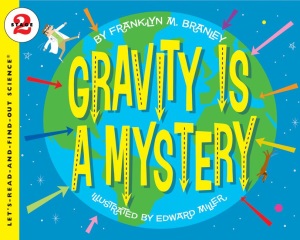 Both science and children ask a lot of questions. Why can’t I float through the air? Why are there seasons? How does a magnet work? What exactly is a hiccup? Books in the Let’s-Read-and-Find-Out Science series often open with a question a curious child might ask, then provide a complete answer in terms simple enough for a preschooler to understand. Take, for example, the classic title Gravity Is a Mystery by Franklyn M. Branley, first published in 1970, revised in 1986, and reissued with new illustrations in 2007. Branley begins by asking what would happen if you dug a hole all the way through the earth and fell through it. After looking at how gravity would affect this plunge, he goes on to examine ways gravity is experienced in everyday life, such as running downhill, throwing a ball, or lying in bed. Then he travels outward to explore gravity’s effects on other planets. The conclusion? Although we can experience gravity, scientists have yet to explain what it really is; in fact, as the title states, gravity is a mystery. A simple activity and some gravity facts round out the book. It may be pretty basic, and forty years old to boot, but it’s one of the best books available that successfully explains gravity to a four-year-old.
Vicki Cobb’s Science Play series also succeeds in explaining physical science to the very young. Each book takes one concept — such as water, gravity, or light — and describes its properties through a series of experiments. Adults are encouraged to read the book aloud to children and do each simple activity with them before reading more. All the books in Cobb’s series would be appropriate for three- and four-year-olds.
 Kids a bit older might want to try books by Gail Gibbons and by Steve Jenkins, whose science picture books meet the standard set by Let’s-Read-and-Find-Out for combining factual, entertaining writing with outstanding illustrations. Jenkins has even illustrated a few books in the series, but his best works are the concept books he’s written himself (and with Robin Page) and illustrated with his trademark cut-paper collages. One of his earliest, Biggest, Strongest, Fastest, introduces “records” held in the animal kingdom. Fun to read aloud, the book asks the audience to guess each record holder before showing them the picture. Other concepts include animal families (Sisters & Brothers), problem solving in the animal world (How Many Ways Can You Catch a Fly?), and animal size (Actual Size and Prehistoric Actual Size). Each book offers fascinating examples using animals you may never have heard of. There are always several pages of back matter that provide extra details for the curious. The pictures in these books are extraordinary — imagine using cut paper to create a diving beetle catching a fish or a mother termite surrounded by hundreds of babies.
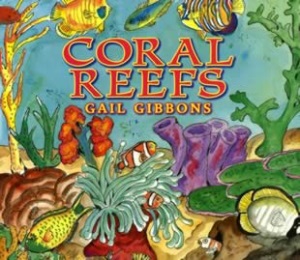 Gail Gibbons’s work is topic-centered rather than concept-centered, and her prolific output has continued virtually nonstop for the last thirty years. Her science book topics include dinosaurs, deserts, planets, butterflies, and, recently, coral reefs. Coral Reefs is lavishly illustrated with watercolor paintings and explains the where, what, and how of this undersea ecosystem. While the text is fairly simple, it’s packed with information. The pages are a visual feast, showcasing many varieties of coral, as well as the fish and other life forms that make their homes in this environment. Like most of Gibbons’s books, Coral Reefs can be enjoyed on many levels, from a preschool read-aloud to a starting point for older children’s research.
If the pictures in a Gail Gibbons book suddenly acquired the realistic detail of photographs, you might end up with something close to a Seymour Simon book. Simon is another amazingly prolific author, with more than 250 science titles to his name. His best works are his large-format books illustrated with spectacular full-page photographs. The topics include many different kinds of animals, natural disasters, the weather, and the solar system. Like Gibbons’s, Simon’s writing is fairly simple, explaining each subject in kid-friendly terms. Many of his books are thirty-two pages, with text on alternating pages, comparable to a typical picture book. His newer volumes, written in conjunction with the Smithsonian Institution, are longer and more detailed.
 Simon demonstrates that in a good science book a picture is worth far more than a thousand words. A written description of a planet can’t compare with a photograph of it floating in space. Likewise, reading about what dwells inside your pillowcase just isn’t the same as looking it in the eye (as it were). Thanks to the scanning electron microscope, science authors are now able to provide readers with this golden opportunity. Two books that use the SEM for different effects are Yuck!: A Big Book of Little Horrors by Robert Snedden and Hidden Worlds: Looking Through a Scientist’s Microscope by Stephen Kramer. As one might guess from the title, Yuck! exploits the gross-out factor, showing up close just what’s living in your bed, your toothbrush, and, yes, your intestinal tract. Hidden Worlds follows microscopist Dennis Kunkel (who also provides photographs for the book), tracing his beginnings as a ten-year-old with a brand-new microscope in Iowa to his current profession operating an SEM in Hawaii. His job has taken him from Mount St. Helens right after it erupted (to learn what life forms survived in the surrounding waters) to the forests of Hawaii (where he’s studied how mosquitoes transmit disease to humans).
 “Microscopist” is probably not at the top of most kids’ lists of what they want to be when they grow up, but there’s no question that Hidden Worlds makes this career look fascinating. Science is a hands-on business, and a good science book shows how exciting working in the field can be. For instance, if you’re interested in a career that includes dodging hot lava bombs while running across a surface so hot it can melt your sneakers, with hydrochloric acid-laced steam stinging your throat, you may want to learn what it’s like to be Donna O’Meara, author of Into the Volcano: A Volcano Researcher at Work. If you prefer adventures in the animal kingdom, try the books of Sy Montgomery and Nic Bishop, namely The Tarantula Scientist, Quest for the Tree Kangaroo, and The Snake Scientist, all entries in Houghton’s Scientist in the Field series. In The Tarantula Scientist, the two examine (sometimes too closely for comfort!) the work of Sam Marshall and the tarantulas that fascinate him. For a reader who pictures a scientist as a person in a white coat working in a lab, seeing photos of Sam in his camouflage pants and floppy hat luring tarantulas out of their holes on the jungle floor will be almost as illuminating as the full-page color photos of the hairy arachnids he studies. Like all the best books of this sort, Tarantula Scientist explains how Sam got interested in science (he hated school until his third year of college, when he did a project comparing desert and rainforest tarantulas), shows the process of scientific research, and gives plenty of information about the topic as well. (And for the record: Sam has never been bitten by a tarantula — they generally don’t eat humans, although humans have been known to eat them.)
With a good novel, the reader enters into the action of the story, sighing with contentment as the last page is read and the story is wrapped up satisfactorily. In a good science book, the story doesn’t end. Science is a mystery that is constantly unfolding, with scientist detectives discovering clues that answer a question, only to find that the answer leads to a host of new questions. But the reader of a good science book can certainly feel satisfaction nonetheless — not that of having finished the story but of having been invited to participate in it, to help solve another part of the mystery.
Recommended Science Books
Franklyn M. Branley Gravity Is a Mystery; illus. by Don Madden (Crowell, 1970, 1986)
Vicki Cobb I Face the Wind; illus. by Julia Gorton (HarperCollins, 2003)
Vicki Cobb I Fall Down; illus. by Julia Gorton (HarperCollins, 2004)
Vicki Cobb I Get Wet; illus. by Julia Gorton (HarperCollins, 2002)
Vicki Cobb I See Myself; illus. by Julia Gorton (HarperCollins, 2002)
Gail Gibbons Coral Reefs; illus. by the author (Holiday, 2007)
Steve Jenkins Actual Size; illus. by the author (Houghton, 2004)
Steve Jenkins Biggest, Strongest, Fastest; illus. by the author (Ticknor & Fields/Houghton, 1995)
Steve Jenkins Prehistoric Actual Size; illus. by the author (Houghton, 2005)
Steve Jenkins and Robin Page How Many Ways Can You Catch a Fly?; illus. by Steve Jenkins (Houghton, 2008)
Steve Jenkins and Robin Page Sisters & Brothers: Sibling Relationships in the Animal World; illus. by Steve Jenkins (Houghton, 2008)
Stephen Kramer Hidden Worlds: Looking Through a Scientist’s Microscope; illus. with photos by Dennis Kunkel (Houghton, 2001)
Sy Montgomery Quest for the Tree Kangaroo: An Expedition to the Cloud Forests of New Guinea; illus. with photos by Nic Bishop (Houghton, 2006)
Sy Montgomery The Snake Scientist; illus. with photos by Nic Bishop (Houghton, 1999)
Sy Montgomery The Tarantula Scientist; illus. with photos by Nic Bishop (Houghton, 2004)
Donna O’Meara Into the Volcano: A Volcano Researcher at Work; illus. with photos by Stephen O’Meara and Donna O’Meara (Kids Can, 2005)
Seymour Simon Destination: Space (HarperCollins, 2002)
Seymour Simon Gorillas (HarperCollins, 2000)
Seymour Simon Guts: Our Digestive System (HarperCollins, 2005)
Robert Snedden Yuck!: A Big Book of Little Horrors (Simon,1996)
From the May/June 2009 issue of The Horn Book Magazine.

Added To Cart
RELATED


RECOMMENDED

Please register with us to continue reading.
ALREADY A SUBSCRIBER? LOG IN
We are currently offering this content for free. Sign up now to activate your personal profile, where you can save articles for future viewing.
ALREADY A SUBSCRIBER? LOG IN
Thank you for visiting.
We’ve noticed you are using a private browser. To continue, please log in or create an account.

Add Comment :-
Be the first reader to comment.
Comment Policy:
Comment should not be empty !!!