



2018 School Spending Survey Report

Night Light
Cathryn M. Mercier on Michael Emberley's Night Light: "This gem of a book exhibits a discerning integration of art and text in the most Caldecott-worthy ways."
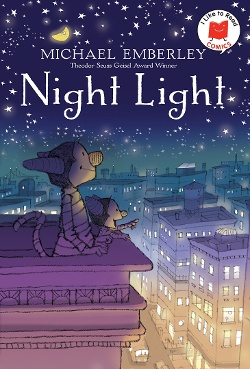
Night Light, written and illustrated by Michael Emberley, functions as an early reader, from its trim size, paperboard covers, and "I Like to Read tag" that also labels it a "COMIC" in red. And yet, this gem of a book exhibits a discerning integration of art and text in the most Caldecott-worthy ways.
Speech bubbles express character voices and offer narrative direction. Single words, such as “Pull!” “GO!” and “Ready?” mix with short sentences (“I’ll take this one...”; “They are warm!”) and partial sentences (“and this one...”) tell the story of borrowing stars from the night sky. Two nongendered characters — I read them as older and younger —dress in full-body pajamas from ears to tails. When a blackout interrupts their bedtime ritual and the flashlight wanes, it becomes just "too dark" to read.
The art delineates the individuality of these characters and shapes their relationship. A sequence of small, varied panels depicts their movement from ideation to action. The older character looks out the window at the stars and moon, puts finger to mouth and tilts head, thinking "hmmm..." before initiating action. Together, they tug and pull a long ladder from a closet and extend it out the window. Their determination can be seen the little details of a tongue sticking out the side a mouth, legs stepping high and in unison, and arms raised to propel the ladder forward and out the window. Just before beginning to climb, the older character leans in from the ladder to almost touch the younger’s finger: “You stay here.” Even though they’re partners in this task, the older character takes the next dangerous step.
The page composition depicting the older character’s climb up the ladder switches the horizontal comic strip to four vertical panels and the ladder breaks the top and bottom frames. Each panel frames a night sky whose color graduates from soft blue to rich violet and the sky darkens as the precariously balanced character bags stars to take home. Once squooshed back through the window and released, the stars fill the room (and page) with light. The bedtime reading ritual can resume.
But wait. Because the stars shine with a blinding yellow, the characters need sunglasses to read. By setting these vibrant panels against crisp white pages, Emberley mimics that experience for readers; it’s hard to look at these pages because there just might be too much light to read by. The artist provides some relief for the reader when he interrupts the linearity of the comic strip with judiciously placed blue violet smudges against which a sniffling crescent moon cries "too dark." The young character faces the reader, then looks back at the moon outside the window, then back to the reader to shout new empathetic understanding. Literally, returning the moon's companions returns light to the sky and metaphorically, it restores the community that had been taken from him.
Few words and effective images over the next few pages repeat vertical panels filled with actions as the characters retrieve the stars. The graduated mix of yellow and blue into chartreuse darkens the room and re-illuminates the sky. An exuberant double-page spread places the characters and the moon on opposite pages as stars swirl, spiral, tornado across the gutter and back to their places in the purple-dark sky. Once again, our characters have collaborated to fix the light.
Once again, it's too dark to read, our characters embark on their ultimate round of triumphant problem-solving as they pack up and climb the stairs to the roof of their building. The third time's the charm, and these new night lights are not too bright, not too dark. They're just right for one more book before bedtime.
A hushed story, with an emotionally satisfying narrative arc. Emberley merges art and text in seamless, speechless collaboration akin to what his characters enjoy. The Cladecott Committee should take time to appreciate the details: the front and back endpapers, the shadowed neighborhood and cityscape outline, the use of fonts and caps, the starting and ending book they read, the one star that's held back, book design and page turns, considered composition, animated expressions, buoyant playfulness. Every detail contributes to the careful pacing — page by page, color by color, speech bubble by speech bubble — that charts the trouble it's always worth to find night lights for a good bedtime story.
[Read The Horn Book Magazine review of Night Light]



RECOMMENDED

Please register with us to continue reading.
ALREADY A SUBSCRIBER? LOG IN
We are currently offering this content for free. Sign up now to activate your personal profile, where you can save articles for future viewing.
ALREADY A SUBSCRIBER? LOG IN
Thank you for visiting.
We’ve noticed you are using a private browser. To continue, please log in or create an account.

Add Comment :-
Be the first reader to comment.
Comment Policy:
Comment should not be empty !!!