



2018 School Spending Survey Report
Physics and chemistry
Adams, Tom Super Science: Matter Matters!
Gr.
 Adams, Tom Super Science: Matter Matters!
Gr. 4–6 18 pp. Candlewick/Templar
Illustrated by Thomas Flintham. In this chemistry overview on eight double-page pop-up spreads, readers can explore topics ranging from atoms and elements to water, air, and radioactivity. Some of the movable features creatively present content, such as mini-booklets for scientist profiles and flaps that allow comparisons of molecular structures, while others are somewhat gimmicky. Cartoonlike illustrations and experiment ideas round out the pages.
Subjects: Physics and Chemistry; Matter; Experiments; Scientists; Toy and movable books
 Pfeffer, Wendy Light Is All Around Us
Gr. K–3 40 pp. HarperCollins/Harper
Illustrated by Paul Meisel. Let's-Read-and-Find-Out Science series. This strong series entry introduces youngsters to light: where it comes from, how fast it travels, and how it enables us to see. The prose is generally lively, but Pfeffer is all business when it comes to scientific explanations. Lighthearted paintings, outlined in pen and ink, add humor but never distract from the text. Three simple experiments are appended.
Subjects: Physics and Chemistry; Light
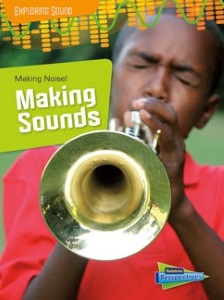 Spilsbury, Louise and Spilsbury, Richard Making Noise!: Making Sounds
Gr. K–3 32 pp. Heinemann
Spilsbury, Louise and Spilsbury, Richard Why Can't I Hear That?: Pitch and Frequency
Gr. K–3 32 pp. Heinemann
Exploring Sound series. The physics of sound, including pitch, frequency, vibration, and speed, are clearly and cleanly explained. The texts are aided by many color photos, diagrams, sidebars, and captions, though some of the spreads are overly busy. Activities (e.g., making a trumpet from a bottle, tube, and paper) are varyingly feasible for a child. Accessibility and an encouraging tone strengthen the presentation. Reading list. Glos., ind.
Subjects: Physics and Chemistry; Sound
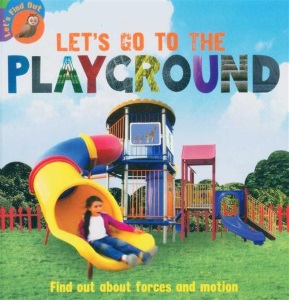 Walton, Ruth Let's Go to the Playground
Gr. K–3 32 pp. Sea to Sea
Let's Find Out series. This wide-ranging overview uses common playground equipment (swings, slide, merry-go-round) to explore principles such as gravity and centrifugal force. Illustrations that resemble cut-paper and photo collage are accompanied by captioned photos and sidebars, which extend the generally judicious though randomly presented coverage (including the now almost-extinct teeter-totter). A "Design a Playground!" activity is appended. Glos., ind.
Subjects: Physics and Chemistry; Playgrounds
 Whiting, Jim Energy
Middle school, high school 48 pp. Creative Education
Whiting, Jim Gravity
Middle school, high school 48 pp. Creative Education
Whiting, Jim Light
Middle school, high school 48 pp. Creative Education
Whiting, Jim Mass & Matter
Middle school, high school 48 pp. Creative Education
Whiting, Jim Space & Time
Middle school, high school 48 pp. Creative Education
Mysteries of the Universe series. Intermediate- to advanced-level explanations of physics concepts are described in chronological formats that roughly follow historical advancements scientists contributed to their fields. The numerous full-page illustrations are mainly decorative; diagrams would have been helpful with more complicated content. Text boxes consider science in films, literature, and technological applications. The tiny type can be frustrating. Reading list, websites. Glos., ind.
Subjects: Physics and Chemistry; Energy; Gravity; Light; Mass (Physics); Matter; Space and time
From the January 2015 issue of Nonfiction Notes from the Horn Book.



RECOMMENDED

Please register with us to continue reading.
ALREADY A SUBSCRIBER? LOG IN
We are currently offering this content for free. Sign up now to activate your personal profile, where you can save articles for future viewing.
ALREADY A SUBSCRIBER? LOG IN
Thank you for visiting.
We’ve noticed you are using a private browser. To continue, please log in or create an account.

Add Comment :-
Be the first reader to comment.
Comment Policy:
Comment should not be empty !!!