



2018 School Spending Survey Report
A Profile of Rita Williams-Garcia: Being Eleven
I first met Rita Williams-Garcia three years ago, soon after One Crazy Summer was published.
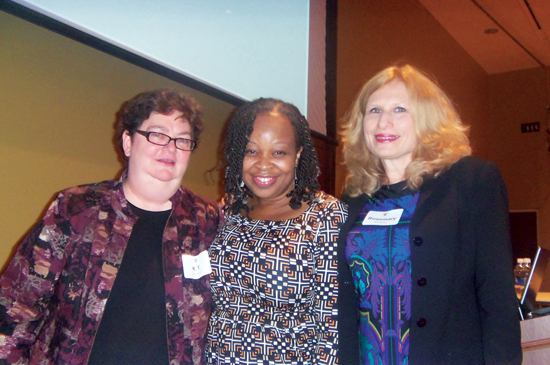 From left: Kathleen T. Horning, Rita Williams-Garcia, and Rosemary Brosnan.
I first met Rita Williams-Garcia three years ago, soon after One Crazy Summer was published. Prior to that, though, I had known her through her books for many years, starting with her first novel, Blue Tights. It stood out among all the YA novels published in 1988 for its honest and realistic depiction of a working-class teen. Blue Tights was followed by Fast Talk on a Slow Track (1991) and Like Sisters on the Homefront (1995), two books that were unusual in their time because they featured older teens. Fast Talk, for example, takes place over the summer between Denzel Watson’s senior year of high school and freshman year of college. Subsequent books dealt with serious subjects: rape, female genital mutilation, teen violence. Heavy subjects, even for young adult literature.
So when I first read One Crazy Summer, I was surprised. It was so different from Rita’s earlier books. Who knew she could write so well for middle-grade readers? And who knew she was so devastatingly funny? I laughed aloud at least once on every page while I was reading the book. It all felt so familiar. In fact, I could tell how old Rita was because we had grown up in exactly the same era. Vietnam. Black Panthers. Power to the people. Right on! It all rang so true that, although Rita and I had not yet met, I felt as though we had grown up together.
We were eleven years old at the same time.
Since we’ve become friends, Rita and I have compared notes about that time in our childhoods. She was born in Queens, New York, and grew up in interesting places like California and Georgia; I was born in the boring Midwest and have stayed there all my life. Rita was the youngest of three siblings in a military family, and I was the middle child of five being raised by a newspaperman and a teacher. On the surface, our lives seemed different.
 But Rita and I bonded over our mutual love of the Jackson 5. Nothing defined the era during which we were eleven better than the Jackson 5. We both remember the thrill of seeing them on TV for the first time in the fall of 1969. Here were five talented brothers, kids like us, performing live on national television. And for African American kids, they represented even more: a twin sense of hope and pride. If you remember the chapter in One Crazy Summer where Delphine and her sisters Vonetta and Fern count the number of words spoken by black people on TV, you’ll get a sense of what a momentous occasion the group’s first television appearance was. As Delphine might say: black infinity — multiplied by five! Rita perfectly re-created that thrill in an early chapter of P.S. Be Eleven, where the three sisters tune in to see the Jackson 5 performing on Hollywood Palace. The chapter is based on her own memories of what it was like; halfway across the country, I was experiencing the same thing. It was an excitement we had to contain. Rita once described it as painful silent screaming — silent so as not to draw undue adult attention after bedtime.
Every girl fan, and probably more than a few boys, set their sights on one brother for singular adoration (and future marriage). Delphine chose the oldest one, Jackie, because of his height. I went for Jermaine’s shy smile. And Rita fell for Tito’s eyebrows. She also thought Tito looked like he could handle himself at the rough school she was attending at the time. Her reasoning was so typical of that eleven-year-old mindset in which a famous pop star might show up in your schoolyard at any moment. In Rita’s fantasy, Tito walked her home each day and carried her books.
 Both Rita and I had time for childhood fantasies, and we both had the luxury of a long childhood; unlike Delphine, who has adult responsibilities thrust on her. She has no choice but to be a surrogate mother for her younger sisters, since her own mother left them. Ironically, it is her estranged mother, in her recurring postscripts, who reminds Delphine to hold on to her childhood a bit longer: “Be eleven.”
I was with Rita and her editor, Rosemary Brosnan, on November 6, 2012. They had come to Madison for the Charlotte Zolotow Lecture the next day, and we all gathered at my house to watch the presidential election returns. I got to see Rita do her happy dance when the race was called for Obama. There was quite a bit of Vonetta in that performance, believe me. And then Rita wanted to read me the opening chapter of her new book, P.S. Be Eleven, because she knew I loved those three sisters as much as I loved the Jackson 5. We talked about what it was like back then, being eleven, and being so hopeful for the future. It felt like anything was possible.
It only occurred to us later that someone else was eleven years old at that time — Michael Jackson, the lead singer of the Jackson 5. He seemed to have everything. Wealth. Fame. Talent. Leather vests and platform shoes. But there was one thing Rita and I both had that he didn’t: being eleven.
I asked Rita if there was anything she had learned from the Jackson 5 when she was a child, other than how to dance the Funky Chicken. She wrote:
The thing I learned came long after I was eleven: there is no foundation quite like having a childhood. A balanced and solid childhood can halfway guarantee a healthy adulthood. Those brothers were incredibly talented. They worked hard but made it look easy and fun. Even with seemingly having it all, the one thing Michael missed was time to play. Be a kid.
Be eleven.
Read Rita Williams-Garcia's 2014 Coretta Scott King Author Award acceptance speech. From the July/August 2014 issue of The Horn Book Magazine.



RECOMMENDED

Please register with us to continue reading.
ALREADY A SUBSCRIBER? LOG IN
We are currently offering this content for free. Sign up now to activate your personal profile, where you can save articles for future viewing.
ALREADY A SUBSCRIBER? LOG IN
Thank you for visiting.
We’ve noticed you are using a private browser. To continue, please log in or create an account.

Add Comment :-
Be the first reader to comment.
Comment Policy:
Comment should not be empty !!!