


2018 School Spending Survey Report
Review of A Line Can Go Anywhere: The Brilliant, Resilient Life of Artist Ruth Asawa
This picture-book biography of Ruth Asawa (1926–2013) uses lines (straight, curved, wavy; physical and imaginary) as metaphors connecting the...
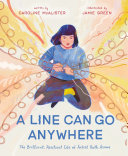
 A Line Can Go Anywhere: The Brilliant, Resilient Life of Artist Ruth Asawa
by Caroline McAlister; illus. by Jamie Green
Primary Roaring Brook 40 pp.
2/25 9781250310378 $19.99
e-book ed. 9781250416063 $11.99
This picture-book biography of Ruth Asawa (1926–2013) uses lines (straight, curved, wavy; physical and imaginary) as metaphors connecting the artist’s life experiences to the sculptures she created. Growing up in rural California, young Ruth attended Japanese school on Saturdays where she “traced arcs in the air with bamboo swords” and practiced calligraphy as “bold black lines stretched across white paper.” She straddles an invisible line that separates the Japanese food, customs, and language at home from those at school. When Japan attacks Pearl Harbor, that invisible line becomes a wall. Incarcerated with her family at the Rohwer Relocation Center in Arkansas, Ruth is eventually allowed to attend college but isn’t allowed to complete her student teaching because of her race; “her path would not be a straight line.” Later, Ruth travels to Mexico and is fascinated by the wire baskets used to carry eggs. Thinking back to the barbed wire at Rohwer, Ruth twists wire into sculpture, showing that “a line could go anywhere, be anything.” After marriage, Ruth refuses to choose between career and family, so she “zigged and zagged” and made art while raising six children. Like her life path, Ruth’s sculptures “curve and curl, with lines that overlap and intersect, connect and divide.” Green’s illustrations nicely complement the thoughtful and well-researched text; brilliant blues against brown backgrounds add visual contrast, highlighting important people and moments. An author’s note, a bibliography, and photos are appended.
From the May/June 2025 issue of The Horn Book Magazine.


Added To Cart
RELATED


RECOMMENDED

Please register with us to continue reading.
ALREADY A SUBSCRIBER? LOG IN
We are currently offering this content for free. Sign up now to activate your personal profile, where you can save articles for future viewing.
ALREADY A SUBSCRIBER? LOG IN
Thank you for visiting.
We’ve noticed you are using a private browser. To continue, please log in or create an account.

Add Comment :-
Be the first reader to comment.
Comment Policy:
Comment should not be empty !!!