



2018 School Spending Survey Report
Review of Afterward, Everything Was Different: A Tale from the Pleistocene
Sometime in the Pleistocene era, “maybe as far back as forty thousand or more years ago,” early humans began to paint on the walls of their caves....
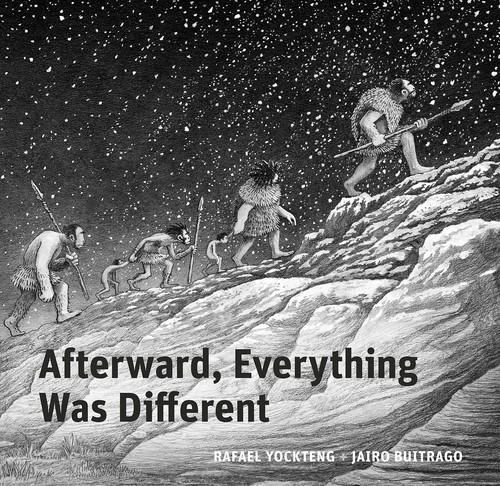 Afterward, Everything Was Different: A Tale from the Pleistocene
by Jairo Buitrago; illus. by Rafael Yockteng; trans. from Spanish by Elisa Amado
Primary, Intermediate Aldana Libros/Greystone Kids 64 pp.
5/23 9781778400605 $19.95
e-book ed. 9781778400612 $19.95
Sometime in the Pleistocene era, “maybe as far back as forty thousand or more years ago,” early humans began to paint on the walls of their caves. Buitrago and Yockteng (Cave Paintings, rev. 1/21) imagine how that first cave painting came about and how, from there, storytelling was born. Wordless double-page spreads show a band of spear-carrying humans in a world with erupting volcanoes, enormous mammoths and bison, and saber-toothed cats. This is not an easy existence. In each spread, a child observes the details of life around her, noticing the stars, measuring an enormous footprint. It is this child who, when left alone in the cave, takes a burnt stick and uses the charcoal to draw a mammoth on the cave wall. When the rest of the group returns, we see her gaining their attention by telling the story she has depicted on the walls. At the end of these wordless pages comes one full page of text. Buitrago writes, “The cave was different afterward” and describes the girl’s feelings about creating her art. He concludes, “The marks she made were never erased. As time went by, she became the leader of the clan.” Yockteng’s graphite and ink illustrations, in shades of black and white, successfully imagine this early time period and, more importantly, tell a story about the emergence and significance of storytelling. An afterword presents the historical and scientific underpinnings of the tale.
Pubissue-From the May/June 2023 issue of The Horn Book Magazine.



RECOMMENDED

Please register with us to continue reading.
ALREADY A SUBSCRIBER? LOG IN
We are currently offering this content for free. Sign up now to activate your personal profile, where you can save articles for future viewing.
ALREADY A SUBSCRIBER? LOG IN
Thank you for visiting.
We’ve noticed you are using a private browser. To continue, please log in or create an account.

Add Comment :-
Be the first reader to comment.
Comment Policy:
Comment should not be empty !!!