


2018 School Spending Survey Report
Review of Change Is in the Air: The Hidden Discoveries of Eunice Newton Foote, the First Climate Scientist
Eunice Newton Foote (1819–1888) is now considered to be “the first climate scientist.” As a student, Eunice attended Troy Female Seminary, a “rare...
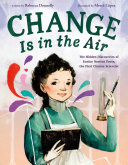 Change Is in the Air: The Hidden Discoveries of Eunice Newton Foote, the First Climate Scientist
by Rebecca Donnelly; illus. by Mercè López
Primary Holt 40 pp.
2/26 9781250828538 $18.99
Eunice Newton Foote (1819–1888) is now considered to be “the first climate scientist.” As a student, Eunice attended Troy Female Seminary, a “rare school” where girls were taught science; she became both a scientist and a pioneering suffragist, defying gender expectations of the time. In 1848, Foote helped to prepare for publication the Declaration of Sentiments at the Seneca Falls Convention for women’s rights, which asserted “all men and women are created equal” (though, as the text points out, the sentiments were limited to white women). In 1856, a Scientific American article inspired her to perform experiments, and she successfully proved that carbon dioxide increased the atmosphere’s temperature. Later that year, her friend Joseph Henry read her paper at an American Association for the Advancement of Science meeting on her behalf (a woman presenter would have been “unusual”). Today, climate scientists agree that “carbon dioxide affects the temperature of the atmosphere,” and, as readers learn, “That earth-shaking discovery began in a small glass tube in Eunice Newton Foote’s home laboratory.” Donnelly clearly presents this great discovery—and Foote’s suffragist activity—along with the obstacles facing women in the nineteenth century. López’s attractive and atmospheric painterly illustrations use geometric lines to form boxes that enclose Foote to emphasize when such obstacles occur, while strokes of reds, pinks, greens, and purples emanate from her in moments of expressing her ideas. A timeline and further information complement the story.
From the January/February 2026 issue of The Horn Book Magazine.

Added To Cart
RELATED


RECOMMENDED

Please register with us to continue reading.
ALREADY A SUBSCRIBER? LOG IN
We are currently offering this content for free. Sign up now to activate your personal profile, where you can save articles for future viewing.
ALREADY A SUBSCRIBER? LOG IN
Thank you for visiting.
We’ve noticed you are using a private browser. To continue, please log in or create an account.

Add Comment :-
Be the first reader to comment.
Comment Policy:
Comment should not be empty !!!