


2018 School Spending Survey Report
Review of Flying Frogs and Walking Fish: Leaping Lemurs, Tumbling Toads, Jet-Propelled Jellyfish, and More Surprising Ways That Animals Move
Flying Frogs and Walking Fish: Leaping Lemurs, Tumbling Toads,
Jet-Propelled Jellyfish, and More
Surprising Ways That Animals Move
by Steve Jenkins and Robin Page; illus.
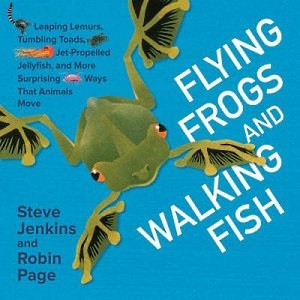 Flying Frogs and Walking Fish: Leaping Lemurs, Tumbling Toads,
Jet-Propelled Jellyfish, and More
Surprising Ways That Animals Move
Flying Frogs and Walking Fish: Leaping Lemurs, Tumbling Toads,
Jet-Propelled Jellyfish, and More
Surprising Ways That Animals Moveby Steve Jenkins and Robin Page; illus. by Steve Jenkins
Primary Houghton 40 pp.
5/16 978-0-544-63090-1 $17.99
The authors’ latest collaboration (How Many Ways Can You Catch a Fly?, rev. 1/09; My First Day, rev. 1/13) features the many intriguing — and sometimes quite surprising — ways that animals move from place to place. Clear and informative statements emphasize three key scientific concepts about locomotion: the act of movement (“Animals walk, leap, climb, and swim. Some roll or turn flips. Others fly”), the body parts employed to move (“They come equipped with legs, fins, wings, or tentacles”), and the purposes for going from place to place (“Sometimes an animal needs to get to a new spot in a hurry”). Grouped loosely into categories, each form of locomotion is introduced with a spread featuring an oddity, such as a walking octopus or a tree-climbing goat, shown in Jenkins’s vivid trademark torn- and cut-paper collage illustrations. A second spread about the same topic includes additional animals (all also pictured, but in smaller illustrations that can make some of the details harder to see) and the variations within that type of movement. The dozens of colorful creatures are described using evocative verbs that invite readers to come up with their own descriptive terms: the Swimming category includes “cruising, paddling, diving,” and Climbing becomes “scrambling, scurrying, slithering.” Readers can find additional facts about each animal in the end pages, neatly organized into categories of locomotion (walking, leaping, swimming, climbing, flying, rolling, jetting).
From the May/June 2016 issue of The Horn Book Magazine.


Added To Cart
RELATED


RECOMMENDED

Please register with us to continue reading.
ALREADY A SUBSCRIBER? LOG IN
We are currently offering this content for free. Sign up now to activate your personal profile, where you can save articles for future viewing.
ALREADY A SUBSCRIBER? LOG IN
Thank you for visiting.
We’ve noticed you are using a private browser. To continue, please log in or create an account.

Add Comment :-
Be the first reader to comment.
Comment Policy:
Comment should not be empty !!!