


2018 School Spending Survey Report
Review of Keith Haring: The Boy Who Just Kept Drawing
Keith Haring: The Boy Who Just Kept Drawing
by Kay A.
 Keith Haring: The Boy Who Just Kept Drawing
by Kay A. Haring; illus. by Robert Neubecker
Primary Dial 40 pp.
2/17 978-0-525-42819-0 $16.99 g
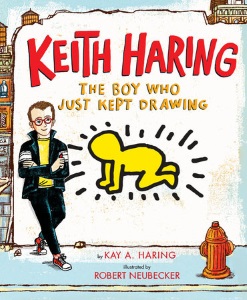
As an upbeat narrative chronicles pop artist Haring’s childhood, early adulthood, and brief but momentous career, our subject faces relentless questions from onlookers confused by his free-spirited artistic habits, ideals, and style. “WHY did you doodle on this important paper?” from a teacher in elementary school. “WHY didn’t you take the money?” after teenage Keith gives a piece away for free. “WHY are you drawing pictures that look like scrambled bodies? This is not what we told you to draw” in art school. After each “WHY?” is shrugged off (“Keith knew how to draw. He just wanted to draw in different ways”), a refrain repeats: Keith “just kept drawing.” This laudatory biography, written by Haring’s sister, is guided by his unapologetic rejection of artistic pretension and illustrated in — what else? — a friendly and accessible cartoony style that fluidly integrates Haring’s own work on subway cars and buildings, as well as in galleries. Neubecker’s illustrations solidly build settings, many of which are quintessential 1980s NYC art scenes populated by eclectic characters in punk garb sporting edgy ’dos. While the book’s messages regarding equal access to art, art’s healing powers, and a general acceptance of otherness are loud and clear, this directness is shared by (to quote the informative endnote) a “universally recognizable visual language” in Haring’s art, the wide appeal of which is grounded in “relevant subject matter and straightforward line.” An intimate-feeling author’s note and an illustrated index to art by Haring and others in the book are appended.
From the March/April 2017 issue of The Horn Book Magazine.


Added To Cart
RELATED


RECOMMENDED

Please register with us to continue reading.
ALREADY A SUBSCRIBER? LOG IN
We are currently offering this content for free. Sign up now to activate your personal profile, where you can save articles for future viewing.
ALREADY A SUBSCRIBER? LOG IN
Thank you for visiting.
We’ve noticed you are using a private browser. To continue, please log in or create an account.

Add Comment :-
Comment Policy:
Comment should not be empty !!!
Molly
I found this picture book wildly disappointing. As a picture book biography of an artist, it is hard for me to not hold it for comparison against this years Caldecott winner "Radiant Child" about Jean-Michel Basquiat and "Cloth Lullaby" about Louise Bourgeois. The art felt bland and uninspired, lacking any real sense of experimentation or impact. The refrain and centering around the fact that he "just kept drawing" didn't make any real statement about Haring as an artist, since the same could be said about most of history's famous artists. The repetition was also a bit droning, failing to ever switch it up or play with the language, leaving it very predictable. But my biggest problem with the work was that the story failed to include that Haring was gay, and made no mention of the topic of AIDS which was so central to his work. Haring's work is so often misunderstood and seen as mearly oddball and cartoony, and it was disappointing that this book didn't do anything to highlight the larger driving forces to his art.Posted : Apr 30, 2017 07:27