


2018 School Spending Survey Report
Review of Marie’s Magic Eggs: How Marie Procai Kept the Ukrainian Art of Pysanky Alive
This picture-book biography, illustrated with the bright yellows, reds, and blues of Ukrainian folk art, tells the life story of Marie Procai...
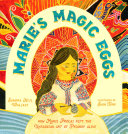 Marie’s Magic Eggs: How Marie Procai Kept the Ukrainian Art of Pysanky Alive
by Sandra Neil Wallace; illus. by Evan Turk
Primary Calkins/Astra 48 pp.
2/26 9781662680694 $19.99
This picture-book biography, illustrated with the bright yellows, reds, and blues of Ukrainian folk art, tells the life story of Marie Procai (1897–1994) and relates her role in preserving the tradition of colored eggs known as pysanky. As a young girl, Marie learns from her baba how to make dye from sunflowers and beets and to use warm beeswax to paint pictures on chicken eggs. These cozy springtime scenes are followed by a grim time of “fighting and famine,” and soon thirteen-year-old Marie flees to the U.S., eventually settling in Minneapolis. Passages with short, rhythmic sentences capture her experiences getting to know her new community (“Mechanics and mill workers. Builders and bakers. All born in Ukraine like Marie”) and explain how she improvised a way to continue making pysanky. Meanwhile, back in Ukraine, pysanky were being destroyed by Russian soldiers, making Procai’s artistry all the more important. Procai uses her art to teach others and to deal with her sorrow, including founding a gift store that continues to this day. Wallace’s tender language (“Every day, like a perfect kind of magic—steeped in the sweet-honey scent of beeswax—Marie created pysanky as beautiful as her baba’s”) and Turk’s gouache, resist, and colored-pencil illustrations combine for an engaging look at a folk artist who accomplished something meaningful for her people. Back matter includes more information about Procai and pysanky as well as a bibliography.
From the January/February 2026 issue of The Horn Book Magazine.


Added To Cart
RELATED


RECOMMENDED

Please register with us to continue reading.
ALREADY A SUBSCRIBER? LOG IN
We are currently offering this content for free. Sign up now to activate your personal profile, where you can save articles for future viewing.
ALREADY A SUBSCRIBER? LOG IN
Thank you for visiting.
We’ve noticed you are using a private browser. To continue, please log in or create an account.

Add Comment :-
Be the first reader to comment.
Comment Policy:
Comment should not be empty !!!